
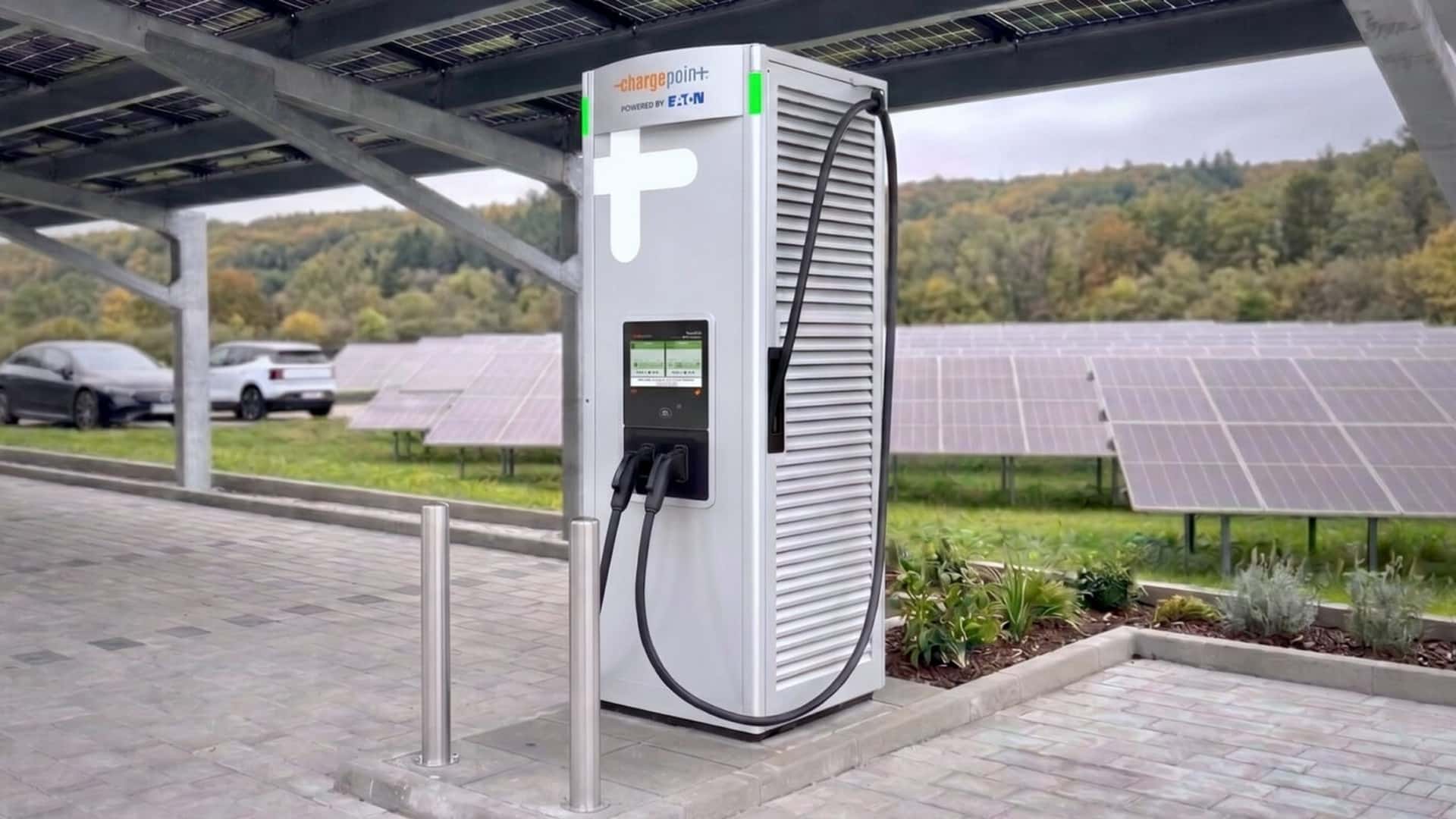
Key Takeaways
- ChargePoint has introduced the Express Solo, a new standalone DC fast charger designed to significantly enhance the electric vehicle (EV) charging experience.
- The Express Solo stands out for its integrated design, eliminating the need for a separate power cabinet, making it ideal for space-constrained locations.
- Capable of delivering up to 600 kilowatts (kW) of power, it is touted as the world’s fastest standalone DC fast charger for passenger EVs, offering dynamic power splitting for two vehicles simultaneously.
- Co-developed with Eaton, the charger features ChargePoint’s Omni Port solution, supporting both CCS and NACS connectors, and integrates seamlessly with renewable energy sources and bidirectional charging capabilities.
- This innovation aims to future-proof charging infrastructure, ensuring high-speed, flexible, and scalable solutions for the evolving EV market in the United States and Europe.
ChargePoint Elevates EV Charging with Express Solo Innovation
In a significant advancement for electric vehicle (EV) infrastructure, ChargePoint, a leading provider of EV charging solutions, has officially unveiled its new Express Solo DC fast charger. This latest offering is poised to redefine high-speed charging, presenting what the company claims to be the world’s fastest standalone DC fast charger specifically designed for passenger electric vehicles.

The introduction of the Express Solo marks a pivotal moment, addressing the critical need for more efficient, compact, and powerful charging solutions. As EV adoption accelerates globally, the demand for robust charging networks that can keep pace with battery technology and user expectations for quick turnarounds becomes increasingly paramount.
Integrated Design for Optimal Efficiency and Space Utilisation
A hallmark feature of the ChargePoint Express Solo is its ingenious integrated design. Unlike many high-power DC fast chargers that rely on separate, bulky power cabinets, the Express Solo consolidates all essential components into a single, sleek enclosure. This architectural choice delivers substantial benefits, particularly for charging operators navigating the complexities of urban environments and other space-constrained sites.
The unified structure not only simplifies the installation process but also dramatically reduces the physical footprint required for a charging station. This makes it an attractive option for locations such as busy retail parking lots, urban charging hubs, and commercial fleet depots where real estate is at a premium and every square foot counts towards operational efficiency.

Unmatched Power Delivery and Flexible Configurations
At the core of the Express Solo’s capabilities is its impressive power output. The unit is engineered to deliver an astounding 600 kilowatts of power. This substantial capacity can be directed entirely to a single electric vehicle, facilitating exceptionally rapid charging times that cater to the latest generation of EVs with larger battery capacities and faster charging rates.
Furthermore, the system boasts dynamic power splitting, allowing the 600 kW output to be intelligently distributed between two connected EVs. This intelligent allocation ensures that both vehicles receive optimal charging power concurrently, maximising throughput and efficiency at the charging station. Such flexibility is crucial for high-traffic locations where multiple vehicles may require simultaneous fast charging.
Scalable Infrastructure for Future Demands
Beyond its dual-port functionality, the ChargePoint Express Solo also introduces a novel concept for expanding charging infrastructure. A single Express Solo unit can function as a central power cabinet for an additional, independent charging stall. This expanded configuration effectively adds another two charging ports, bringing the total to four, while maintaining the system’s overall power output at 600 kW.
This innovative scalability ensures that charging station owners can initially deploy a compact solution and then easily expand their capacity as demand grows, without undertaking a complete overhaul of their infrastructure. This strategic design helps to future-proof investments in EV charging technology, adapting to the evolving landscape of electric mobility.
Setting New Industry Benchmarks for Power Density
ChargePoint asserts that the Express Solo sets a new industry standard for power density within the smallest possible footprint. The company claims that its standalone DC fast charger delivers approximately 40% higher power density compared to other DC charging solutions currently available in the market. This efficiency in space and power packaging is a significant differentiator.
To put this into perspective, the article highlights comparisons with existing market leaders. For instance, Alpitronic’s HYC400, a widely recognised standalone dual-port DC fast charger, offers up to 400 kW. Meanwhile, prominent charging networks like Tesla’s Superchargers and BYD’s Flash chargers typically rely on separate, external power cabinets to deliver their high-power outputs, underscoring the Express Solo’s unique integrated approach.
A Collaborative Effort with Eaton
The development of the ChargePoint Express Solo is the result of a strategic collaboration with Eaton, a global leader in power management. This partnership leverages Eaton’s expertise in power distribution and electrical infrastructure with ChargePoint’s innovative charging technology, culminating in a robust and highly efficient solution.
Rick Wilmer, ChargePoint’s CEO, articulated the long-term vision behind this innovation: “For those with plans for expansion, Express Solo enables scalable configurations for any charging scenario, futureproofing a station owner’s investment by giving drivers an ideal fast charging experience today while offering flexibility for the EVs of tomorrow.” This statement underscores the commitment to developing adaptable and sustainable charging solutions that can meet both current and future demands of the electric vehicle market.
Universal Connectivity and Advanced Energy Management
Addressing the critical need for interoperability, the Express Solo comes equipped with ChargePoint’s innovative Omni Port solution. This advanced feature ensures compatibility with both the Combined Charging System (CCS) and the North American Charging Standard (NACS) connectors. The integration of both connector types directly into the stalls simplifies the user experience and broadens the charger’s appeal to a wider range of EV models and drivers.
Furthermore, the new 600 kW dispenser is an integral part of ChargePoint and Eaton’s Express architecture. This robust architecture facilitates seamless integration with renewable energy sources, such as solar arrays, and energy storage systems. Such integration allows for more sustainable and resilient charging operations, potentially reducing strain on local grids and lowering operating costs through optimised energy use.
Empowering the Grid with Bidirectional Charging
A key capability embedded within the Express Solo, as part of the Express architecture, is bidirectional charging functionality. This advanced feature allows not only power to flow from the grid to the EV but also from the EV’s battery back to the grid or a building. Bidirectional charging, often referred to as Vehicle-to-Grid (V2G) or Vehicle-to-Home (V2H), holds immense potential for grid stability, peak shaving, and providing backup power during outages.
The inclusion of this technology positions the Express Solo as more than just a charger; it makes it a vital component of future smart grids and decentralised energy systems, adding significant value for both individual users and utility providers.
Strategic Market Rollout in the United States and Europe
In a strategic move, ChargePoint has announced that the Express Solo will be available in key global markets, specifically the United States and Europe. Unlike some of ChargePoint’s other products which might be geographically constrained, this widespread availability reflects the company’s confidence in the universal appeal and necessity of such advanced charging solutions.
Both the United States and Europe are experiencing rapid growth in EV adoption and are actively investing in expanding their charging infrastructures. The deployment of the Express Solo in these regions is expected to significantly contribute to the build-out of high-power charging networks, alleviate range anxiety, and accelerate the transition towards sustainable transportation.
Conclusion
The ChargePoint Express Solo standalone DC fast charger represents a significant leap forward in the evolution of electric vehicle charging technology. By combining a compact, integrated design with industry-leading power output, universal connector compatibility, and smart grid functionalities, ChargePoint, in collaboration with Eaton, is setting new standards for efficiency, scalability, and user experience. As the world continues its shift towards electric mobility, innovations like the Express Solo will be instrumental in building a robust, reliable, and future-ready charging ecosystem that supports the widespread adoption of EVs.
Frequently Asked Questions (FAQ)
What is the ChargePoint Express Solo?
The ChargePoint Express Solo is a new standalone DC fast charger for electric vehicles. It integrates all necessary components into a single unit, eliminating the need for a separate power cabinet, and is designed to offer the fastest standalone charging experience for passenger EVs.
How much power can the Express Solo deliver?
The Express Solo is capable of delivering up to 600 kilowatts (kW) of power. This high output can be used to charge a single EV at blistering speeds or dynamically split between two connected electric vehicles, ensuring efficient use.
What makes the Express Solo a “standalone” charger?
A “standalone” charger means that all its power electronics and components are housed within the dispenser itself, without requiring a separate, external power cabinet. This design makes it more compact and easier to install, especially in space-limited environments.
Which EV connectors does the Express Solo support?
Thanks to ChargePoint’s Omni Port solution, the Express Solo supports both the Combined Charging System (CCS) and the North American Charging Standard (NACS) connectors. This ensures broad compatibility with a wide range of electric vehicles on the market.
Can the Express Solo integrate with renewable energy sources?
Yes, the Express Solo is part of ChargePoint and Eaton’s Express architecture, which allows for seamless integration with renewable energy sources like solar arrays and energy storage systems. This promotes sustainable charging operations.
Does the Express Solo offer bidirectional charging?
Yes, the Express Solo features bidirectional charging functionality. This means it can not only charge an EV but also allow power to flow from the EV’s battery back to the grid or a building, offering potential benefits for grid stability and energy management.
In which markets will the ChargePoint Express Solo be available?
The ChargePoint Express Solo standalone DC fast charger will be available for deployment in both the United States and Europe. These key markets are at the forefront of electric vehicle adoption and infrastructure development.
How does the Express Solo compare to other fast chargers?
ChargePoint claims the Express Solo offers approximately 40% higher power density than other DC charging solutions in a smaller footprint. For example, it provides 600 kW compared to Alpitronic’s 400 kW HYC400, while many competitors use separate power cabinets.