
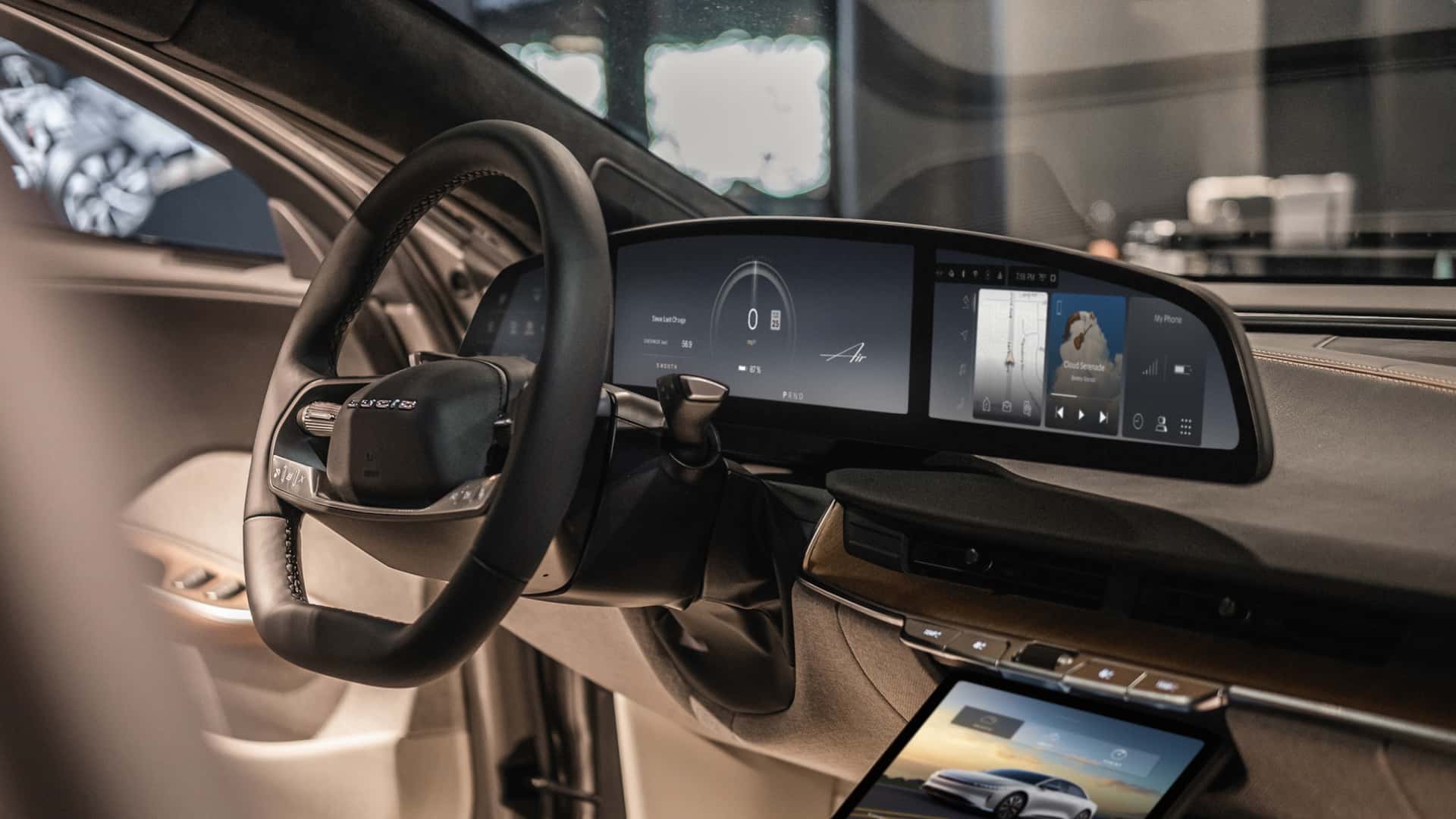
Lucid Motors has recently unveiled a comprehensive redesign of the Lucid Air infotainment system, branded as UX 3.0. This significant update promises to deliver a faster, more intuitive, and highly integrated digital experience for drivers and passengers. While the update will roll out via an over-the-air (OTA) download for newer models, owners of specific older Air variants will need a hardware upgrade costing $950 to access the enhanced features.
Key Takeaways: UX 3.0 Update for Lucid Air
- Lucid’s new UX 3.0 interface for the Air sedan aims for a faster, more intuitive infotainment experience.
- The update introduces advanced route planning, improved Apple CarPlay and Android Auto integration, and enhanced multitasking capabilities.
- For 2025 and newer Lucid Air models, UX 3.0 will be delivered as a standard over-the-air software update (version 2.11.0).
- Owners of 2022, 2023, and certain 2024 Lucid Air vehicles will require a $950 processor upgrade to implement UX 3.0.
- This hardware retrofit is necessary due to a mid-2024 model year transition to a second-generation infotainment processor.
Revolutionising the Lucid Air Infotainment System with UX 3.0
The core objective behind the UX 3.0 update is to elevate the in-car digital experience, making it both more efficient and user-friendly. Lucid Motors has integrated elements reminiscent of the system that first debuted in their Gravity SUV, ensuring a consistent and cutting-edge interface across its premium electric vehicle lineup. This brings the current Air sedan up to par with the company’s latest technological advancements.
A central feature of the redesigned Lucid Air infotainment system is its revamped home screen. It now incorporates swipeable cards, allowing drivers to quickly access frequently used features. These tiles can be swiped to expand and open the full application on the lower, vertically-oriented “Pilot Panel” display. This intuitive design aims to minimise distractions and streamline interaction with critical vehicle functions.
Advanced Features for Enhanced Driving
Beyond the aesthetic changes, UX 3.0 introduces a suite of functional improvements designed to enhance daily usability. New quick controls are now accessible by swiping down from the top of the Pilot Panel, providing immediate access to popular settings. This allows for rapid adjustments without navigating through multiple menus, contributing to a safer and more focused driving experience.
The route planning feature has also seen a significant overhaul. Drivers can now customise their navigation preferences, including choices for charging networks, desired arrival range, and specific charging adapter compatibility. This level of customisation is particularly valuable for long-distance electric vehicle travel, enabling more confident and stress-free journey planning within the Lucid Air infotainment system.
The Hardware Mandate: Why Some Owners Need an Upgrade
While the UX 3.0 update is primarily a software enhancement, its advanced computational demands necessitate a hardware upgrade for a subset of existing Lucid Air owners. Specifically, owners of 2022, 2023, and some 2024 model year vehicles will need to invest in a $950 processor upgrade. This cost, quoted for the U.S. market, includes both the new hardware and its installation.
Lucid spokespersons have clarified that the requirement for a hardware retrofit stems from a mid-model year change in 2024. During this period, the company transitioned to a second-generation infotainment processor in its production vehicles. Therefore, Air models manufactured with the earlier processor simply lack the necessary computational power to smoothly run the sophisticated UX 3.0 software.
This situation highlights the rapid evolution of in-car technology, where software advancements can quickly outpace the capabilities of older hardware. Lucid Motors is expected to provide details regarding upgrade availability and pricing for other international markets in due course, ensuring all eligible owners can eventually access the latest Lucid Air infotainment system experience.
Seamless Multitasking and Superior Connectivity
A notable improvement in the UX 3.0 software lies in its enhanced multitasking capabilities across the Air’s dual-screen setup. Previously, the upper and lower screens were often linked, limiting the flexibility of displaying different applications simultaneously. The new software addresses this by allowing drivers to operate apps more freely across the main Cockpit display and the Pilot Panel.
For instance, a driver can now have their navigation system prominently displayed on the upper screen while simultaneously managing media playback or vehicle settings on the lower Pilot Panel. Lucid states that this functionality allows drivers to “move more smoothly among navigation, media, vehicle controls, and apps across the Cockpit and Pilot Panel displays.” This decoupling of screens was a frequently requested feature among early Air owners, significantly improving the practicality of the Lucid Air infotainment system.
Connectivity features have also received a crucial boost. Apple CarPlay and Android Auto integrations are reported to be more reliable with the UX 3.0 update. Crucially, these smartphone mirroring systems will now appear larger on the Air’s distinctive crescent-shaped screen, enhancing visibility and ease of use for navigation, communication, and entertainment features.
The Broader Impact on the EV Landscape
In the competitive luxury electric vehicle market, a sophisticated and responsive infotainment system is no longer a mere convenience but a critical differentiator. As EVs become increasingly software-defined, the quality of the digital experience directly contributes to the perceived premium nature and overall satisfaction of a vehicle. Lucid’s commitment to regularly updating its Lucid Air infotainment system underscores this industry trend.
This update positions the Lucid Air to maintain its edge against rivals by offering a user interface that aligns with modern expectations for digital interaction. The focus on speed, intuitiveness, and seamless multitasking demonstrates an understanding of how drivers interact with their vehicles in the 21st century. As automotive technology continues to advance, such comprehensive software and, where necessary, hardware upgrades will become commonplace, shaping the future of in-car digital ecosystems.
Frequently Asked Questions (FAQs) about Lucid Air Infotainment System Update
What is the UX 3.0 update for the Lucid Air?
UX 3.0 is a significant software overhaul for the Lucid Air infotainment system, designed to make it faster, more intuitive, and feature-rich. It introduces new interface elements, improved navigation, and enhanced smartphone integration.
Which Lucid Air models will receive UX 3.0 as an over-the-air update?
The UX 3.0 software update (version 2.11.0) will be automatically delivered over-the-air to all 2025 and newer Lucid Air models, requiring no additional hardware or cost for these vehicles.
Why do some older Lucid Air models require a hardware upgrade for UX 3.0?
Certain 2022, 2023, and some 2024 Lucid Air models are equipped with an earlier generation infotainment processor. This older hardware lacks the necessary computational power to run the advanced UX 3.0 software efficiently, hence requiring an upgrade.
How much does the processor upgrade for older Lucid Air models cost?
In the U.S., the processor upgrade required for older Lucid Air models to receive UX 3.0 costs $950. This price includes both the new hardware component and its professional installation by Lucid service centres.
What are the key improvements in Apple CarPlay and Android Auto with UX 3.0?
With the UX 3.0 update, Apple CarPlay and Android Auto integrations are expected to be more reliable. Crucially, they will also appear larger on the Lucid Air’s unique crescent-shaped display, improving visibility and user interaction.
Can I multitask more effectively with the new Lucid Air infotainment system?
Yes, UX 3.0 significantly enhances multitasking. Drivers can now run different applications simultaneously on the upper Cockpit display and the lower Pilot Panel, allowing for greater flexibility, such as having navigation on one screen and media controls on the other.