
Key Takeaways
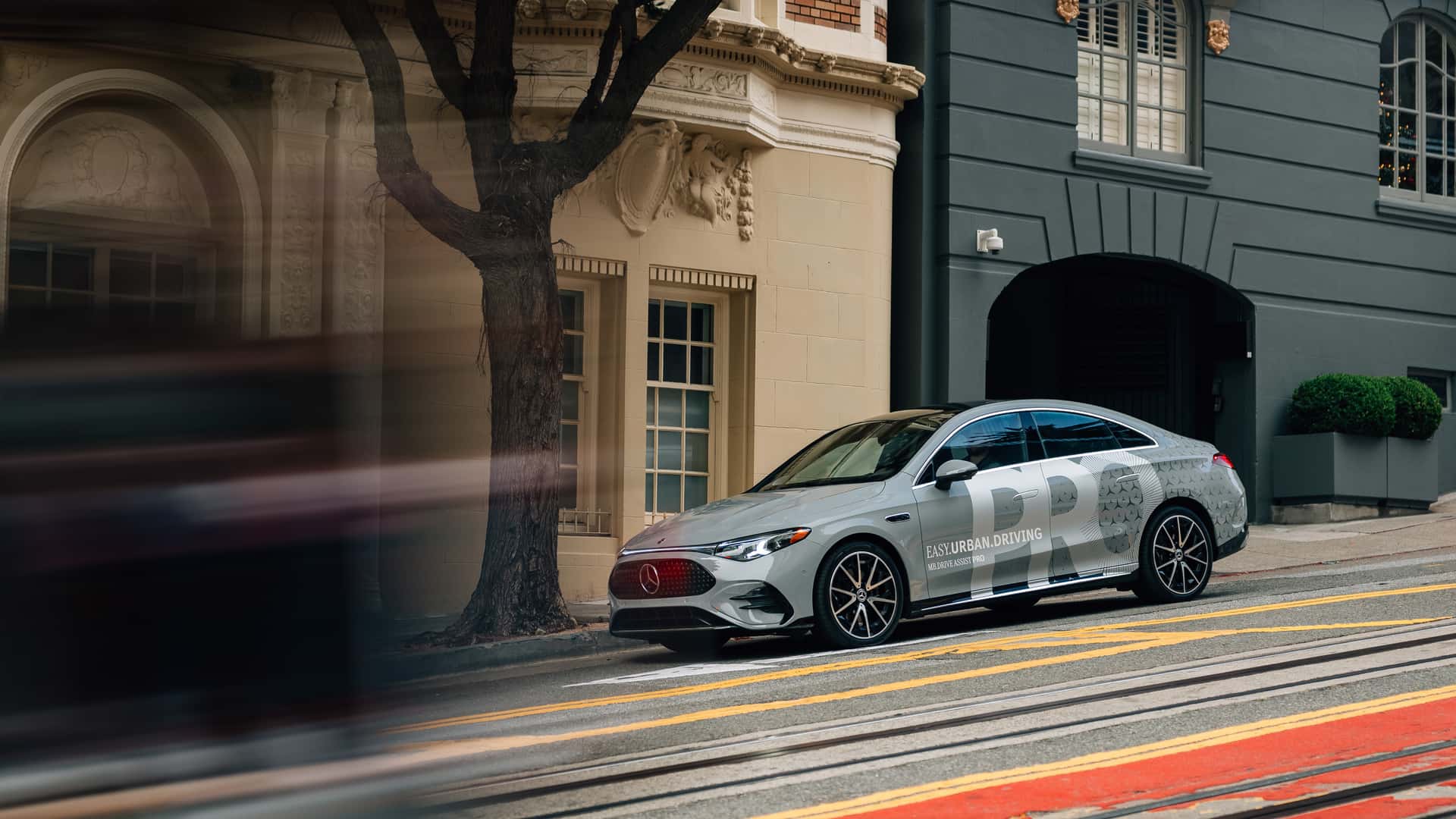
- Mercedes-Benz MB.Drive Assist Pro is an upcoming point-to-point automated driving system for a broad range of Mercedes-Benz vehicles, launching early next year.
- Unlike Tesla’s Full Self-Driving (Supervised), MB.Drive Assist Pro requires drivers to keep a hand on the wheel when operating on surface streets, adhering strictly to SAE Level 2 definitions.
- Mercedes-Benz executives cite a “philosophical” decision, emphasizing driver responsibility at Level 2 and the increased complexity of urban environments.
- The system utilizes a comprehensive sensor suite, including five radar sensors and 12 ultrasonic sensors alongside cameras, which Mercedes-Benz argues enhances safety and performance over camera-only systems.
- Tesla FSD users, accustomed to hands-off driving on surface streets, express skepticism about adopting a system with stricter driver engagement requirements.
- The market will soon evaluate whether Mercedes-Benz’s safety-first, hands-on approach resonates with consumers seeking advanced driver assistance.
For many commuters, navigating daily traffic can be a monotonous ordeal. Lucian Capellaro, for instance, faces a tedious daily drive through Laurel Canyon from the San Fernando Valley to Los Angeles’ west end. This personal experience highlights a growing desire among drivers for advanced solutions to ease the burden of their commutes.
Capellaro’s interest was piqued when colleagues spoke highly of Tesla’s Full Self-Driving (FSD) feature, which promised to autonomously navigate to a destination and park. However, his preference for a vehicle beyond Tesla, influenced by design, interior quality, and body style, led him to seek alternatives.
An alternative is now on the horizon from Mercedes-Benz. The marque is preparing to roll out its proprietary point-to-point automated driving system, known as MB.Drive Assist Pro. This system is slated for introduction across a significant portion of the brand’s electric and internal combustion vehicle lineup early next year. Existing eligible vehicles will also gain access to this advanced functionality through over-the-air updates.
The Philosophical Divide: Hands-On vs. Hands-Off Autonomy
While Mercedes-Benz MB.Drive Assist Pro shares the core functionality of guiding a vehicle to a pre-set destination and parking it, a crucial distinction emerges when comparing it to Tesla’s FSD (Supervised) feature. Both systems offer hands-free operation on controlled-access highways, but Mercedes-Benz mandates that drivers maintain a hand on the steering wheel when navigating surface streets.
This difference is not indicative of technological inferiority but rather stems from a fundamental philosophical stance. Mercedes-Benz strictly adheres to the Society of Automotive Engineers (SAE) definitions for autonomous driving levels. MB.Drive Assist Pro, like FSD (Supervised), is classified as a Level 2 system, or what Mercedes-Benz refers to as “Level 2 Plus Plus.” This classification inherently requires continuous driver supervision.
Adhering to SAE Autonomy Levels
The distinction between autonomy levels is paramount for Mercedes-Benz. “There is a very important borderline between the levels,” explained Jörg Burzer, Mercedes’ Chief Technology Officer, in an interview with InsideEVs. “That borderline is that with Level 2 Plus Plus, you are responsible. At Level 3, the machine, the car, the software stack, is responsible.”
Burzer further elaborated that controlled-access highways present a more predictable environment with fewer variables for a Level 2 system to manage. Conversely, surface streets are characterized by significantly greater chaos and complexity, necessitating heightened driver engagement. Consequently, Mercedes-Benz imposes the hands-on requirement for urban driving scenarios.
User Perspectives on Hands-On Driving
This design choice appears logical to some drivers, including Lucian Capellaro, despite his experience as a motorcycle rider, which suggests a degree of risk tolerance. “Think about the reaction time it must be for someone to take their hands from off the wheel to on the wheel,” Capellaro stated. “I’d view my hand on the wheel as lessening the seconds of reaction time to something crazy happening.”
Mercedes’ internal customer research, particularly among European drivers, seems to validate this approach. “In the city, they like to have something, some regulation or some requirement that you have to have a hand on the wheel,” Burzer noted, although he acknowledged uncertainty regarding U.S. customer preferences.
When directly confronted with why a consumer would opt for the Mercedes-Benz MB.Drive Assist Pro system over Tesla’s FSD, which permits hands-off driving on surface streets, Burzer consistently redirected the discussion to regulatory compliance and the strict definitions of SAE autonomy levels. “The big question is when is level 3 coming?” he insisted. “Because then you can have the hands off (anywhere).”
However, many current Tesla FSD users hold a different view. They often perceive their vehicles as already delivering Level 3-like functionality, despite the official Level 2 (Supervised) classification. These users, and arguably Tesla itself, appear less bound by the Society of Automotive Engineers’ definitions, prioritising real-world performance over strict adherence to classifications.
Antonio Hidalgo, another Los Angeles resident, is a frequent FSD user. He recounts instances where he has even been able to nap while his car drives, only noticing minor system flaws related to parking. For Hidalgo, the prospect of a hands-on requirement for the Mercedes-Benz MB.Drive Assist Pro system is a significant deterrent. “If the (Mercedes system) worked the same but I had to keep my hand on the wheel … You know, I probably wouldn’t (make the switch). I mean, I think I would be interested in having a nicer car with a better interior. But no.”
Mharlon Barrientos, who uses FSD during his commute in Indianapolis, echoed this sentiment. After an initial period of cautious supervision, system updates and prolonged experience have enabled him to drive fully hands-off. “Having a hand on the wheel as a requirement would be a bit of a step back to the feel of full autonomous driving that I’ve gotten used,” Barrientos explained, recalling that his Model Y originally mandated hands-on driving.
Technology Under the Hood: Sensors and Safety
Mercedes-Benz is quick to highlight what it views as a significant technological advantage of MB.Drive Assist Pro over Tesla’s FSD (Supervised) system. While Tesla’s approach heavily relies on cameras for obstacle detection and environmental perception, Mercedes-Benz integrates a more diverse sensor suite.
Mercedes’ Multi-Sensor Suite
The Mercedes-Benz MB.Drive Assist Pro system is equipped with five radar sensors and 12 ultrasonic sensors, which feed raw data to the vehicle’s Nvidia-powered computer, in addition to cameras. This multi-faceted sensing approach, according to Mercedes-Benz, enhances both performance and safety.
Christoph von Hugo, Mercedes’ Head of Active Safety, underscored this point. “Different sensor inputs increases performance and safety,” he stated. In subtle references to what he implied was Tesla’s less comprehensive strategy, he added that “Relying on one just is not enough.” Von Hugo further asserted that Mercedes-Benz would not even consider ascending to Level 3 autonomous capability without incorporating LiDAR technology on top of its existing camera, radar, and ultrasonic sensor array. It is notable that Mercedes-Benz had briefly offered a Level 3 system in the U.S., but it has since been phased out.
Trust and Performance: A Driver’s View
Despite Mercedes-Benz’s emphasis on its robust sensor package, drivers like Mharlon Barrientos are not immediately swayed by technical specifications alone. “I honestly haven’t even thought about the tech behind it, so I’m not so sure knowing that there’s radar and ultra-sonic sensors (on the window sticker) would be a huge selling point,” Barrientos commented.
He suggested that tangible performance advantages, demonstrated through videos or detailed reviews, would be more compelling. “Just like the Tesla system, I think it would take me some mileage on both highway and streets to gain a trust for the system to know it’ll handle either situation well,” Barrientos added, emphasizing that real-world experience is crucial for building driver confidence.
Market Reception and Future Outlook
Barrientos also conveyed that his loyalty is not exclusively tied to Tesla or its FSD feature, representing a broader segment of Tesla owners who are not necessarily staunch brand loyalists. “The hands-on requirement in the city would not be enough to sway me off of the car provided I like the rest of the car,” he affirmed. “While I like the functionality of FSD, it’s still a bit further down the list of what I look for in a car. Functionality, comfort, value … I still like to feel the mechanics and have the feel of actually driving a car.”
Lucian Capellaro shares a similar perspective. He often questions how much of an advancement the Mercedes-Benz MB.Drive Assist Pro system would truly be compared to the adaptive cruise control and low-speed hands-free highway driving assist found in his wife’s BMW i4.
“I guess I’d just have to experience (MB.Drive Assist Pro) for myself, but if it can navigate all the craziness that is Laurel Canyon through Hollywood, and it is literally just my hand resting on the wheel, and that’s it, then sure,” Capellaro mused. “The fact that it’s truly point-to-point, then yes, that sounds super appealing.”
The Road Ahead: User Experience and Trust Building
The fundamental question that remains is whether the Mercedes-Benz MB.Drive Assist Pro system can indeed match the real-world performance of Tesla FSD, even with its mandated hands-on requirement for urban environments. Early impressions from InsideEVs, based on a passenger-seat ride in San Francisco in January, indicated promising capabilities.
A comprehensive review of the system’s full capabilities is eagerly anticipated. This will provide crucial insights into whether the hands-on approach is, ultimately, a prudent safety measure or a perceived limitation by consumers accustomed to more permissive systems. The adoption and success of Mercedes-Benz MB.Drive Assist Pro will heavily depend on its performance and how effectively it builds trust with drivers.
FAQ Section
What is Mercedes-Benz MB.Drive Assist Pro?
Mercedes-Benz MB.Drive Assist Pro is an advanced point-to-point automated driving system designed to navigate vehicles to a destination and park. It is slated for release early next year and will be available across many Mercedes-Benz models, with over-the-air updates for eligible vehicles.
How does MB.Drive Assist Pro differ from Tesla FSD (Supervised)?
Both systems offer hands-free driving on highways. However, MB.Drive Assist Pro requires the driver to keep a hand on the steering wheel when operating on surface streets, a key distinction from Tesla FSD (Supervised) which allows hands-off driving in such conditions.
Why does Mercedes-Benz require hands on the wheel for surface streets?
Mercedes-Benz adheres strictly to SAE Level 2 autonomous driving definitions, which mandate driver supervision. Executives describe this as a philosophical decision, citing the increased complexity and chaotic nature of surface streets compared to controlled-access highways, where the driver remains responsible.
What sensors does Mercedes-Benz MB.Drive Assist Pro use?
MB.Drive Assist Pro employs a comprehensive sensor suite that includes cameras, five radar sensors, and 12 ultrasonic sensors. Mercedes-Benz argues this multi-sensor approach provides superior performance and safety compared to systems that primarily rely on cameras alone.
Do current Tesla FSD users find the hands-on requirement appealing?
Generally, no. Tesla FSD users, accustomed to hands-off driving on surface streets, express skepticism. They often prioritise the convenience of less driver engagement and indicate that a hands-on requirement would be a significant step backward in their autonomous driving experience.
When will MB.Drive Assist Pro be available?
The Mercedes-Benz MB.Drive Assist Pro system is scheduled to be added to a large number of the brand’s electric and internal combustion vehicles early next year. Already-purchased eligible vehicles will receive the update via an over-the-air installation.
Is MB.Drive Assist Pro considered a Level 3 autonomous system?
No, Mercedes-Benz classifies MB.Drive Assist Pro as a Level 2 system (or “Level 2 Plus Plus”), which requires the driver to remain responsible and supervised. True Level 3 systems allow the driver to disengage from driving tasks under specific conditions, with the car taking responsibility.
Will Mercedes-Benz add LiDAR to its systems in the future?
Mercedes-Benz has stated that it will not ascend to Level 3 autonomous capability without adding LiDAR technology on top of its current array of cameras, radar, and ultrasonic sensors, highlighting its commitment to a robust multi-sensor approach for higher autonomy levels.