
Key Takeaways
- BYD has introduced an innovative EV charging station featuring integrated solar panels and battery storage, designed to provide high-speed charging independent of the main electricity grid.
- The system incorporates a robotic arm for automated vehicle connection, streamlining the charging process, especially when combined with automated parking systems.
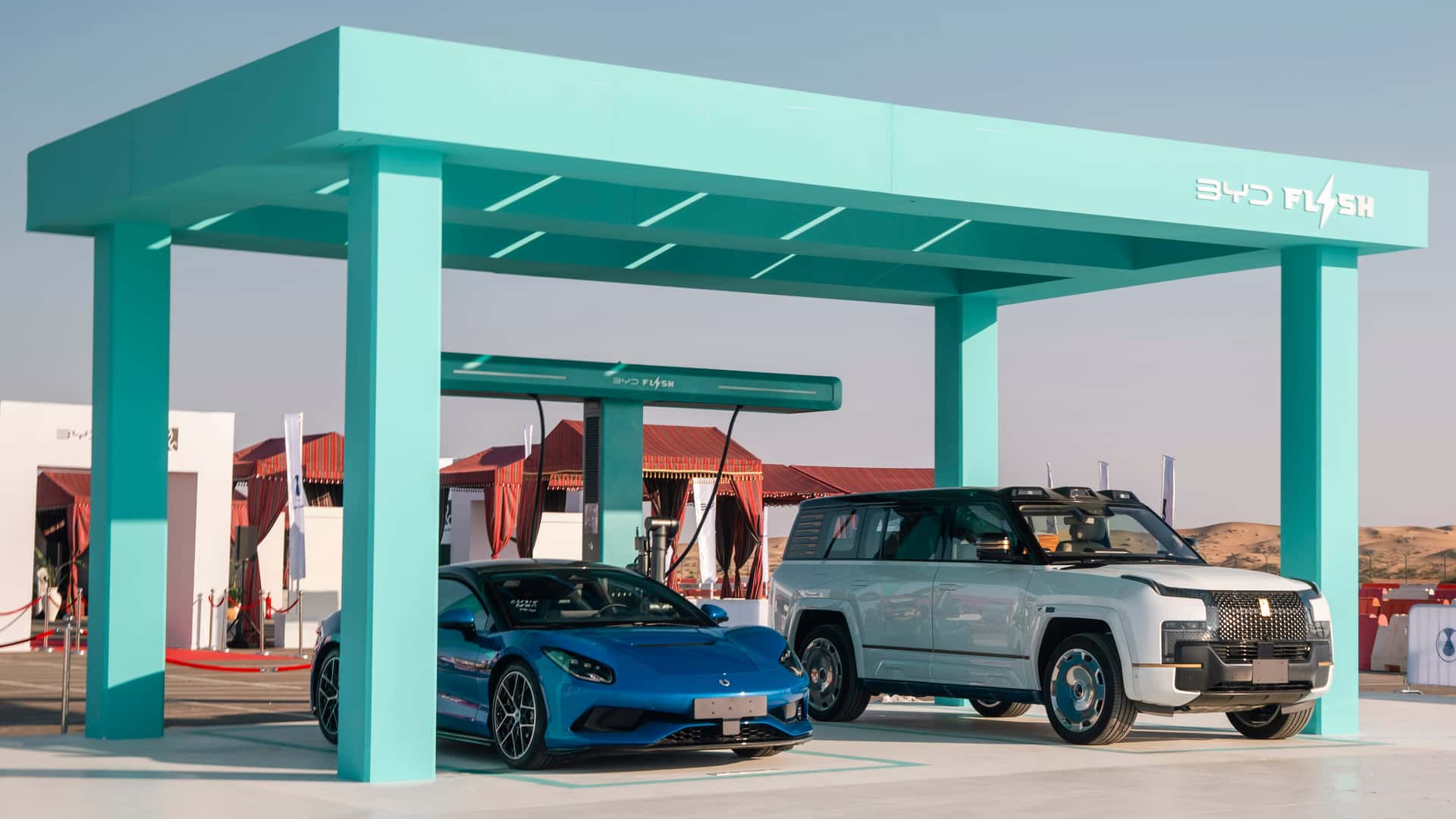
- Demonstrated in the challenging environment of the Abu Dhabi desert, this **futuristic EV charger** aims to extend rapid **electric vehicle charging** infrastructure to remote or underserved locations.
- While showcasing impressive charging speeds of up to 1,500 kW, BYD has yet to fully disclose the specific solar output and battery capacity of this particular off-grid installation.
- BYD plans a significant global expansion, aiming for 6,000 Flash Charging stations worldwide by the end of 2027, with deployments already underway in Europe.
BYD Revolutionises EV Charging with Grid-Independent, Robotic Solution
In a significant stride towards sustainable mobility, Chinese automotive giant BYD has unveiled a groundbreaking **BYD EV charger** that promises to redefine **electric vehicle charging** infrastructure. This advanced charging station integrates solar power generation, substantial battery energy storage, and a sophisticated robotic arm, enabling ultra-fast charging capabilities even in locations far removed from conventional power grids.
The innovative system tackles a critical challenge in the widespread adoption of electric vehicles: ensuring reliable and rapid access to power, particularly in remote areas or during peak demand on existing grids. By combining renewable energy sources with intelligent automation, BYD is positioning itself at the forefront of the global energy transition.

Pioneering Off-Grid EV Charging with Solar and Battery Power
The core concept behind BYD’s new charging site, first demonstrated in the demanding environment of the Abu Dhabi desert, is elegant in its simplicity. Solar panels harness the abundant energy of the sun, while large-capacity batteries store this electricity. The integrated Flash Charging technology then delivers this stored renewable energy to electric vehicles at exceptional speeds.
This self-sufficient model means that the station can operate independently, offering a viable solution for deploying fast chargers where a robust grid connection might be impractical or economically unfeasible. Such innovations are crucial for expanding electric mobility beyond urban centers.
The Role of Advanced Battery Storage in Enhancing Grid Stability
Battery-backed charging stations are becoming increasingly prevalent, serving a dual purpose in modern **EV infrastructure**. They allow charging sites to provide power surges beyond what their direct grid connection can sustain, ensuring consistent high-speed charging.
Furthermore, these **energy storage systems** play a vital role in reducing strain on the electricity grid during periods of high demand. This approach helps to balance the load, making the overall energy network more efficient and resilient.
Even BYD’s standard Flash Chargers, not necessarily located off-grid or paired with solar, utilise on-site energy storage to augment power delivery. This commitment to **sustainable energy solutions** underlines a broader industry trend towards more intelligent and adaptable charging ecosystems.
Technical Capabilities of the Flash Chargers
Each of BYD’s distinctive T-shaped Flash Chargers is equipped with two 185-kilowatt-hour (kWh) storage batteries, culminating in a substantial 370 kWh total capacity. These batteries draw power from the grid at rates ranging from 100 to 560 kilowatts.
Once stored, the energy is discharged to compatible electric vehicles at significantly higher rates, delivering up to 1,500 kW through a single cable. When both cables are in simultaneous use, the system can still supply an impressive 1,000 kW, ensuring rapid turnaround times for multiple vehicles.
However, BYD has yet to disclose the precise battery capacity and overall **solar output** specifically for the pioneering desert installation. This lack of detailed information makes it challenging to ascertain the exact number of vehicles the station can charge, or the specific charging speeds it can maintain, solely through **solar power** generation.
Robotic Precision: Enhancing User Experience and Automation
Adding another layer of innovation, the BYD EV charger incorporates a sophisticated robotic arm designed to plug into the electric vehicle automatically. This **robotic charging technology** enhances convenience, removing the need for manual intervention from the driver.
The system is envisioned to work in tandem with automated parking technologies, creating a seamless, hands-free charging experience. As autonomous vehicles become more prevalent, such integrated robotic solutions will be indispensable for completely automated electric mobility ecosystems.
Unprecedented Charging Speeds: The Flash Charging Advantage
The raw charging hardware itself represents a significant leap forward in **high-power DC charging**. With BYD’s latest 1,500-kW Flash Chargers, electric vehicles equipped with the company’s second-generation Blade battery can achieve remarkable charging times.
Compatible cars can charge from 10% to 70% in a mere five minutes, and reach a 97% state of charge in just nine minutes. These figures rival traditional refuelling times, effectively addressing one of the primary concerns of potential EV buyers: range anxiety and charging duration.
A demonstration involving the Denza Z9 GT, an electric wagon, showcased its ability to charge from 10% to 80% in six minutes and 32 seconds, and then to 97% in nine minutes and 22 seconds. Such rapid charging capabilities are pivotal for the widespread adoption of **electric vehicles**, particularly for long-distance travel and commercial fleet operations.
Global Ambitions: Expanding the Flash Charging Network
BYD’s vision extends far beyond a single desert installation. The company has articulated ambitious plans to establish a vast network of 6,000 Flash Charging stations across the globe by the close of 2027. This aggressive rollout underscores BYD’s commitment to building a robust global **EV charging infrastructure**.
Europe is already witnessing the deployment of BYD’s Flash Charging technology, with operational sites now established in Italy, Germany, France, and the United Kingdom. Furthermore, plans are in motion to introduce these advanced charging solutions to Canada in the near future, signifying a truly global expansion strategy.
However, the company has not yet provided specific details regarding how many of these planned stations will incorporate the full suite of innovations, such as **off-grid operation** capabilities, integrated solar power, or the advanced robotic arm. Further clarity on these aspects will shed more light on the future accessibility of these cutting-edge features.
The Future Landscape of Electric Vehicle Charging
BYD’s latest innovation represents more than just a new charging station; it signifies a strategic shift in how **electric mobility** can be supported. By addressing the critical needs for **grid independence** and rapid charging, particularly in diverse geographical contexts, BYD is paving the way for broader EV adoption.
The ability to deploy **solar EV charging** solutions in remote or rural areas, previously constrained by inadequate grid access, opens up new markets and expands the reach of electric transport. This also contributes significantly to reducing the carbon footprint associated with transportation by relying on **renewable power** sources.
As the automotive industry continues its rapid transition towards electrification, such **technological innovations** from industry leaders like BYD will be crucial in building a resilient, accessible, and environmentally sustainable charging ecosystem for the future.
FAQ Section
Q1: What makes BYD’s new EV charger unique?
A1: BYD’s new **BYD EV charger** stands out due to its integration of solar panels and battery storage for off-grid operation, paired with a robotic arm for automated vehicle connection. This combination allows for ultra-fast charging independent of the electricity grid, enhancing accessibility and convenience.
Q2: Where was this innovative charger first demonstrated?
A2: The first demonstration of this **futuristic EV charger** system took place in the Abu Dhabi desert. This challenging location was chosen to showcase the charger’s ability to provide reliable and rapid electric vehicle charging even in environments lacking conventional grid infrastructure.
Q3: How fast is BYD’s Flash Charging technology?
A3: BYD’s Flash Charging technology can deliver up to 1,500 kW through a single cable. Compatible vehicles, particularly those equipped with BYD’s second-generation Blade battery, can charge from 10% to 70% in just five minutes, reaching 97% in approximately nine minutes.
Q4: What are the benefits of battery-backed charging?
A4: Battery-backed charging allows stations to deliver higher power output than their grid connection alone might permit, reducing demand on the main grid during peak hours. This system also enables **off-grid charging** by storing **solar power**, thereby enhancing grid stability and supporting sustainable energy solutions.
Q5: What are BYD’s global expansion plans for Flash Charging stations?
A5: BYD plans to establish 6,000 Flash Charging stations globally by the end of 2027. Currently, stations are operational in Italy, Germany, France, and the United Kingdom, with further expansion planned for Canada, contributing to a robust global **EV charging infrastructure**.
Q6: Does the robotic arm work with all electric vehicles?
A6: The article indicates the robotic arm plugs into the car, implying a degree of standardisation or adaptive technology. While specific universal compatibility details aren’t provided, its integration with automated parking suggests a move towards seamless, hands-free charging for future electric vehicle models.
Q7: Has BYD released full technical specifications for the off-grid desert installation?
A7: No, BYD has not yet disclosed the specific battery capacity or **solar output** details for the Abu Dhabi desert installation. This information would clarify how many vehicles the station can charge and how quickly it can do so using only **renewable energy sources** from its integrated solar panels.