
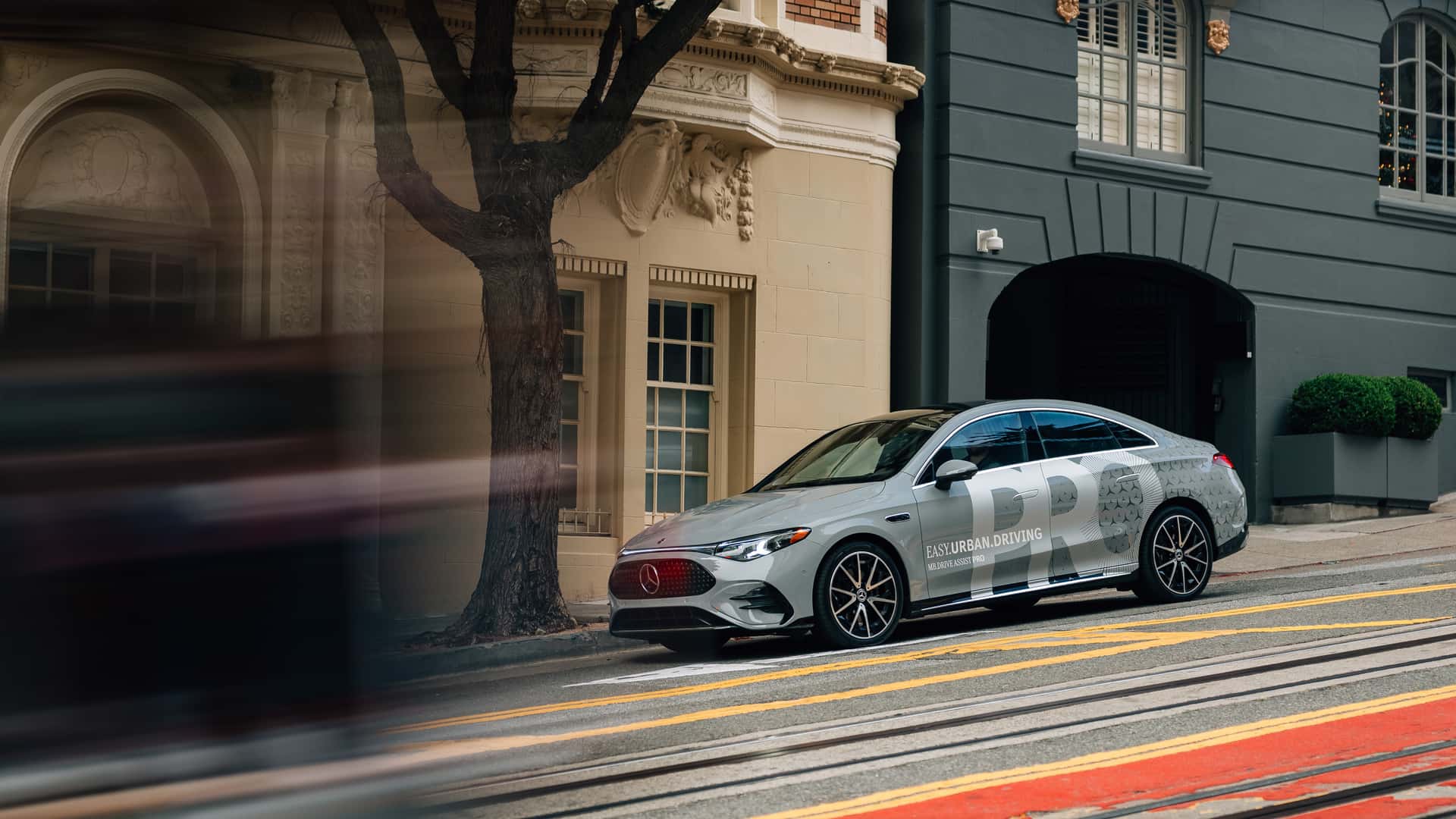
For many commuters navigating challenging daily routes, the promise of advanced driver-assistance systems offers a compelling vision of the future. Lucian Capellaro, whose daily journey through Laurel Canyon from the San Fernando Valley to Los Angeles’ west end is a constant struggle, represents a segment of drivers keenly interested in such innovations. He heard colleagues praise Tesla’s Full Self-Driving (FSD) for its ability to autonomously navigate to a destination, yet his preference for diverse vehicle design and interior quality kept him from embracing a Tesla.
Mercedes-Benz is now poised to offer a significant alternative with its MB.Drive Assist Pro point-to-point automated driving system. Slated for widespread integration into many of the brand’s electric and internal combustion vehicles early next year, this system will also be available for already-purchased eligible vehicles via over-the-air updates. This development sets the stage for a critical comparison with Tesla’s established Full Self-Driving capabilities, particularly concerning their core philosophical differences in driver engagement.
Key Takeaways
- Mercedes-Benz MB.Drive Assist Pro is an upcoming advanced driver-assistance system, launching early next year for Mercedes EV and ICE vehicles, available via OTA updates.
- The system is classified as SAE Level 2, requiring drivers to keep hands on the wheel on surface streets, a key distinction from Tesla FSD (Supervised).
- Mercedes-Benz executives emphasize strict adherence to SAE definitions, asserting driver responsibility at Level 2, contrasting with Level 3 where the machine assumes responsibility.
- MB.Drive Assist Pro employs a comprehensive multi-sensor suite, including cameras, five radar sensors, and 12 ultrasonic sensors, aiming for enhanced environmental perception.
- User feedback highlights a divide: some value the hands-on requirement for perceived safety, while others find the hands-off experience of Tesla FSD on surface streets a significant convenience.
- The true performance comparison between Mercedes-Benz MB.Drive Assist Pro and Tesla FSD in complex urban environments remains a subject of considerable industry and public interest.
Mercedes-Benz Enters the Autonomous Arena with MB.Drive Assist Pro
The automotive industry continues its rapid evolution towards enhanced automation, with leading manufacturers like Mercedes-Benz pushing the boundaries of what vehicles can achieve. The forthcoming introduction of Mercedes-Benz MB.Drive Assist Pro marks a significant stride for the German luxury automaker in the competitive advanced driver-assistance system (ADAS) landscape. This system aims to offer comprehensive point-to-point navigation, enabling vehicles to drive to a user-specified destination and park autonomously, mirroring the core functionality offered by Tesla’s Full Self-Driving (Supervised) feature.
However, a crucial distinction lies in the operational parameters enforced by Mercedes-Benz. While MB.Drive Assist Pro allows for hands-free operation on controlled-access highways, much like Tesla FSD, it mandates that the driver maintain a hand on the steering wheel when navigating surface streets. This requirement is not merely a technical limitation but stems from a deeply ingrained philosophical approach to autonomous driving, guided by industry-standard definitions.
Adherence to SAE Levels: A Philosophical Stance
Understanding SAE Autonomous Driving Levels
Mercedes-Benz’s decision to enforce a hands-on requirement on surface streets for its MB.Drive Assist Pro system is rooted in a strict interpretation of the Society of Automotive Engineers (SAE) J3016 standard for autonomous driving levels. These levels, ranging from 0 (no automation) to 5 (full automation), delineate the degree to which a vehicle can perform driving tasks and the corresponding level of human supervision required.
Both MB.Drive Assist Pro and Tesla FSD (Supervised) are categorized as Level 2 systems, or what Mercedes-Benz occasionally refers to as “Level 2 Plus Plus.” At Level 2, the vehicle provides combined automated functions, such as steering and acceleration/braking, but the human driver remains responsible for monitoring the driving environment and performing all other tasks. The system acts as an assistant, not a replacement for the driver.
Jörg Burzer, Mercedes’ Chief Technology Officer, articulated the company’s principled stance to InsideEVs: “There is a very important borderline between the levels. That borderline is that with Level 2 Plus Plus, you are responsible. At Level 3, the machine, the car, the software stack, is responsible.” This statement underscores Mercedes-Benz’s commitment to clear lines of accountability, an aspect they view as paramount in the development and deployment of autonomous technologies.
The Complexity of Surface Streets
Burzer further elaborated on the rationale behind the hands-on requirement, explaining that while controlled-access highways present a relatively predictable environment for Level 2 systems to manage, surface streets introduce a far greater degree of chaos and complexity. The presence of pedestrians, cyclists, varied speed limits, complex intersections, and unpredictable human behavior exponentially increases the variables a system must process and react to. For these reasons, Mercedes-Benz maintains that continuous driver engagement, signified by a hand on the wheel, is essential for safety and responsibility off the highway.
This approach resonates with some drivers. Lucian Capellaro, the aforementioned Los Angeles commuter, stated, “Think about the reaction time it must be for someone to take their hands from off the wheel to on the wheel. I’d view my hand on the wheel as lessening the seconds of reaction time to something crazy happening.” This perspective highlights a common concern regarding driver readiness and the critical role of human intervention in unforeseen circumstances, even with advanced assistance systems. Burzer also noted that customer research, particularly among European drivers, indicates a preference for maintaining a hand on the wheel in urban driving scenarios.
Tesla FSD (Supervised) and Divergent User Experiences
In contrast to Mercedes-Benz’s strict interpretation, Tesla FSD (Supervised) users frequently report a different experience. Many assert that their vehicles effectively operate hands-off on surface streets, allowing for a more disengaged driving experience than current SAE Level 2 definitions typically imply. This perceived capability leads to a philosophical divergence between the manufacturers and their user bases.
Antonio Hidalgo, another L.A. resident and frequent FSD user, shared his confidence in the system, even admitting to taking naps while driving with FSD engaged. He noted, “If the (Mercedes system) worked the same but I had to keep my hand on the wheel… You know, I probably wouldn’t (make the switch). I mean, I think I would be interested in having a nicer car with a better interior. But no.” This sentiment highlights that for some users, the hands-off freedom offered by Tesla’s system is a significant factor, potentially outweighing other vehicle attributes.
Similarly, Mharlon Barrientos, who uses FSD for his commute in Indianapolis, described a progression from initially hovering a hand over the wheel to fully hands-off operation as system updates and personal experience built trust. Barrientos commented, “Having a hand on the wheel as a requirement would be a bit of a step back to the feel of full autonomous driving that I’ve gotten used.” His experience illustrates how user trust and comfort with a system can evolve, shaping expectations for future autonomous driving features.
Technological Approaches: Sensors and Safety
Mercedes-Benz’s Multi-Sensor Strategy
Beyond philosophical differences, Mercedes-Benz also points to its technological architecture as a key differentiator for MB.Drive Assist Pro. Unlike Tesla, which predominantly relies on cameras for its FSD system, Mercedes-Benz integrates a comprehensive suite of sensors. Christoph von Hugo, Mercedes’ Head of Active Safety, explained that MB.Drive Assist Pro utilizes not only cameras but also five radar sensors and 12 ultrasonic sensors. This diverse array of inputs feeds raw data to the car’s Nvidia-powered computer, creating a more robust perception of the vehicle’s surroundings.
“Different sensor inputs increases performance and safety,” von Hugo affirmed, making veiled references to what he suggested was Tesla’s less comprehensive approach. He explicitly stated, “Relying on one just is not enough.” Mercedes-Benz’s commitment to a multi-sensor fusion strategy is further evidenced by its position that it will not advance to SAE Level 3 capability without the addition of LiDAR technology, augmenting its existing cameras, radar, and ultrasonic sensors. This emphasis on redundant and varied sensor data reflects a deeply conservative engineering philosophy prioritizing safety and reliability.
User Perceptions of Sensor Technology
Despite Mercedes-Benz’s strong arguments for its multi-sensor approach, consumer perception may not always align with engineering priorities. Mharlon Barrientos indicated that the technical specifications of sensors were not a primary driver for his adoption of FSD. “I honestly haven’t even thought about the tech behind it, so I’m not so sure knowing that there’s radar and ultra-sonic sensors (on the window sticker) would be a huge selling point,” he said. Barrientos suggested that real-world performance, demonstrated through videos or reviews, and personal experience over many miles, would be far more influential in building trust.
This perspective highlights a challenge for automakers: while advanced sensor technology is crucial for system robustness, the ultimate measure of success for many users is the system’s seamless and reliable operation in diverse driving conditions. Users prioritize proven functionality and ease of use over the underlying hardware specifications, suggesting that practical demonstration is key to market adoption.
Market Dynamics and Consumer Priorities
The debate between Mercedes-Benz MB.Drive Assist Pro and Tesla FSD extends beyond technical specifications and regulatory interpretations to broader market dynamics and consumer priorities. Not all Tesla owners are unswerving loyalists, as Barrientos clarified: “The hands-on requirement in the city would not be enough to sway me off of the car provided I like the rest of the car. While I like the functionality of FSD, it’s still a bit further down the list of what I look for in a car. Functionality, comfort, value… I still like to feel the mechanics and have the feel of actually driving a car.” This indicates that features like FSD or MB.Drive Assist Pro are one part of a larger purchase decision, alongside traditional automotive considerations such as design, comfort, and overall value proposition.
Lucian Capellaro’s initial hesitation about Tesla, driven by preferences for design and interior quality, further underscores this point. He currently drives a BMW i4, which offers adaptive cruise control and low-speed hands-free highway driving assist. For him, the key question for Mercedes-Benz MB.Drive Assist Pro is its ability to handle extremely complex routes, such as Laurel Canyon, with minimal driver intervention. “I guess I’d just have to experience (MB.Drive Assist Pro) for myself, but if it can navigate all the craziness that is Laurel Canyon through Hollywood, and it is literally just my hand resting on the wheel, and that’s it, then sure,” he said. “The fact that it’s truly point-to-point, then yes, that sounds super appealing.”
The success of MB.Drive Assist Pro will ultimately depend on its real-world performance and how effectively Mercedes-Benz communicates its value proposition, particularly against the backdrop of an already established competitor like Tesla FSD. While early passenger-seat experiences in San Francisco in January showed promise, comprehensive reviews are still awaited to definitively assess its capabilities in diverse and challenging urban environments. The central question remains: Is the hands-on requirement on surface streets a prudent safety measure or a perceived limitation for drivers accustomed to greater autonomy?
Frequently Asked Questions (FAQ)
What is Mercedes-Benz MB.Drive Assist Pro?
Mercedes-Benz MB.Drive Assist Pro is an upcoming advanced driver-assistance system that provides point-to-point automated driving capabilities. It allows the vehicle to navigate to a destination and park, launching for a wide range of Mercedes-Benz vehicles early next year, and will be available via over-the-air updates for eligible existing models.
How does MB.Drive Assist Pro differ from Tesla’s Full Self-Driving (FSD) in operation?
Both systems offer hands-free driving on controlled-access highways. The primary difference is that MB.Drive Assist Pro requires drivers to keep a hand on the steering wheel when operating on surface streets, whereas many Tesla FSD users report a hands-off experience in similar conditions.
Why does Mercedes-Benz require hands on the wheel on surface streets?
Mercedes-Benz adheres strictly to the Society of Automotive Engineers (SAE) Level 2 definition for autonomous driving. This means the driver remains responsible for supervision. Surface streets present complex, unpredictable environments, and maintaining driver engagement with hands on the wheel is deemed crucial for safety and accountability.
What sensor technology does MB.Drive Assist Pro use?
MB.Drive Assist Pro employs a multi-sensor suite for environmental perception. It utilizes cameras, five radar sensors, and 12 ultrasonic sensors to gather comprehensive data. Mercedes-Benz believes this diverse input enhances performance and safety compared to systems relying primarily on cameras.
Will MB.Drive Assist Pro ever offer hands-off driving on all roads?
Mercedes-Benz indicates that true hands-off driving in all conditions, without driver supervision, would classify as SAE Level 3 autonomy. The company states it will not achieve Level 3 capability without incorporating LiDAR technology in addition to its current sensor array, thereby shifting responsibility from the driver to the vehicle system.
How do users react to the hands-on requirement on surface streets?
User reactions vary. Some drivers, like Lucian Capellaro, view the hands-on requirement as a sensible safety measure that improves reaction time. Others, particularly experienced Tesla FSD users, perceive it as a step back from the greater autonomy they have become accustomed to, prioritizing the hands-off convenience.
Is the Mercedes-Benz system focused on safety more than Tesla’s?
Mercedes-Benz’s approach emphasizes safety through strict adherence to regulatory definitions, a multi-sensor suite, and maintaining driver engagement in complex scenarios. While both systems aim for safety, Mercedes-Benz’s public statements and technical choices reflect a more cautious, layered approach to achieving higher levels of autonomy.