
KEY TAKEAWAYS
- New York City’s burgeoning electric vehicle (EV) registrations, exceeding 81,000 in September, highlight a critical need for accessible urban charging solutions beyond traditional fast chargers.
- The introduction of Voltpost Air, the city’s inaugural lamppost EV charger, at Bush Terminal Park in South Brooklyn offers a transformative approach to curbside charging.
- This innovative lamppost EV charger system leverages existing street infrastructure, significantly reducing deployment costs by up to 70% and installation time to mere hours, by eliminating the need for extensive trenching and new electrical connections.
- The Level 2 lamppost EV charger provides a cost-effective alternative to fast charging, enabling EV owners to replenish approximately 30 miles of range in an hour at $0.39 per kilowatt-hour, aligning with convenience for daily urban driving needs.
- Despite requiring QR code activation, the Voltpost system demonstrated a smooth user experience, and its design protects the charger from vandalism and flooding while retracting cables prevent pedestrian obstruction.
- While NYC currently lags behind cities like London in curbside charging infrastructure, the success of solutions like the lamppost EV charger, alongside other startups like It’s Electric and Gravity Charging Center, signals a promising shift towards scalable and efficient EV adoption in dense urban environments.
Navigating the intricate streetscape of New York City in an automobile is often described as a competitive sport. Drivers contend with perennial challenges, from evading potholes and meticulously searching for parking to adhering to strict street-cleaning schedules and enduring some of the nation’s most congested traffic. Yet, despite these obstacles, the city’s embrace of electric vehicles (EVs) and plug-in hybrids is rapidly accelerating, with combined registrations surpassing 81,000 as of September.
This surge in EV adoption creates a pronounced logistical challenge, particularly for the vast majority of New Yorkers who reside in apartments and rely on street parking. Unlike suburban homeowners with dedicated garages and home charging stations, urban EV owners face a fundamentally different and often more complex charging dilemma.
While new fast chargers continue to emerge across the five boroughs, their rapid expansion is constrained by dense urban planning, exorbitant real estate costs, and lengthy permitting processes. Moreover, not every charging session necessitates a high-powered station. For many city dwellers, the ideal charging solution would allow them to plug in their vehicles for several hours while attending to other activities.
This is precisely where the increased availability of Level 2 charging, both curbside and in parking facilities, becomes critical. These chargers are significantly more economical to use than their fast-charging counterparts and can fully recharge an EV in approximately six to eight hours, depending on battery capacity.
Unless one’s profession demands frequent, rapid charging, such as a rideshare driver, most vehicles remain stationary for extended periods. Expanding the network of Level 2 plugs in locations where cars are typically parked for prolonged durations not only offers greater cost efficiency for owners but also subjects EV batteries to less stress during the charging process.
Several New York-based startups are actively developing solutions to address this precise need, with Voltpost leading the charge. The company’s concept is elegantly straightforward: instead of constructing entirely new charging stations, it ingeniously repurposes existing street infrastructure, such as lampposts or utility poles, into functional EV charging points.
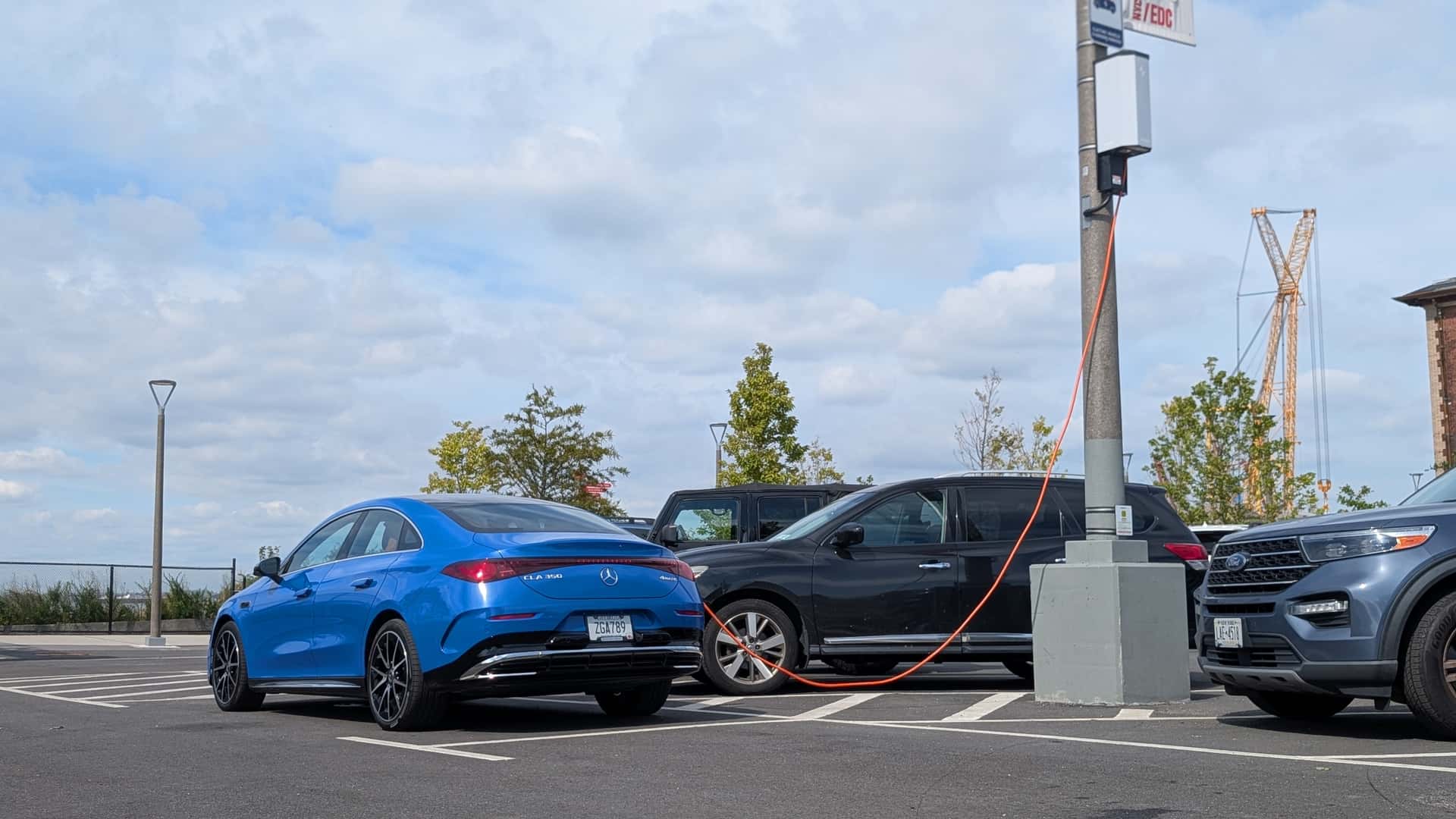
Voltpost recently unveiled NYC’s pioneering lamppost EV charger, known as Voltpost Air, situated at the Bush Terminal Park in South Brooklyn. A hands-on evaluation of this innovative charger revealed its profound potential as a game-changer. If deployed extensively across the city, this lamppost EV charger infrastructure could dramatically accelerate New York’s ambitious EV integration goals.
Experiencing New York City’s First Lamppost EV Charger
The Voltpost Air charger is strategically positioned approximately 10 feet up a streetlight pole, placing it roughly at the height of a basketball hoop. This elevated placement, as explained by Voltpost, serves a dual purpose: it safeguards the unit from potential vandalism and mitigates risks associated with urban flooding. Upon arrival at the Bush Terminal Park location, it was unsurprising to find conventionally fueled cars parked on either side of the charger.
However, the dispenser’s ample 25-foot cable proved sufficiently long to effortlessly reach the charge port of the Mercedes-Benz CLA 350 Electric being tested, without obstructing the surrounding vehicles. Initiating the charging session was a notably streamlined process. Users simply scan a QR code prominently displayed on the charger, and with just two subsequent taps on the associated app, the charging cable automatically descends from the pole.
Once the cable is within comfortable reach, a button on the handle extends the connector to the vehicle’s charge port. While the preference for a physical card reader for truly frictionless charging remains, avoiding repeated QR code scans and app usage, Voltpost’s application demonstrated impressive efficiency.
The app proved remarkably slick, with instantaneous connection speeds — a significant achievement given that some larger, more established fast-charging networks still struggle with application stability and responsiveness. Upon completion of the charging session, the cable retracted automatically into the dispenser after being unplugged. A minor operational nuance noted was the need for a gentle release of the handle; an abrupt drop could cause the cable to swing and hit the pole during its retraction.
Overall, the charging experience was remarkably uneventful and efficient. During the hour spent utilizing the lamppost EV charger, the Mercedes-Benz CLA gained approximately 30 miles of indicated range. This increment was more than sufficient to cover the round trip from the reporter’s apartment and provided an additional 20 miles of range, effectively addressing the day’s driving requirements.
This scenario precisely underscores the utility of Level 2 chargers like the Voltpost Air. They eliminate the necessity for drivers to remain idle while their vehicles charge, instead allowing them to park, plug in, and proceed with other engagements. Ideal locations for such deployments include parks, shopping centers, apartment complexes, and office environments, where the charger can seamlessly add range while users are engaged in activities like dog walking, grocery shopping, or socializing.
The cost of charging was recorded at $0.39 per kilowatt-hour, representing a considerable saving compared to nearby fast chargers, which frequently exceed $0.60 per kWh. This pricing structure was broadly consistent with other public Level 2 chargers available throughout New York City, solidifying the economic advantage of the lamppost EV charger.
The Strategic Advantages of Lamppost EV Chargers
Voltpost asserts that its lamppost EV charger installations effectively resolve several common inconveniences associated with conventional curbside EV charging infrastructure. These issues include charging cables lying haphazardly on sidewalks and charging stations occupying valuable pedestrian space.
Critically, the charger unit itself is positioned safely above street level, offering inherent protection against potential urban flooding. Furthermore, the automatic retraction mechanism for the charging cable prevents it from being left on the ground, thereby reducing wear and tear on the equipment and ensuring clear, unobstructed pathways for pedestrians.
However, the most significant advantages, according to Luke Mairo, COO and co-founder of Voltpost, lie in the rapid deployment capabilities and substantially reduced installation costs. Unlike traditional methods that necessitate excavating sidewalks, laying new conduits, and establishing dedicated electrical connections, Voltpost’s system leverages existing utility poles and electrical infrastructure. This approach significantly streamlines the installation process for each lamppost EV charger unit.
“The main benefit of using pole mounted infrastructure is that we don’t do construction and trenching work,” Mairo stated in an interview. He further elaborated that this method translates to “less permitting, significant reductions in the cost to install, and less disruption to the communities.”
It is important to note that the Brooklyn lamppost EV charger does not draw power from the streetlight it is mounted on. Instead, it sources electricity from a nearby building. Mairo clarified this aspect: “We don’t split the power to the light. With the conversion of street lights to LED, there’s spare capacity on the grid. We can use the existing capacity at the distribution to bring new service through the grid to our lamppost locations.”
This innovative power sourcing and installation methodology can slash project costs by an impressive 70% and enables a charger to be installed within a matter of hours, largely circumventing the need for extensive construction or trenching. Each Voltpost Air lamppost EV charger is designed to support both J1772 and Tesla-style J3400 connectors, capable of delivering up to 9.6 kilowatts at 240 volts and 40 amps.
Voltpost initiated its first lamppost EV charger deployment in Chicago last year, followed by subsequent installations in Detroit and New York. An additional 26 lamppost EV charger units are slated for New York State as part of a program funded by the New York State Energy Research and Development Authority (NYSERDA). Cumulatively, approximately 500 new lamppost chargers have been awarded for deployment across nine U.S. states.
Ensuring Durability in Diverse Urban Environments
The integration of a cable retraction system onto a streetlight naturally introduces a new potential point of failure. Addressing concerns regarding the mechanism’s resilience against real-world conditions—such as freezing winters, scorching summers, and thousands of charging cycles—Mairo highlighted the charger’s UL certification. He affirmed that the mechanism has undergone extensive testing, enduring thousands of operational cycles across a broad spectrum of climates and temperatures. The unit is rated to function reliably within a temperature range of -22 degrees Fahrenheit to 122 degrees Fahrenheit.
However, the true litmus test for any urban charging infrastructure lies in its performance under widespread public use. Anecdotal evidence suggests that city drivers are not always gentle with public charging equipment, often leading to damaged plugs and cracked screens. Voltpost mitigates these risks by continuously monitoring its chargers in real-time. This capability allows the company to remotely address certain software-related issues. For problems necessitating a physical intervention, Voltpost can promptly dispatch local maintenance providers.
The Evolving Landscape of Curbside Charging in NYC
Voltpost is not the sole innovator leveraging existing electrical infrastructure to circumvent costly and time-consuming utility upgrades. Another prominent New York startup, It’s Electric, is actively planning to expand its network of sleek curbside chargers. These units draw spare capacity directly from adjacent residential and commercial buildings. A distinguishing feature of It’s Electric is that drivers utilize their own charging cables—which the company also supplies—thereby eliminating dangling cables across sidewalks. After charging, users simply retrieve their cables, akin to an iPhone charger.
On a grander scale, the Gravity Charging Center in Times Square employs a similar foundational principle. This expansive facility claims to utilize sufficient spare electricity from its surrounding block to power its formidable 500 kW charging station. The unifying theme among these innovative startups is their proactive approach: they are not passively awaiting a complete overhaul of New York City’s streets to accommodate EVs. Instead, they are strategically working within the confines of the city’s existing infrastructure, aiming to accelerate EV adoption through more efficient and scalable means.
Despite these advancements, a significant journey lies ahead before chargers from companies like Voltpost and It’s Electric become a ubiquitous sight across the United States. New York City, in particular, still trails behind several other major global metropolises in terms of widespread curbside charging availability. London, for instance, boasts an impressive network of over 27,000 curbside chargers, many of which are similarly integrated through lamppost retrofits, demonstrating the established efficacy of this approach.
New York City’s current curbside charging infrastructure is comparatively smaller, comprising only 88 chargers installed by Flo. These units, characterized by their towers and long cables, can often appear visually intrusive within already congested and dynamic urban streetscapes. Nevertheless, the burgeoning demand for EV charging is undeniable, evidenced by the long queues frequently observed at public fast-chargers across the city.
With EVs now constituting 8.3% of all new vehicle registrations in New York City, and plans underway to install some 600 additional curbside chargers in the coming years, the trajectory is clear. The pivotal question now revolves around the speed at which the city can implement these vital charging solutions and, in doing so, significantly enhance the daily lives of its growing EV driving community.
FAQ Section: Understanding Lamppost EV Chargers
What is a lamppost EV charger?
A lamppost EV charger is an electric vehicle charging unit integrated directly into existing street infrastructure, such as lampposts or utility poles. This innovative solution repurposes urban elements to provide convenient curbside charging, minimizing the need for extensive construction and leveraging existing electrical grids for power.
How does the Voltpost Air lamppost EV charger work?
The Voltpost Air charger, installed high on a streetlight pole, is activated by scanning a QR code with a smartphone app. The charging cable automatically lowers to reach the vehicle’s port. Once charging is complete and unplugged, the cable retracts, ensuring safety and preventing obstruction on sidewalks.
What are the main advantages of using lamppost EV chargers in cities?
Lamppost EV chargers offer significant benefits, including rapid deployment and lower installation costs by utilizing existing poles and electrical capacity. Their elevated position protects against vandalism and flooding, while automatic cable retraction ensures pedestrian safety. They are also less visually intrusive than traditional charging stations.
How much does it cost to charge an EV using a Voltpost lamppost charger?
As tested in New York City, the Voltpost lamppost EV charger cost $0.39 per kilowatt-hour. This pricing is notably more affordable than many public fast chargers, which can exceed $0.60 per kWh, making it a cost-effective option for urban EV owners requiring Level 2 charging.
Are lamppost EV chargers durable in harsh weather conditions?
Yes, Voltpost’s lamppost EV chargers are designed for durability, holding UL certification and tested to operate reliably between -22 degrees Fahrenheit and 122 degrees Fahrenheit. Real-time monitoring and local maintenance providers further ensure their continuous operation and address any issues promptly, even in challenging urban environments.
How many lamppost EV chargers are planned for New York City?
Following the initial installation in South Brooklyn, an additional 26 lamppost chargers are slated for New York State, funded by NYSERDA. Broader city plans include adding approximately 600 new curbside chargers in the coming years, indicating a significant expansion of EV charging infrastructure across New York City.