
Key Takeaways
- New York City faces significant challenges in providing adequate EV charging for its dense, apartment-dwelling population.
- The introduction of Voltpost Air, the city’s first lamppost EV charger in South Brooklyn, offers a promising solution to these urban charging hurdles.
- This Level 2 charging infrastructure leverages existing lampposts and electrical grids, drastically reducing deployment costs and time by avoiding extensive construction.
- Testing revealed the system to be highly user-friendly, providing efficient, cost-effective charging suitable for extended parking periods.
- The success of such initiatives could significantly accelerate EV adoption in densely populated urban environments, aligning New York with global leaders in curbside charging.
NEW YORK, NY – Navigating the bustling streets of New York City presents a unique set of challenges for motorists, from the perpetual hunt for parking to stringent street-cleaning regulations and formidable traffic. Despite these complexities, the city is witnessing a notable surge in electric vehicle (EV) adoption, with combined registrations for EVs and plug-in hybrids exceeding 81,000 as of September.
This growing embrace of electric mobility, however, underscores a critical infrastructure deficit. While suburban homeowners often enjoy the convenience of private home charging solutions, the reality for many New Yorkers, residing in apartments and relying on street parking, is starkly different.

The continuous expansion of fast-charging networks across the five boroughs, while crucial, faces inherent limitations. New York’s dense urban fabric, prohibitive real estate costs, and protracted permitting processes constrain the rapid deployment of these high-powered stations. Moreover, not every charging scenario necessitates high-speed infrastructure; many urban drivers seek convenient, slower charging options during their daily routines.
The Strategic Importance of Curbside Level 2 Charging
This gap highlights the pressing need for more ubiquitous Level 2 charging solutions, both curbside and within parking facilities. These chargers offer a significantly more economical alternative to fast chargers, capable of fully replenishing an EV battery in approximately six to eight hours, depending on its capacity.
For most vehicle owners, particularly those who are not rideshare operators requiring frequent rapid charging, cars remain stationary for the majority of the day. Integrating more Level 2 plugs where vehicles are parked for extended periods offers a dual benefit: it is more cost-efficient for owners and places less stress on the EV battery during the charging cycle.
In response to this urban charging dilemma, several New York-based startups are pioneering innovative solutions. Among them is Voltpost, a company that has conceptualized a remarkably simple yet effective approach: repurposing existing street infrastructure, such as lampposts and utility poles, into functional EV chargers.
Introducing New York City’s First Lamppost EV Charger
Voltpost recently unveiled New York City’s inaugural lamppost EV charger, the Voltpost Air, at Bush Terminal Park in South Brooklyn. A first-hand assessment of this innovative system revealed its potential to be a significant catalyst for the city’s electric vehicle ambitions if scaled effectively.
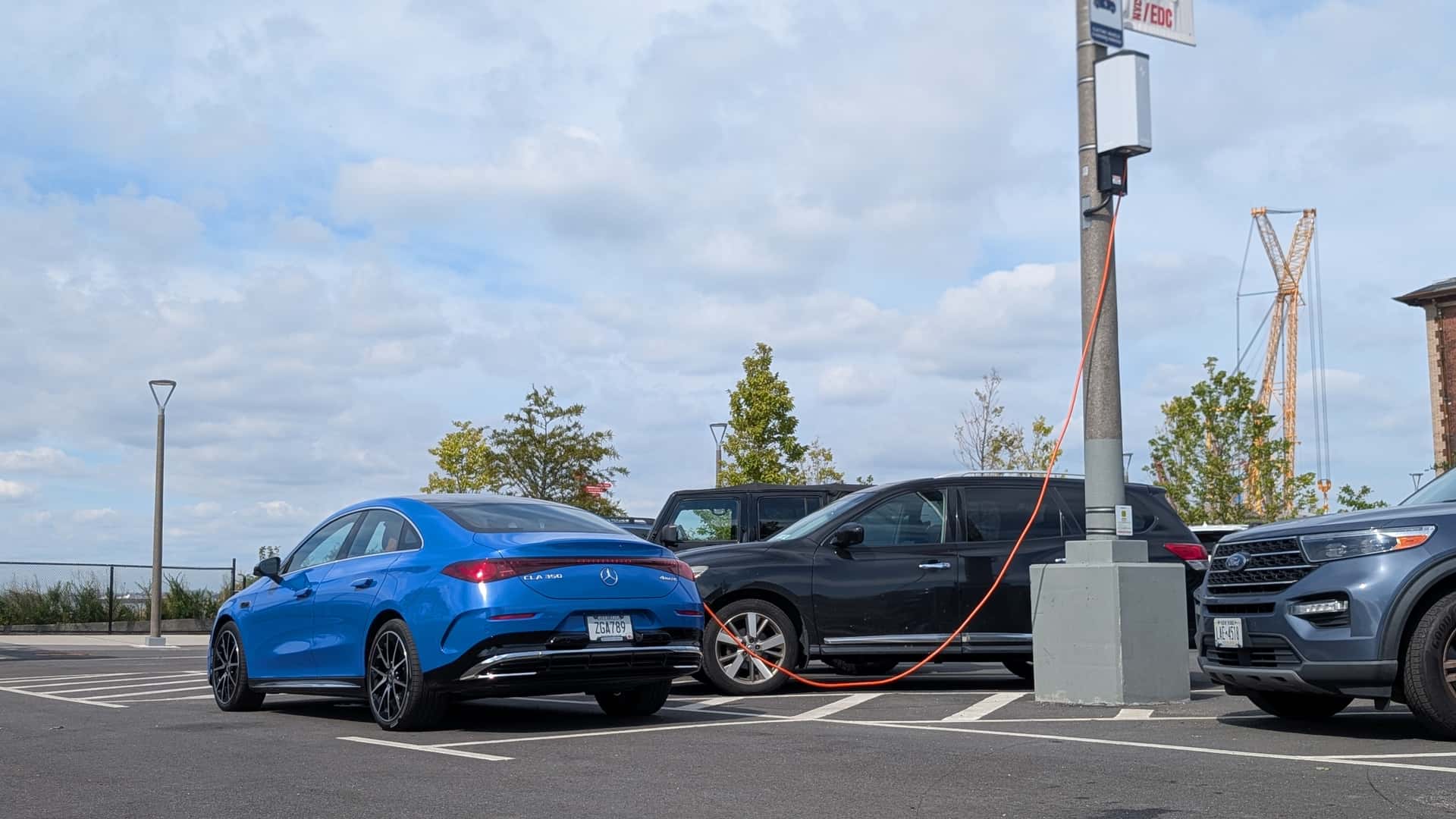
The charger is strategically positioned approximately 10 feet up a streetlight pole, a height chosen by Voltpost to mitigate risks associated with vandalism and potential flooding. During the test, despite the presence of conventionally fueled cars parked on either side, the dispenser’s ample 25-foot cable easily reached the charge port of the Mercedes-Benz CLA 350 Electric being used, without obstructing adjacent vehicles.
Operational Mechanics and User Interface
Initiating a charging session with the Voltpost Air proved to be straightforward. The process involved scanning a QR code on the charger, followed by two quick taps within the application. This action prompted the cable to automatically lower itself from the pole. Once within reach, a simple button press on the handle extended the cable to connect with the vehicle.
While the convenience of a card reader remains the preferred standard for truly seamless charging, Voltpost’s application demonstrated impressive efficiency and responsiveness. The instantaneous connection and smooth operation of the app stood out, particularly given the frequent connectivity issues encountered with some larger fast-charging networks.
Upon completion of the charging session, disconnecting the vehicle initiated the automatic retraction of the cable back into the dispenser. A minor operational nuance noted was the need for a gentle release of the handle; an abrupt detachment could cause the cable to swing against the pole during retraction. Overall, the charging experience was notably uneventful and efficient.
Cost-Effectiveness and Convenience
During a one-hour charging period, the Mercedes-Benz CLA gained approximately 30 miles of indicated range. This incremental charge was sufficient to cover the round trip from the reporter’s apartment and provided an additional 20 miles, effectively addressing daily driving requirements. This scenario perfectly illustrates the utility of such chargers: drivers can plug in their vehicles and engage in other activities, eliminating the need to wait.
Ideal locations for such Level 2 lamppost EV chargers include parks, shopping centers, residential apartment complexes, and office environments, where vehicles are typically parked for extended durations. The charger can incrementally add range while users are walking their dog, grocery shopping, or socializing.
The cost of charging was recorded at $0.39 per kilowatt-hour, a rate considerably more economical than many fast chargers in the area, where prices often surpass $0.60 per kWh. This pricing aligns closely with that of other public Level 2 chargers available across the city.
Strategic Advantages of Lamppost Installations
Voltpost asserts that its lamppost installations effectively resolve several common inconveniences associated with existing curbside EV chargers. These include preventing charging cables from lying haphazardly on sidewalks and avoiding the occupation of pedestrian space by bulky charging stations.
A key protective feature is the charger’s elevated position above street level, safeguarding it from potential flooding. The automatic cable retraction mechanism further contributes to safety and longevity by preventing cables from being left on the ground, thereby reducing wear and tear and eliminating potential tripping hazards for pedestrians.
Luke Mairo, COO and co-founder of Voltpost, emphasized the paramount advantage of this system: the speed and significantly lower cost of deployment. “The main benefit of using pole mounted infrastructure is that we don’t do construction and trenching work,” Mairo stated. He elaborated that this approach means “less permitting, significant reductions in the cost to install, and less disruption to the communities.”
Crucially, the Brooklyn lamppost EV charger operates independently of the streetlight’s power supply, drawing electricity from a nearby building. Mairo clarified, “We don’t split the power to the light. With the conversion of street lights to LED, there’s spare capacity on the grid. We can use the existing capacity at the distribution to bring new service through the grid to our lamppost locations.”
This innovative method can slash project costs by up to 70% and enables charger installation within mere hours, circumventing the need for extensive construction or trenching. The charger supports both J1772 and Tesla-style J3400 connectors, delivering up to 9.6 kilowatts at 240 volts and 40 amps.
Technological Resilience and Maintenance
Voltpost initially launched its first lamppost EV charger in Chicago last year, followed by subsequent installations in Detroit and New York. The New York State Energy Research and Development Authority (NYSERDA) is further supporting the deployment of 26 additional lamppost chargers across New York State. Globally, approximately 500 new chargers have been sanctioned across nine U.S. states.
Addressing concerns regarding the durability of a cable retraction system exposed to extreme weather conditions, Mairo highlighted the charger’s UL certification. He affirmed that the mechanism has undergone extensive testing over thousands of cycles in varying climates and temperatures, engineered to operate reliably between -22 degrees Fahrenheit and 122 degrees Fahrenheit.
While laboratory tests provide assurance, real-world usage at scale will be the ultimate determinant of durability. Anecdotal evidence suggests that urban charging equipment often endures rough handling, leading to broken plugs and damaged screens. Voltpost maintains real-time monitoring of its chargers, enabling remote troubleshooting via software, and dispatches local maintenance providers for physical repairs when necessary.
Broader Landscape of NYC’s Curbside Charging Innovations
Voltpost is not alone in its quest to leverage existing electrical infrastructure to circumvent costly and time-consuming utility upgrades. Another New York startup, It’s Electric, is expanding its network of sleek curbside chargers. These units draw spare capacity from residential and commercial buildings, with drivers utilizing their own charging cables, akin to charging a smartphone, thereby eliminating dangling cables on sidewalks.
Similarly, the Gravity Charging Center in Times Square employs a comparable large-scale strategy, utilizing surplus electricity from its block to power its 500 kW charging station. A common thread among these startups is their proactive approach: rather than awaiting a comprehensive overhaul of city streets, they are innovating within existing urban frameworks to accelerate EV adoption more efficiently.
Global Comparison and Future Outlook
Despite these promising innovations, widespread deployment of chargers from companies like Voltpost and It’s Electric across the U.S. is still a distant goal. New York City, in particular, lags behind several other major global metropolises in terms of curbside charging availability.
London, for instance, boasts over 27,000 curbside chargers, a substantial portion of which are lamppost retrofits, demonstrating that the concept is not entirely novel. In contrast, NYC’s current curbside charging infrastructure is considerably smaller, with only 88 chargers installed by Flo. These units, with their prominent towers and lengthy cables, can often appear visually intrusive in the city’s already congested and dynamic streetscape.
Nevertheless, the demand for EV charging in New York City significantly outstrips current supply, evident from the frequent queues at public fast-charging stations. With electric vehicles now constituting 8.3% of new vehicle registrations in the city, plans are underway to install approximately 600 additional curbside chargers in the coming years. The pivotal question remains how rapidly the city can implement these solutions to genuinely enhance the driving experience for its growing EV community.
FAQ Section
What is a lamppost EV charger?
A lamppost EV charger is an electric vehicle charging unit integrated directly into existing street infrastructure, such as lampposts or utility poles. This innovative solution repurposes existing urban elements to provide charging points, circumventing the need for extensive new construction and reducing deployment costs and time significantly.
How does the Voltpost Air lamppost EV charger work?
The Voltpost Air charger, positioned 10 feet high on a streetlight pole, is activated via a smartphone app and QR code. Upon authorization, its 25-foot cable automatically lowers for connection to the EV. Once charging is complete, the cable retracts, keeping sidewalks clear. It draws power from a nearby building, utilizing existing grid capacity.
What are the benefits of curbside Level 2 charging?
Curbside Level 2 charging offers a cost-effective alternative to fast chargers, ideal for urban dwellers who park for extended periods. It places less stress on EV batteries and is significantly cheaper per kilowatt-hour. These chargers enhance urban EV adoption by providing convenient charging access where drivers already park.
How does this technology address New York City’s EV charging challenges?
New York City faces high real estate costs and complex permitting for new charging stations. Lamppost EV chargers overcome these by using existing infrastructure, drastically cutting construction, trenching, and permitting needs. This accelerates deployment, making EV charging more accessible in dense urban environments without major street disruptions.
Is the Voltpost Air charger durable in varying weather conditions?
Yes, the Voltpost Air charger is UL certified and rated to operate reliably across a wide range of temperatures, from -22 to 122 degrees Fahrenheit. Its design, including an elevated position and automatic cable retraction, aims to protect it from vandalism, flooding, and general wear and tear from urban use.
How does New York City’s curbside charging compare to other global cities?
New York City currently lags behind global leaders like London, which boasts over 27,000 curbside chargers, many of which are lamppost retrofits. While NYC has promising new initiatives and plans for hundreds more chargers, it still has a significant journey to match the scale of more established urban EV charging networks.