
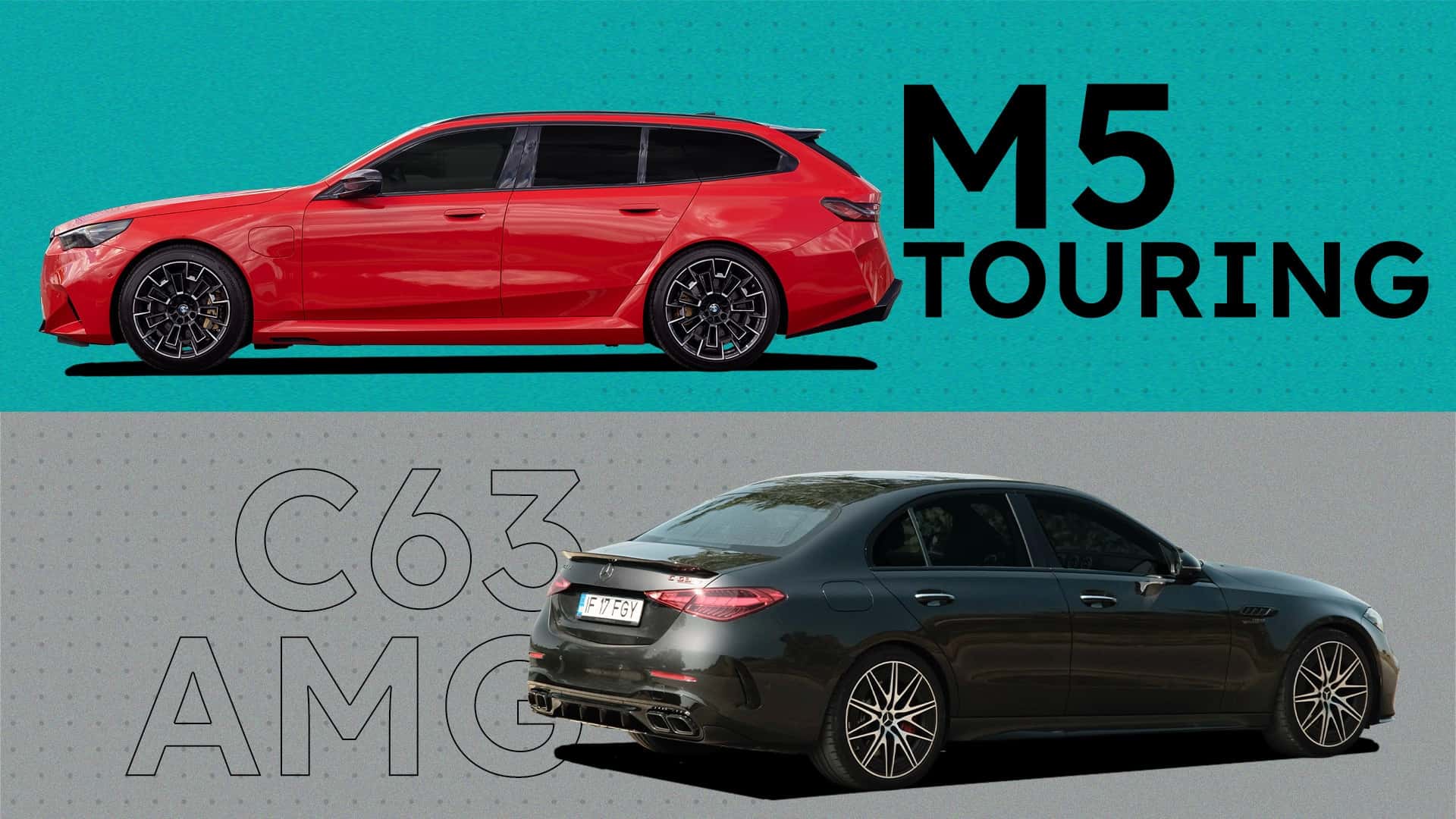
In the evolving landscape of high-performance automobiles, carmakers are increasingly integrating substantial battery packs into their most potent and emission-heavy flagship models. This strategic shift aims to reduce carbon footprints, yet it has inadvertently given rise to a unique category of vehicles: immensely powerful hybrids that, while offering breathtaking straight-line acceleration and considerable electric-only range, often struggle to maintain the agile cornering dynamics of their purely combustion-engined predecessors.
This dynamic was particularly evident during a recent evaluation comparing the new G99 BMW M5 Touring with the Mercedes-AMG C63s E-Performance. Each vehicle represents a distinct approach to the performance plug-in hybrid electric vehicle (PHEV) concept, eliciting varied reactions from enthusiasts and critics alike at their respective launches.

Key Takeaways
- The BMW M5 Touring, with its large V-8 and 22.1 kWh battery, offers immense straight-line speed and significant electric range (approx. 35 miles), but its 5,456-pound weight compromises handling and ride quality.
- The Mercedes-AMG C63s E-Performance, featuring a 2.0-liter four-cylinder engine and a smaller 6.1 kWh battery, prioritizes performance boosting over electric range (approx. 5 miles), resulting in superior agility and a more engaging driving experience despite lower overall horsepower.
- The article argues that for performance PHEVs, a smaller, strategically integrated battery can lead to better driving dynamics by minimizing weight, even if it reduces electric-only range.
- The C63’s engineering philosophy, akin to Ferrari’s high-performance hybrids, demonstrates that electrification can enhance performance without overburdening the chassis.
- Real-world efficiency for both models often falls short of advertised figures, as many PHEV drivers do not consistently keep batteries charged.
The G99 BMW M5 Touring: Raw Power, Compromised Agility
The latest iteration of the BMW M5 Touring, coded G99, presents an undeniably potent package. Its hybrid powertrain, combining a robust 4.4-liter twin-turbocharged V-8 engine with an electric motor, generates a claimed 717 horsepower. However, dyno testing has indicated that the actual power delivered to the wheels approaches 700 hp, suggesting a total output closer to 800 hp, coupled with a formidable 737 pound-feet (1,000 Nm) of torque.
This immense power translates into alarming pace, capable of pinning occupants to their seats from both standing starts and rolling acceleration. The M5’s powertrain is, by all accounts, unequivocally brilliant, offering a visceral driving experience when the V-8 is engaged.
Adding to its versatility, the M5 also offers a compelling electric-only driving mode. The 197 hp and 206 lb-ft (280 Nm) electric motor, integrated within the eight-speed automatic gearbox, capably propels the M5 without engaging the combustion engine. Even in the substantial 5,456-pound (2,475 kg) Touring model, the vehicle feels brisk in EV mode, providing approximately 35 miles of pure electric range.

Intriguingly, the author found the M5 most enjoyable in EV mode. The system pipes in a subtle, engaging acceleration sound through the speakers, and drivers can feel the shifts even without the V-8, though manual control is absent. Power is distributed to all four wheels, ensuring reliable traction in various conditions, making it a capable around-town electric experience.
Despite its undeniable power and sophisticated hybrid system, the sheer mass of the M5 Touring presents significant challenges. The vehicle’s weight, notably heavier than the pure electric i5, necessitates a specific suspension tune to manage its substantial bulk. This results in an oddly inconsistent ride quality, oscillating between extreme comfort and jarring stiffness. The car struggles to decide if it’s a Maybach or a pogo stick, leaving the driver uncertain of the forthcoming experience.
Furthermore, mid-corner bumps can unsettlingly disturb the car’s composure, leading to noticeable transfers of force that undermine confidence on winding roads. The formidable inertia makes the M5 feel like “an athlete trying to run with ankle weights on,” constantly threatening to pull the car into understeer when driven spiritedly. This heavy nature somewhat diminishes the immediate covetability usually associated with BMW M cars, highlighting a potential drawback of integrating such a large battery into a performance PHEV.
Mercedes-AMG C63s E-Performance: Agile Electrification
In stark contrast to the M5’s approach, the Mercedes-AMG C63s E-Performance, though still a hybrid, offers a significantly different driving proposition. While it belongs to a different size class and is not a direct peer to the M5 Touring, its driving dynamics provide crucial context for the discussion of performance PHEVs. The C63’s relatively lighter build and more agile nature immediately underscore the M5’s substantial mass.
Despite its smaller 2.0-liter four-cylinder engine—half the cylinders of the BMW—and slightly lower horsepower, the C63 delivers a more special and engaging driving experience. Its M139 engine, a hand-assembled unit boasting a signed plaque under the hood, proudly displays its big turbo and electric supercharger setup, a more visually impressive sight than the M5’s plastic-covered engine bay.
The M139 engine, derived from AMG’s compact performance offerings like the CLA 45, produces over 400 horsepower independently. Combined with its electric motor, the C63’s total output reaches 670 hp and an impressive 752 lb-ft (1,020 Nm) of torque. This torque figure surpasses the BMW’s, and critically, it’s delivered in a vehicle approximately 880 pounds (400 kg) lighter, a difference profoundly felt on the road.
The C63’s “Race Start” function generates a sensation unlike anything experienced in a combustion car, feeling subjectively faster than the M5 despite similar on-paper acceleration figures. Its all-wheel-drive system expertly channels power to the ground, facilitating shockingly quick launches. An electric supercharger works to rapidly build boost, minimizing turbo lag and contributing to a highly responsive powertrain. The combined torque from the electric motor and gasoline engine creates a remarkable surge of power.
Furthermore, the C63’s exhaust note, even with piped-in enhancement disabled, remains characterful, complemented by the audible build and release of turbo pressure, adding to the overall driving enjoyment. Crucially, the C63 excels in cornering, feeling far more composed and precise than its predecessors. It behaves more like a track car, focused on maximizing corner exit speed with minimal drama, a stark departure from the M5’s unsettling behavior on twisty roads.
Engineering Philosophies: Battery Size and Performance
Mercedes’ engineering strategy for the C63 PHEV stands apart from BMW’s. Unlike the M5 and the E53, which share similar battery and motor configurations with their lesser PHEV siblings, the C63 features a smaller, bespoke setup. Its electric motor is integrated into the rear axle, and its primary function is to boost performance, not to provide extensive electric-only range. While it can operate on electricity for approximately 5 miles, this capability is secondary to its performance enhancement role.
The “genius move” by Mercedes with the C63 was opting for a significantly smaller battery. The M5 carries a 22.1-kilowatt-hour battery, contributing substantially to its weight. In contrast, the C63’s battery has a mere 6.1 kWh capacity. This smaller battery, though minimal by PHEV standards, fulfills its essential regulatory purpose, helping the car meet stringent European Union emissions standards in laboratory testing.
However, real-world efficiency often diverges from these laboratory figures. The heavier BMW M5, with its larger battery, boasts a WLTP efficiency rating of 1.6 to 1.7 liters/100 km (nearly 150 mpg). This is largely conditional on consistently recharging the battery, a practice not all PHEV owners adhere to. Consequently, the M5’s EPA combined rating of 13 mpg (18 l/100 km) offers a more realistic reflection of its fuel consumption in typical driving conditions when the battery is depleted.
The C63, lacking a directly comparable WLTP rating in Europe, claims an average of 6.9 l/100 km (34 mpg). Achieving this requires an extremely light foot, yet it remains attainable even with a drained battery. When driven similarly to the M5 for enjoyment rather than fuel conservation, the C63 returned around 15 mpg, which is commendable given its prodigious acceleration. The EPA rates the C63 at 20 mpg with a depleted battery, a figure that is realistically achievable without specific efforts to drive efficiently.
The True Essence of a Performance PHEV
For enthusiasts, the essence of a performance PHEV should lie in enhancing the driving experience, not merely in achieving impressive, and often unrealistic, efficiency numbers. Purchasers of vehicles like the C63 or M5 are typically not driven by fuel economy as a primary selling point; they prioritize exhilaration and driving dynamics. Moreover, performance cars constitute a minuscule fraction of overall vehicle sales, meaning their individual emissions impact is marginal compared to mass-market electrification efforts.
The M5, while offering significant electric range, exemplifies how an oversized battery can impede the ultimate driving experience. In this contest, the Mercedes-AMG C63 PHEV, despite initial criticisms regarding its four-cylinder engine, emerges as the superior driver’s car. Its approach aligns more closely with performance-oriented plug-in hybrids from brands like Ferrari, where the battery’s role is to boost power without compromising chassis purity.
Examples such as the second-generation Acura NSX, Corvette E-Ray, Ferrari 296 GTB, or the new Lamborghini Temerario demonstrate successful integration of electrification for performance. In these vehicles, battery capacities are typically under 8 kWh, preventing excessive weight gain that could negatively impact handling. While electrification inherently offers some efficiency benefits, a performance PHEV burdened by a disproportionately large battery can paradoxically become less efficient than its purely combustion-engined counterpart due to the added mass.
A common concern with performance-focused smaller batteries is the potential for power loss when the battery is depleted, especially under sustained high-performance driving. The engine might then act as a generator, diverting power to recharge the pack. However, in real-world scenarios, short of multiple laps on a demanding track like the Nürburgring, this is rarely an issue. The author’s experience with the C63, driving hard for over half an hour, showed approximately 33% battery remaining, with no perceived performance degradation. This indicates that for most spirited road driving, the battery provides ample support for performance augmentation.
FAQ: Understanding Performance PHEVs
Q1: What is a Performance PHEV?
A Performance PHEV (Plug-in Hybrid Electric Vehicle) combines a combustion engine with an electric motor and a battery, designed primarily to enhance acceleration, horsepower, and overall driving dynamics. Unlike conventional PHEVs that prioritize electric range and fuel efficiency, performance models use electrification to deliver a more exhilarating and responsive driving experience, often with a secondary focus on emissions reduction.
Q2: How does battery size impact a Performance PHEV’s driving experience?
Larger batteries, while offering extended electric-only range, significantly increase vehicle weight. This added mass can negatively affect handling, agility, and ride quality, making the car feel less nimble and responsive through corners. Conversely, smaller, lighter batteries, as seen in the C63s E-Performance, are typically integrated to provide a performance boost without excessively compromising the chassis dynamics, thereby preserving a more engaging driving feel.
Q3: What are the key differences in the electrification strategies of the BMW M5 Touring and Mercedes-AMG C63s E-Performance?
The BMW M5 Touring employs a large 22.1 kWh battery for a considerable electric range (approx. 35 miles) alongside its powerful V-8, resulting in high weight but significant EV capability. The Mercedes-AMG C63s E-Performance uses a smaller 6.1 kWh battery and a 2.0-liter four-cylinder engine, with its electric motor primarily boosting performance and offering only a short electric range (approx. 5 miles), prioritizing agility and responsiveness.
Q4: Do Performance PHEVs truly achieve their advertised fuel efficiency?
Advertised fuel efficiency figures, such as WLTP ratings, are often achieved under specific lab conditions that assume consistent battery charging. In real-world driving, especially if the battery is not frequently topped up, the actual fuel economy of Performance PHEVs can be considerably lower. For instance, the M5’s EPA combined rating (depleted battery) is 13 mpg, far below its theoretical WLTP equivalent.
Q5: Is a four-cylinder engine sufficient for a high-performance AMG model like the C63s E-Performance?
Despite having only four cylinders, the 2.0-liter M139 engine in the C63s E-Performance is a highly sophisticated, hand-assembled unit producing over 400 hp independently. Combined with its electric motor, it delivers 670 hp and 752 lb-ft of torque. The electric supercharger and rear-axle integrated motor ensure rapid response and immense power, making it a formidable and exciting performance vehicle that feels genuinely special to drive.
Q6: Can Performance PHEVs maintain their power output when the battery is low?
This is a common concern. While some performance PHEVs might experience a slight power reduction if the battery is completely depleted and the engine has to generate electricity, modern systems are designed to manage this. In most spirited road driving scenarios, the battery retains enough charge to provide continuous performance boosts. Track conditions with sustained full throttle might present a greater challenge, but for typical use, performance loss is rarely an issue.