
Key Takeaways
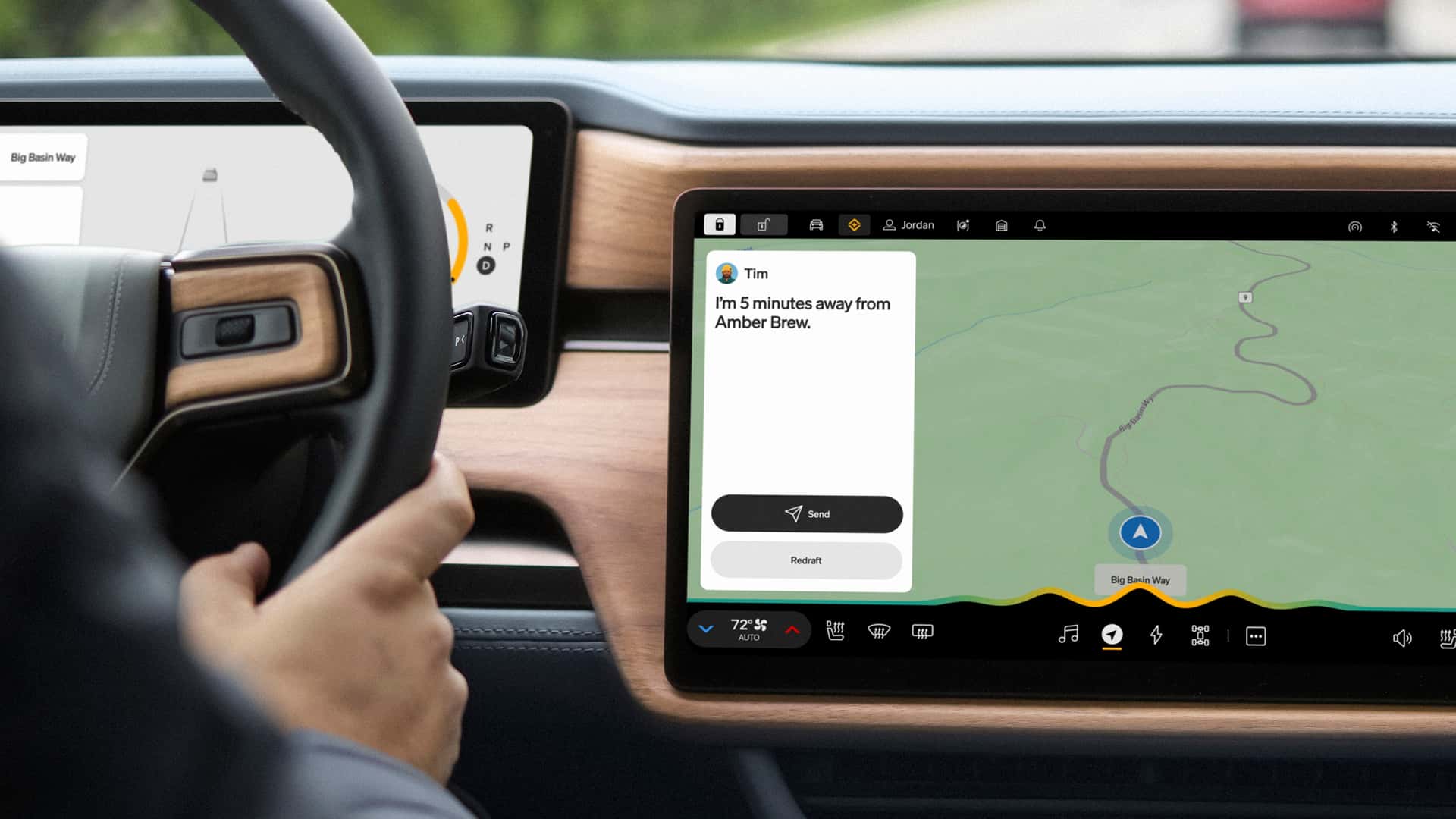
- Rivian’s proprietary AI voice assistant, the Rivian Assistant, is now rolling out to R1S and R1T vehicles via the latest over-the-air software update.
- The system offers natural-language processing, enabling more intuitive interactions than standard voice commands.
- Deeply integrated into the vehicle’s hardware and software, it leverages both in-house and external AI models.
- Features include adjusting drive modes, accessing vehicle cameras, providing navigation assistance, answering general knowledge questions, and acting as an in-car ‘encyclopedia’.
- Its ‘agentic capability’ allows complex, multi-step commands and integrates with services like Google Calendar for managing appointments and communications.
- The Rivian Assistant requires an active connectivity subscription and will also be available in the forthcoming R2 model.
In a significant leap forward for in-car technology, Rivian has officially commenced the rollout of its in-house artificial intelligence (AI) voice assistant, known as the Rivian Assistant. This advanced feature is being deployed to all R1S SUVs and R1T electric pickup trucks through the company’s latest over-the-air (OTA) software update, defying earlier projections for a 2026 launch.
The introduction of the Rivian Assistant marks a pivotal moment in the electric vehicle (EV) manufacturer’s strategy to enhance the user experience through sophisticated, natural-language interaction. This initiative aligns with a broader industry trend of integrating advanced AI chatbot technology into vehicles, aimed at transforming how drivers and passengers interact with their cars.
Accelerated Rollout and Availability
The announcement on Tuesday confirmed that the Rivian Assistant is now accessible to owners of Gen 1 and Gen 2 R1S and R1T vehicles. This rollout is a direct result of the company’s commitment to continuous innovation, delivering on a promise made during its Autonomy & AI Day in December, albeit significantly ahead of schedule.
Access to the Rivian Assistant requires an active connectivity subscription, ensuring that users can leverage its full range of cloud-dependent functionalities. Looking ahead, Rivian has also confirmed that the R2, its eagerly anticipated new model, will launch with the Rivian Assistant integrated, further expanding the reach of this cutting-edge technology.
Beyond Basic Voice Commands: Deep Integration and Natural Language
What distinguishes the Rivian Assistant from conventional voice control systems is its deep integration into the vehicle’s core architecture. Unlike basic tools often limited to phone-mirroring applications, this system is embedded directly within Rivian’s hardware and software ecosystem.
This fundamental integration allows the Rivian Assistant to interact seamlessly with nearly every aspect of the vehicle. The company articulated this advantage, stating, “Unlike basic voice command tools found in phone-mirroring systems, Rivian Assistant is built directly into your vehicle’s hardware and software, providing the unique power to talk to every aspect of the vehicle and get things done for you.” The assistant utilizes a combination of Rivian’s proprietary in-house AI models and external AI frameworks to power its diverse range of tasks.
This approach moves beyond rigid, pre-programmed phrases, enabling a much more natural and intuitive conversational experience. Drivers can now speak to their Rivian vehicles using everyday language, expecting the system to understand context and intent, much like interacting with a human assistant.
Advanced Capabilities for Enhanced Driving
The functional scope of the Rivian Assistant is extensive, offering a comprehensive suite of features designed to simplify and enrich the driving experience. Users can activate the assistant by simply saying “Hey Rivian” or pressing a dedicated button on the steering wheel.
Among its many capabilities, the system allows for the adjustment of drive modes, providing a hands-free way to adapt the vehicle’s performance to different terrains or driving conditions. It can also display feeds from vehicle cameras, offering quick access to vital visual information without manual menu navigation.
Furthermore, the Rivian Assistant enhances navigation and point-of-interest discovery. Drivers can inquire about nearby landmarks, restaurants, or other destinations, receiving information verbally and visually. Crucially, the system demonstrates an ability to remember previous conversational context, facilitating more fluid and continuous interactions.
Beyond vehicle-specific functions, the assistant is equipped to answer general knowledge questions, akin to popular AI chatbots like ChatGPT. This means it can serve as a valuable resource for information on a wide array of topics, directly accessible within the vehicle environment.
Your Vehicle’s Encyclopedia and Agentic Intelligence
Rivian also positions its AI assistant as “an encyclopedia for your vehicle.” This innovative feature eliminates the need to consult physical owner’s manuals or digital documents for routine queries. Drivers can simply ask their vehicle for instructions on tasks such as “how to change a tire,” receiving immediate and relevant guidance.
Perhaps one of the most transformative aspects of the Rivian Assistant is its “agentic capability.” This refers to its ability to connect with and manage various external services, performing complex, multi-step actions on behalf of the user. Rivian has announced that the first such integration is with Google Calendar, showcasing the practical application of this advanced intelligence.
Through this integration, Rivian owners who link their Google accounts can manage their schedules entirely by voice while on the road. This includes moving meetings, navigating directly to appointments, and relaying calendar information via text messages. Such functionality underscores a move towards a truly proactive and helpful in-car AI, designed to streamline daily tasks and keep drivers connected and organized.
Competitive Landscape and Future Outlook
Rivian’s foray into advanced in-car AI places it squarely in a competitive landscape where other major automotive players are also making significant strides. General Motors, Volvo, and Polestar, for instance, have recently integrated Google Gemini into their vehicles, while newer Tesla models feature xAI’s Grok.
However, Rivian’s emphasis on deep, native integration into its vehicle’s hardware and software aims to offer a distinct advantage, promising a more seamless and powerful user experience compared to systems that might rely more heavily on external device mirroring or less integrated AI solutions.
The Rivian Assistant represents a significant step towards creating a more intuitive, intelligent, and interconnected driving experience. As electric vehicle technology continues to evolve, advanced voice AI like the Rivian Assistant will play an increasingly critical role in defining the future of smart mobility and user engagement within the digital cockpit. Rivian owners are encouraged to explore this new feature and provide feedback as it enhances their daily driving interactions.
FAQ
Q1: What is the Rivian Assistant?
The Rivian Assistant is an in-house developed AI voice assistant rolling out via an over-the-air software update. It provides natural-language interaction, allowing drivers to control vehicle functions and access information more intuitively.
Q2: Which Rivian models will receive the AI voice assistant?
The Rivian Assistant is currently rolling out to all Gen 1 and Gen 2 R1S SUVs and R1T electric pickup trucks. It is also slated to be available in the upcoming Rivian R2 model upon its launch.
Q3: What kind of commands can the Rivian Assistant execute?
It can adjust drive modes, display vehicle camera feeds, provide information on points of interest, answer general knowledge questions, and act as an owner’s manual. It also supports complex, multi-step commands and remembers conversational context.
Q4: Does the Rivian Assistant require a subscription?
Yes, to access the full functionalities of the Rivian Assistant, owners must have an active connectivity subscription. This ensures seamless access to cloud-based services and features.
Q5: How does the Rivian Assistant differ from other in-car AI systems?
Rivian emphasizes that its assistant is deeply integrated into the vehicle’s hardware and software, using both in-house and external AI models. This allows for more comprehensive vehicle control and advanced agentic capabilities compared to basic phone-mirroring systems or less integrated third-party AIs.
Q6: What are the ‘agentic capabilities’ of the Rivian Assistant?
Agentic capabilities refer to the assistant’s ability to connect with and manage external services. The first announced integration is with Google Calendar, allowing users to manage meetings, navigate to appointments, and relay calendar information via voice commands.