
Key Takeaways:
- Rivian has launched its in-house artificial intelligence (AI) voice assistant, branded as the “Rivian Assistant.”
- The new feature is being deployed to R1S and R1T electric vehicles through the company’s latest over-the-air software update.
- The Rivian Assistant offers advanced natural language understanding, deep vehicle integration, and includes “agentic capabilities” such as Google Calendar integration.
- Drivers can use the assistant for complex, multi-step commands and access vehicle information as an on-demand “encyclopedia.”
- This innovative system will also be available in the forthcoming Rivian R2 model and requires an active connectivity subscription.
A New Era of In-Vehicle Interaction Arrives for Rivian Owners
Rivian, the burgeoning electric vehicle (EV) manufacturer, has officially commenced the rollout of its highly anticipated in-house AI voice assistant, the Rivian Assistant. This significant technological advancement, initially previewed at the company’s Autonomy & AI Day in December, is now reaching R1S and R1T owners through the latest over-the-air software update, marking a pivotal moment in the evolution of in-vehicle human-machine interface. This update delivers on Rivian’s commitment to enhancing the digital experience for its drivers.
The introduction of the Rivian Assistant positions the brand at the forefront of a growing trend within the automotive industry, where sophisticated AI chatbot technology is increasingly integrated into vehicles. This move aims to provide a more intuitive and natural way for drivers and passengers to interact with their electric trucks and SUVs, moving beyond traditional, rigid voice command systems.
Beyond Basic Commands: The Power of Natural Language
The core of the Rivian Assistant’s appeal lies in its sophisticated natural language capabilities, which represent a substantial leap forward from conventional voice recognition systems. These legacy systems typically confine users to a limited set of vehicle functions and demand precise, often unnatural, phrasing to execute commands.
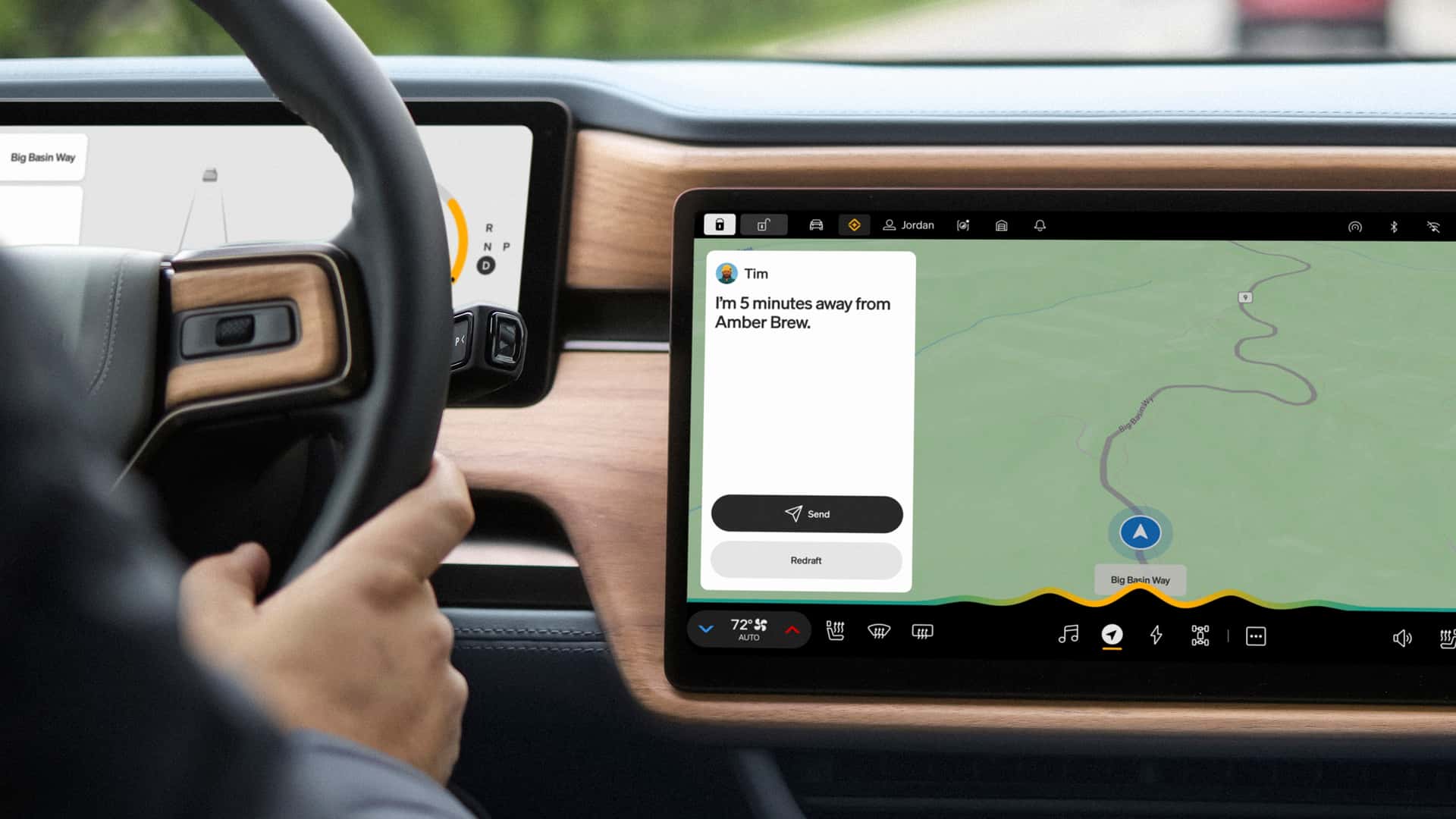
In contrast, the Rivian Assistant is engineered to understand and process more complex, conversational requests. Drivers can activate the system by simply saying “Hey Rivian” or pressing a designated button on the steering wheel. This allows for fluid interaction to manage various vehicle functions, from adjusting drive modes to accessing vehicle cameras or even inquiring about points of interest along a route. The system is designed to seamlessly integrate these functionalities into the driver’s flow, enhancing overall control and convenience.
One of the most compelling aspects demonstrated during earlier previews of the Rivian Assistant was its capacity for handling multi-step commands. For instance, a driver could theoretically string together a sequence of actions, such as sending a friend a curated list of restaurant recommendations directly from the navigation system, alongside an estimated time of arrival (ETA), all through a single voice prompt. Furthermore, the assistant retains conversational context, allowing for follow-up questions and more dynamic interactions, similar to popular AI chatbot tools like ChatGPT, thereby providing a richer in-car experience.
Deep Integration: Rivian’s Distinctive Approach to AI
What truly distinguishes the Rivian Assistant in a crowded market is its profound level of integration within the vehicle’s architecture. Unlike many basic voice command tools that often rely on phone-mirroring systems, Rivian’s solution is deeply embedded into both the vehicle’s hardware and software infrastructure. This fundamental integration ensures that the assistant possesses unparalleled access and control over various vehicle systems, promising a cohesive and responsive user experience.
The company underscored this commitment in a recent press release, stating: “Unlike basic voice command tools found in phone-mirroring systems, Rivian Assistant is built directly into your vehicle’s hardware and software, providing the unique power to talk to every aspect of the vehicle and get things done for you.” This intrinsic design allows the Rivian Assistant to deliver a level of functionality and immediacy that externally linked systems often cannot match, leveraging a combination of in-house developed and external AI models to power its diverse range of tasks.
Agentic Capabilities: Seamless Digital Life Integration
A hallmark feature that sets the Rivian Assistant apart is its “agentic capability,” allowing it to actively connect and interact with external services. The initial integration highlights this advanced functionality through its seamless link with Google Calendar. This means Rivian owners who opt to connect their Google accounts can manage their schedules directly from their vehicle, using only their voice.
While driving, users can effortlessly move scheduled meetings, navigate directly to upcoming appointments, or relay crucial calendar information via text messages. This deep integration transforms the vehicle into a productive extension of one’s digital life, enhancing convenience and safety by minimizing manual interaction with screens while on the road. Rivian has also indicated plans to progressively connect additional services to the assistant over time, promising an expanding ecosystem of integrated functionalities.
Your Vehicle as an Encyclopedia: On-Demand Information
Beyond active task management, the Rivian Assistant also serves as an invaluable source of information, effectively transforming the vehicle into “an encyclopedia for your vehicle.” This innovative feature allows drivers to quickly access detailed information about their vehicle’s operation, maintenance, and features without having to consult a physical owner’s manual or navigate through complex digital menus.
Imagine needing to understand how to change a tire or troubleshoot a specific setting while on a journey. Instead of pulling over and flipping through a manual, a driver can simply ask the Rivian Assistant. This on-demand access to vehicle-specific knowledge not only saves time but also significantly improves the user experience by making essential information readily available and digestible, further strengthening the appeal of the Rivian Assistant as a comprehensive in-car companion.
The Broader Landscape: AI Integration in the Automotive Sector
Rivian’s strategic move into advanced in-vehicle AI voice assistance mirrors a broader trend sweeping across the global automotive industry. Major manufacturers are increasingly investing in and deploying sophisticated AI technologies to elevate the user experience, moving past rudimentary voice controls towards more intelligent and context-aware systems.
For instance, General Motors, Volvo, and Polestar recently announced their vehicles would gain access to Google Gemini, Google’s advanced AI model, offering enhanced conversational capabilities. Similarly, newer Tesla models are integrating xAI’s Grok, bringing another layer of AI-driven interaction to their vehicles. This competitive landscape underscores the growing importance of AI in defining the next generation of in-car technology, with manufacturers vying to offer the most intuitive, integrated, and feature-rich digital cockpits. The Rivian Assistant is a direct response to this demand for more intelligent and integrated vehicle systems, aiming to set a new benchmark for natural language interaction in electric vehicles.
Availability and Connectivity Requirements
The Rivian Assistant is now being deployed to all Generation 1 and Generation 2 R1S SUVs and R1T pickup trucks. This ensures that current owners of Rivian’s flagship models can benefit from the enhanced AI capabilities provided by this new software update. Looking ahead, the Rivian Assistant is also slated to be a foundational feature in the highly anticipated R2 model when it launches to customers in the coming weeks, promising a consistent and advanced user experience across Rivian’s product line.
It is important for owners to note that access to the full suite of features offered by the Rivian Assistant requires an active connectivity subscription. This subscription ensures that the vehicle can maintain the necessary data connection to power the AI models, access external services like Google Calendar, and receive future updates that will further enhance the assistant’s capabilities.
FAQ Section
What is the Rivian Assistant?
The Rivian Assistant is an in-house AI voice assistant developed by Rivian, designed to provide natural language interaction and deeply integrated control over vehicle functions. It enhances the in-car experience by understanding complex commands and integrating with external services.
Which Rivian vehicles support the new AI voice assistant?
The Rivian Assistant is rolling out to all Generation 1 and Generation 2 R1S SUVs and R1T pickup trucks. It will also be included in the upcoming Rivian R2 model when it launches to customers.
What are the key features of the Rivian Assistant?
Key features include natural language understanding, the ability to execute complex multi-step commands, deep integration with vehicle hardware and software, and agentic capabilities such as Google Calendar integration. It also serves as an “encyclopedia” for vehicle information.
How does Rivian Assistant compare to other in-car AI systems?
Unlike basic phone-mirroring voice tools, the Rivian Assistant is built directly into the vehicle’s systems, offering deeper control and functionality. It competes with other advanced AI integrations like Google Gemini in GM/Volvo/Polestar vehicles and xAI’s Grok in newer Teslas.
Is a subscription required to use Rivian Assistant?
Yes, an active connectivity subscription is required for Rivian owners to access and utilize the full range of features and functionalities offered by the Rivian Assistant.
What are “agentic capabilities” in Rivian Assistant?
Agentic capabilities refer to the Rivian Assistant’s ability to connect with and perform actions through external services. The first example is its integration with Google Calendar, allowing users to manage appointments, navigate, and relay information using voice commands.