
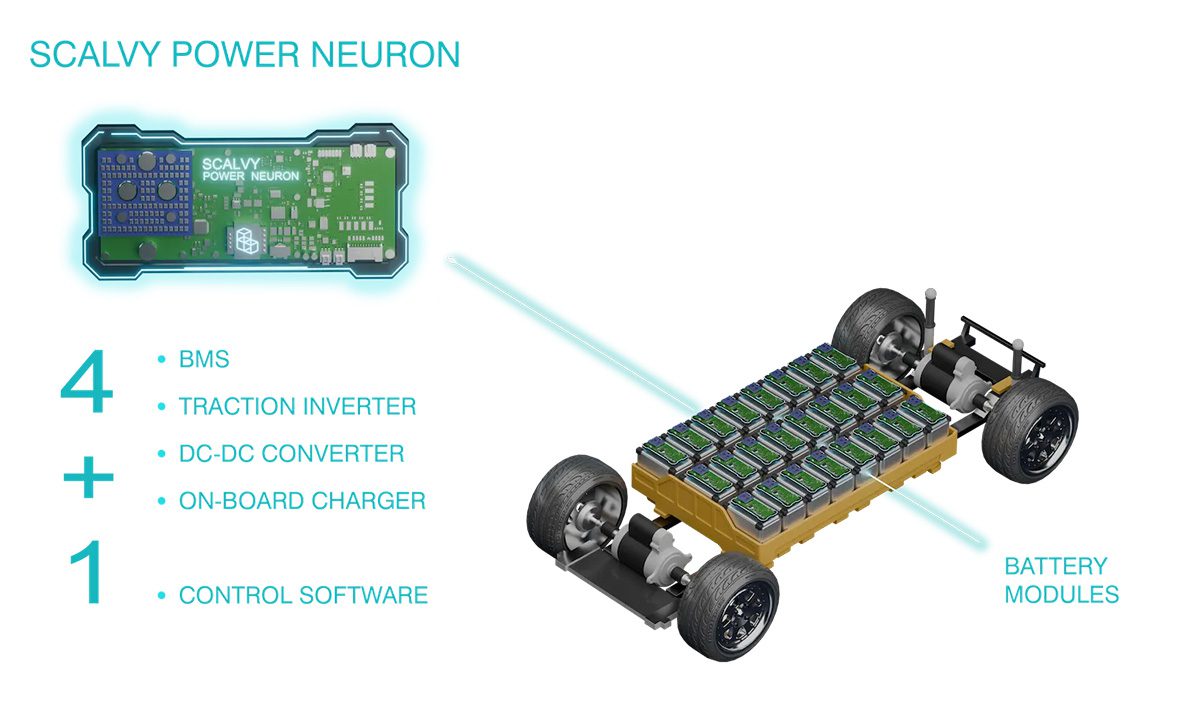
In a significant development for the electric vehicle (EV) industry, Scalvy has announced that a joint concept evaluation with automotive technology leader Valeo has successfully validated its innovative modular battery-integrated power architecture. Conducted under stringent Worldwide Harmonized Light Vehicles Test Cycle (WLTC) operating conditions, this validation marks a crucial step toward the widespread automotive deployment of Scalvy’s pioneering distributed ‘Power Neuron’ platform.
This breakthrough in EV battery architecture challenges conventional designs by integrating critical power electronics directly into the battery modules. The successful evaluation underscores the potential for substantial advancements in vehicle performance, energy efficiency, and overall battery longevity for a new generation of electric vehicles.

Revolutionising EV Power Management
Traditionally, electric vehicles rely on a centralised system for their power electronics, comprising separate inverters, DC-DC converters, and onboard chargers. These components are typically housed in a single, often bulky unit, which can introduce inefficiencies and limitations in terms of packaging and thermal management. Scalvy’s ‘Power Neuron’ platform, however, represents a fundamental shift in this design philosophy.
Instead of a centralised approach, Scalvy’s innovative EV battery architecture distributes these essential functions into compact, modular units positioned at the edge of each battery pack. This decentralised configuration offers multiple advantages, primarily by reducing switching and conduction losses inherent in more traditional, centralised systems. Furthermore, this modular design inherently makes the system highly scalable, enabling its seamless integration across a diverse range of vehicle classes and adapting to various battery chemistries.
Understanding Switching and Conduction Losses
Switching losses occur whenever power electronic devices, such as transistors, switch between on and off states. During these transitions, there is a brief period where both voltage and current are non-zero, leading to energy dissipation as heat. Conduction losses, on the other hand, refer to the power dissipated as heat when current flows through the resistive elements of a power device while it is in its ‘on’ state.

By distributing these functions closer to the power source and load, Scalvy’s architecture minimises the distance electrical energy must travel and optimises the switching behaviour, thereby directly contributing to a reduction in these efficiency-sapping losses. This fundamental redesign contributes significantly to the overall efficiency improvements observed in the validation tests.
Rigorous Validation: Performance Under WLTC
The concept evaluation was meticulously conducted in a laboratory setting under WLTC operating conditions. The WLTC is a global standard for measuring fuel consumption and emissions from light-duty vehicles, including EVs. It simulates real-world driving scenarios more accurately than previous test cycles, incorporating various speeds, accelerations, and decelerations. Validating under WLTC conditions provides a reliable indication of how the technology would perform in typical automotive use.
During these rigorous tests, Scalvy’s system demonstrated exceptional performance, achieving a peak inverter efficiency of an impressive 98.3%. This remarkable figure was recorded at 10,000 rpm and 65 Nm, highlighting the system’s ability to convert direct current (DC) from the battery into alternating current (AC) for the electric motor with minimal energy loss. Such high efficiency directly translates into more available power for propulsion, potentially extending an EV’s range and improving its overall energy consumption.
Advanced Thermal and State-of-Charge Management
Beyond raw efficiency, the evaluation also highlighted the sophistication of Scalvy’s thermal and state-of-charge (SOC) management systems. Effective thermal management is paramount in EVs, as excessive heat can degrade battery performance and longevity, as well as compromise the reliability of power electronics. The test results showed that the system maintained motor temperatures below 62 °C and power-device temperatures below 65 °C, critically, without any hotspot formation.
Thermal hotspots are localised areas of significantly higher temperature within a component or battery pack. These can accelerate degradation, lead to uneven wear, and in severe cases, pose safety risks. The absence of hotspot formation under demanding conditions underscores the robustness and intelligent design of Scalvy’s distributed power electronics and cooling strategies.
The Critical Role of SOC Balancing
Another crucial aspect validated was module-level state-of-charge balancing. The SOC represents the remaining electrical energy in a battery relative to its maximum capacity. In a multi-module battery pack, maintaining consistent SOC across all modules is vital. If some modules are overcharged or undercharged relative to others, it can lead to reduced overall pack capacity, premature degradation of individual cells, and a shortened lifespan for the entire battery.
Scalvy reported that its system kept SOC deviation between battery modules negligible throughout the testing. This precise balancing act ensures that each battery module is utilised optimally, preventing stress on individual components and contributing significantly to the pack’s overall health and operational lifespan. This intelligent management of each module is a cornerstone of their advanced EV battery architecture.
Beyond Efficiency: Extending EV Battery Life
The combined benefits of tight SOC balancing and the system’s pulse-like distributed switching mechanism lead to a significant reduction in localised electrical and thermal stress across the battery pack. Electrical stress, such as high current density or voltage spikes, and thermal stress, from excessive heat, are primary contributors to battery degradation over time.
By mitigating these stresses at a granular, module level, Scalvy’s EV battery architecture not only enables faster charging capabilities but also significantly extends the overall life of the battery pack. The company projects that this technology could extend battery life by up to 15%. This longevity improvement has profound implications for consumers, potentially reducing the total cost of EV ownership and addressing concerns about battery replacement costs and environmental impact associated with shorter battery lifespans. Furthermore, a longer-lasting battery supports the circular economy by delaying the need for recycling or second-life applications.
Industry Endorsement and Future Deployment
The positive results from the joint evaluation have garnered strong industry endorsement. Farouk Boudjemai of Valeo expressed optimism regarding the findings, stating that the results were “highly encouraging” and would play a pivotal role in advancing the concept’s readiness level for commercial application. Valeo’s involvement as a collaborator lends significant credibility to Scalvy’s claims, given its standing as a global automotive supplier and technology partner.
Looking ahead, Scalvy is actively engaged in field-testing its advanced EV battery architecture with a selection of key customers. This crucial phase will gather real-world performance data and refine the technology further before large-scale production. The company has set an ambitious target for commercial production to commence in 2027, signalling its intent to bring this transformative technology to the mainstream automotive market in the near future.
The Road Ahead for EV Battery Architecture
The advancements demonstrated by Scalvy’s modular EV battery architecture underscore a broader industry trend towards more sophisticated and integrated power solutions for electric vehicles. As the global push for electrification intensifies, innovations that promise higher efficiency, extended battery life, and enhanced thermal management will be critical enablers for widespread EV adoption.
This technology has the potential to influence future design paradigms for EV powertrains, offering manufacturers greater flexibility in vehicle design and performance optimisation. The pursuit of more robust, efficient, and durable battery systems remains a central focus for the EV sector, and Scalvy’s ‘Power Neuron’ platform represents a compelling step forward in achieving these ambitious goals.