
Key Takeaways
- Tesla has detailed its ambitious plans for a Tesla robotaxi service, aiming for a hybrid operational model akin to ‘Airbnb and Uber’.
- The automaker intends to operate a significant portion of the autonomous fleet itself, while also allowing individual Tesla owners to integrate their vehicles into the network.
- Owners will have granular control over their car’s availability, choosing to offer rides to friends, highly-rated users, or the general public.
- The service hinges on Tesla’s ‘vision-only architecture’ and end-to-end neural networks, trained on extensive real-world driving data.
- While showcasing future app functionality, the company acknowledges that the full deployment of a fully autonomous ride-hailing system is still a significant challenge.
NEW DELHI — Tesla, the electric vehicle titan, has offered a clearer glimpse into its long-anticipated Tesla robotaxi service during its first-quarter earnings call. The highly anticipated announcement on April 23, 2024, by CEO Elon Musk detailed a unique operational model combining elements of popular ride-hailing and accommodation-sharing platforms, effectively merging ‘Airbnb and Uber’ into a single autonomous mobility solution.
This strategic reveal comes as investors and analysts sought specifics regarding the company’s future trajectory, particularly in light of recent reports suggesting a pivot towards autonomous vehicles over more affordable consumer models. While Tesla affirmed its commitment to accelerating the launch of new, including more affordable, vehicles, the emphasis on its ride-hailing aspirations underscores a significant directional shift in its long-term vision for urban transportation.
Musk’s Vision: A Hybrid Fleet Management System
Elon Musk outlined a two-pronged approach for the forthcoming Tesla robotaxi service. A core component of the network will be directly operated by Tesla, deploying its own fleet of self-driving electric vehicles. This strategy aims to ensure consistent service quality and availability, while potentially leveraging economies of scale in maintenance and charging infrastructure.
Beyond the corporate fleet, individual Tesla owners will play a pivotal role in expanding the network’s reach and capacity. Musk explained, “They can decide if they want to only let the car be used by friends and family, or only by five-star users or by anyone.” This innovative model grants owners unprecedented flexibility, allowing them to “add or subtract their cars from the fleet whenever they want.”
This proposed framework positions Tesla at the intersection of private vehicle ownership and shared mobility. By enabling owners to monetise their idle vehicles, Tesla aims to create a decentralised, yet integrated, autonomous ride-hailing ecosystem. The potential for owners to generate income from their vehicles could also influence future purchase decisions, adding a compelling financial incentive to Tesla ownership.
The Technological Backbone: Vision-Only Autonomy
Tesla’s first-quarter earnings report elaborated on the technological underpinnings vital for the Tesla robotaxi service. The company has been “investing in the hardware and software ecosystems necessary to achieve vehicle autonomy and a ride-hailing service.” This investment primarily focuses on advancing its proprietary autonomous driving systems.
A key highlight from the report is Tesla’s belief that “a scalable and profitable autonomy business can be realized through a vision-only architecture with end-to-end neural networks, trained on billions of miles of real-world data.” This approach relies exclusively on cameras and advanced artificial intelligence to perceive the environment and navigate, diverging from many competitors who integrate lidar and radar sensors.
The development of robust end-to-end neural networks, processing vast datasets of real-world driving scenarios, is crucial for enhancing the reliability and safety of autonomous vehicles. Tesla’s commitment to this vision-centric strategy represents a significant technological gamble, requiring continuous refinement and validation to meet the stringent demands of driverless operations in diverse urban environments.
Previewing the Ride-Hailing Interface
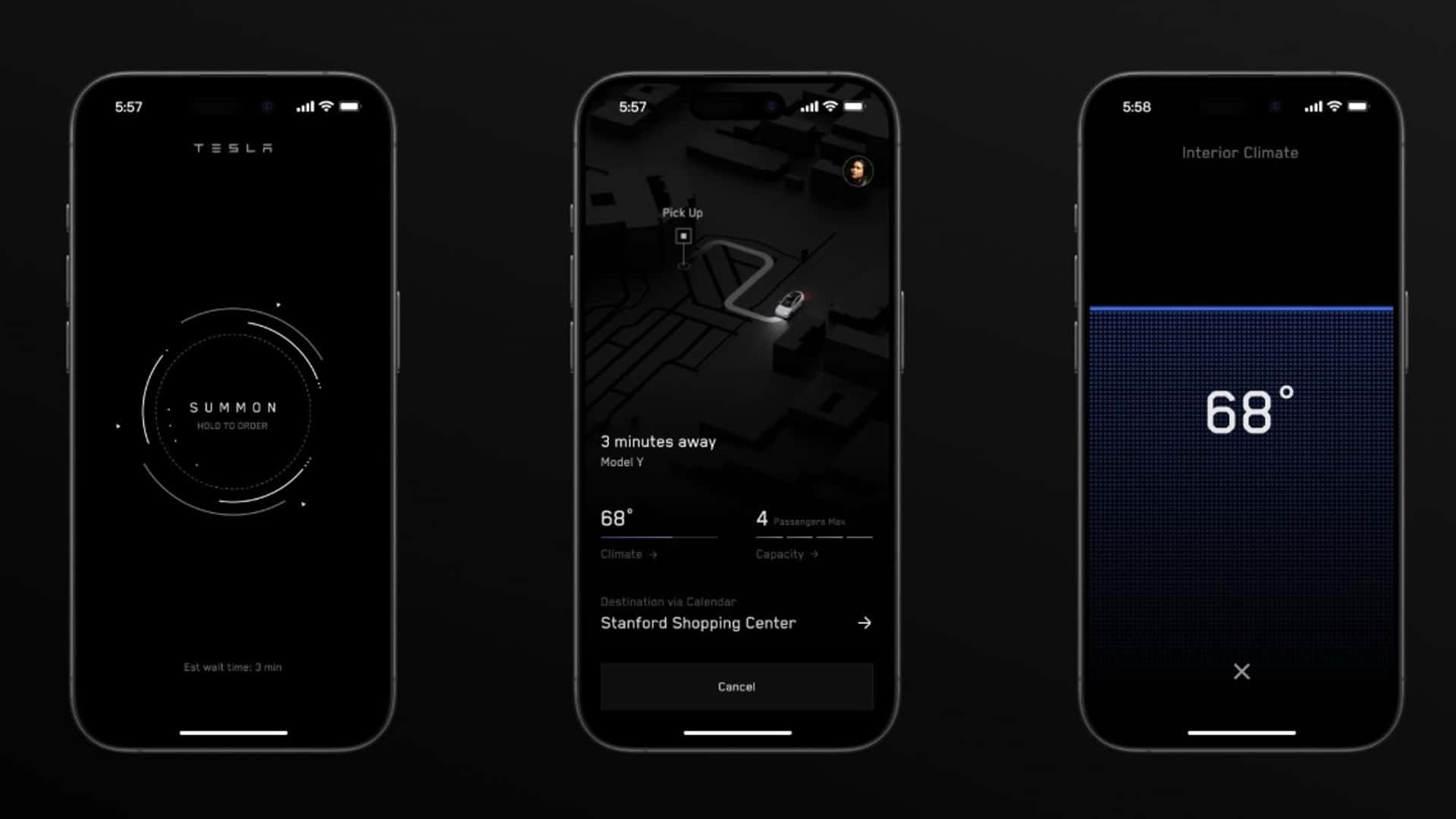
Accompanying the announcements, Tesla released renderings offering a preliminary look at how the ride-hailing functionality might be integrated into the existing Tesla app. The preview highlighted a prominent “Summon” button, presumably the primary interface for users to request an autonomous taxi.
One screen within the renderings displayed a temperature of 68 degrees, hinting at the possibility for customers to pre-set climate control settings within their designated robotaxi before arrival. While these details are currently scant, they provide a glimpse into the anticipated user experience, emphasising convenience and personalised comfort within the futuristic mobility service.
The development of a seamless and intuitive user interface will be critical for widespread adoption of the Tesla robotaxi service. Ensuring a smooth interaction from booking to arrival and departure, along with advanced features like climate control, will be essential in differentiating Tesla’s offering in a competitive future mobility landscape.
Strategic Realignment and Investor Confidence
The renewed emphasis on the Tesla robotaxi service appears to be a strategic move designed to reassure investors amidst fluctuating market sentiment. Following a Reuters report indicating a potential shift from a cheaper consumer car, the company swiftly articulated its plans for future product launches, stating an acceleration in the timing of “new vehicles, including more affordable models,” with the robotaxi arriving later.
This dual announcement suggests Tesla is balancing the immediate market demand for accessible electric vehicles with its long-term vision for autonomous transportation. The detailed roadmap for ride-hailing is intended to underscore a clear future growth engine and a path to enhanced profitability, particularly as competition in the EV sector intensifies globally.
The promise of a scalable and profitable autonomy business aims to provide a compelling narrative for sustained investor confidence. By detailing the revenue streams from both Tesla-owned and owner-operated vehicles, the company seeks to demonstrate a robust business model for its advanced self-driving technology.
Challenges and Historical Context
Despite the ambitious unveiling, the successful deployment of the Tesla robotaxi service faces significant hurdles. A primary concern remains Tesla’s Full Self-Driving (FSD) feature, which, despite its name and high price tag, still requires active driver supervision and has been observed making mistakes in real-world scenarios.
Critics and industry observers frequently point to CEO Elon Musk’s past projections regarding autonomous capabilities. Notably, Musk famously declared in 2019 that Tesla would have 1 million robotaxis on the road by 2020—a target that went unfulfilled. Such historical context invites a cautious assessment of new timelines and claims surrounding Tesla’s autonomous driving progress.
The journey from advanced driver-assistance systems to fully autonomous, unsupervised operation is fraught with complex technical, regulatory, and ethical challenges. Achieving Level 4 or Level 5 autonomy, which is necessary for a true robotaxi service, demands impeccable safety records and regulatory approvals that are still evolving across jurisdictions worldwide. Therefore, while the idea of a Tesla taxi business is intriguing, the company’s past grand pronouncements serve as a reminder for tempered expectations.
Outlook for the Future of Mobility
The introduction of a widespread Tesla robotaxi service, if successful, could fundamentally reshape the urban mobility landscape. By offering a convenient, potentially cost-effective, and environmentally friendly transportation alternative, it could reduce individual car ownership, alleviate traffic congestion, and lower carbon emissions in metropolitan areas.
However, the transition to such an autonomous future is not merely a technological race. It involves navigating complex regulatory frameworks, addressing public perception and trust in driverless vehicles, and developing robust support infrastructure for maintenance, charging, and dynamic fleet management. Tesla’s detailed roadmap marks a significant step, but the path ahead will undoubtedly require persistent innovation and meticulous execution.
Frequently Asked Questions About Tesla’s Robotaxi Service
What is Tesla’s new robotaxi service plan?
Tesla announced plans for a robotaxi service operating as a hybrid model, combining company-owned autonomous vehicles with private Tesla owners who can add their cars to the fleet. CEO Elon Musk described it as a blend of ‘Airbnb and Uber’, allowing owners to earn income from their vehicles while Tesla manages a core fleet.
How will individual Tesla owners participate in the robotaxi fleet?
Tesla owners will be able to opt into the robotaxi service, allowing their self-driving cars to operate autonomously as taxis. They will have control over when their cars join or leave the fleet and can specify user preferences, such as limiting rides to friends and family or highly-rated users, offering significant flexibility.
What technology will power the Tesla robotaxi service?
The service will be powered by Tesla’s vision-only architecture, relying on cameras and sophisticated end-to-end neural networks. These AI systems are trained on billions of miles of real-world driving data to achieve vehicle autonomy. This approach aims for a scalable and profitable self-driving business without additional sensor types like lidar.
When is the Tesla robotaxi service expected to launch?
Tesla indicated that the ride-hailing functionality will be available “in the future” and that the robotaxi itself would arrive later than new, more affordable vehicle models. No specific launch date was provided during the Q1 earnings call, suggesting a multi-year timeline for full deployment of the autonomous service.
What are the main challenges facing Tesla’s robotaxi ambitions?
Key challenges include achieving true full self-driving capability, as Tesla’s current FSD system still requires driver supervision and makes errors. Overcoming regulatory hurdles for widespread autonomous operation and building public trust in driverless technology are also significant obstacles, compounded by CEO Elon Musk’s past unfulfilled promises regarding robotaxi deployment.
How does this robotaxi plan differ from Tesla’s Full Self-Driving (FSD) feature?
While the robotaxi service leverages FSD technology, the key difference is the intent for fully unsupervised, revenue-generating autonomous operation. FSD currently functions as an advanced driver-assistance system that requires constant human supervision. The robotaxi service aims for Level 4 or 5 autonomy, where human intervention is not typically required.