
Key Takeaways
- A recent “Electrification 101” program by Toyota Motor North America revealed that many employees, even within an automotive giant, lacked fundamental knowledge about electric vehicles (EVs) and hybrid technology.
- The training aimed to bridge this knowledge gap, educating staff members who may not be traditional “car enthusiasts” but are crucial to the company’s future strategy.
- Toyota champions a “multi-pathway” approach, emphasizing hybrids currently, with a long-term view towards EVs and hydrogen fuel cell vehicles (FCEVs).
- The program dispelled common EV myths, highlighted the efficiency and environmental benefits of electrification, and included interactive sessions to demonstrate core electric motor principles.
- Employee education is critical for fostering internal advocacy and driving long-horizon decisions, transforming staff into proponents for an electrified future.
As industry observers, it is often easy to become engrossed in the intricate debates surrounding electric vehicles (EVs) and the broader electrification movement. We follow every company’s strategic moves, assess their anxieties, and understand the rationale behind their electrification efforts. This immersion frequently leads to an assumption that all individuals within major automotive firms share a similar depth of understanding regarding these critical philosophical and technical shifts.
However, a recent experience at Toyota Motor North America’s “Electrification 101” program offered a profound reality check. It underscored a significant, yet not disheartening, truth: the average employee at a legacy automaker often possesses limited knowledge about electrification or its inherent advantages.

This revelation, far from being discouraging, highlights a crucial area for growth and strategic investment within the automotive sector, demonstrating the importance of internal education as the industry pivots towards sustainable mobility solutions.
Bridging the Knowledge Gap: Why “Electrification 101” Matters
Toyota, as a global automotive leader, acutely recognizes that not every individual working within its corporate offices, such as those in Plano, Texas, is an inherent expert on electrification. While many may perceive employees of an automotive giant as dedicated car enthusiasts, this perception does not always align with reality.
Many professionals join such a prestigious corporation for its comprehensive benefits, career stability, respectful workplace culture, and the professional gravitas associated with working for the world’s largest automaker. For an accountant managing corporate finances or an app developer crafting digital solutions, a deep-seated passion for automotive intricacies, especially the highly technical realm of electric vehicle technology, is not a prerequisite for their roles.

Even among those who identify as car enthusiasts, their interests may not necessarily extend to the specific nuances of electric vehicles or hybrid systems. For instance, explaining the differences between NCM (Nickel Cobalt Manganese) and LFP (Lithium Iron Phosphate) battery chemistries to a veteran V8 muscle car aficionado could easily elicit a bewildered response, illustrating the highly specialized and relatively nascent nature of this technological domain.
Recognizing this internal knowledge disparity, Toyota established the Electrification 101 program. This initiative is designed to equip curious staff members with foundational knowledge, ensuring they are well-informed about the company’s direction in sustainable mobility. This marks the second instance of such a class, following an earlier broader introduction to automotive fundamentals for employees, further cementing the notion that not all on campus are deeply immersed in product minutiae.
Toyota’s Multi-Pathway Approach to Electrification
The program’s nomenclature, “Electrification 101” rather than “EV 101,” is strategically chosen and reflective of Toyota’s broader corporate philosophy. The company is a staunch advocate for a “multi-pathway” approach, which signifies a deliberate and comprehensive focus on hybrid vehicles in the immediate term, while simultaneously developing capabilities in pure electric vehicles (EVs) and, notably, hydrogen fuel cell vehicles (FCEVs) for future deployment.
This strategy has yielded tangible results. In the most recent quarter, 56.8% of Toyota’s total sales comprised electrified vehicles, encompassing hybrids, EVs, plug-in hybrid vehicles (PHEVs), and hydrogen fuel cell vehicles. However, it is important to note that pure battery electric vehicles accounted for a smaller fraction, representing just 1.7% of these electrified sales, underscoring the current emphasis on hybrid models.
The training curriculum meticulously covered the fundamental principles of these diverse powertrain types, including a clear delineation between the operational mechanisms of conventional hybrids and plug-in hybrids. Despite Toyota’s significant current investment in hybrid technology, a substantial portion of the program’s focus was dedicated to demystifying electric vehicles and rectifying prevalent misconceptions.
Dispelling Myths and Highlighting Advantages
The educational module commenced by drawing a historical parallel, examining the nascent stages of the gasoline car industry in the early 20th century. At that time, a rudimentary infrastructure, limited public education, inconsistent service networks, and ambiguous road rules presented challenges. Owning a horse, for many, was a simpler and more predictable alternative. Yet, despite these initial hurdles, automobiles ultimately prevailed, illustrating the transformative power of emerging technologies.
The program then transitioned to articulating the numerous advantages of electrification, primarily focusing on enhanced efficiency and environmental cleanliness. A core tenet of Toyota’s “multi-pathway” advocacy is its argument that this diversified strategy represents the most judicious allocation of finite battery resources, enabling broader environmental impact. While this perspective is a subject of ongoing debate, with most research I’ve seen suggests that EVs are almost always the cleanest option on a life cycle basis, as further evidenced by articles like EV Myth Busted: No, They’re Not ‘Dirtier’ Than Gas Cars, Even If You Use Fossil Fuel Power and Yes, EVs Really Are Cleaner Than Gas Cars. Here’s By How Much.
One section of the program, which detailed the comparative advantages of each powertrain type, garnered particular attention from the author. It appeared to place a greater emphasis on the perceived limitations of EVs, rather than comprehensively addressing the additional maintenance requirements or the noise, vibration, and harshness (NVH) characteristics inherent to gasoline-powered vehicles. Concurrently, the module maintained a distinctly optimistic stance regarding the future potential of hydrogen technology.
A specific slide, for instance, suggested that hydrogen “can reduce ‘range anxiety’ as number of stations grow,” highlighting the Toyota Mirai’s capability of offering up to 402 miles per tank. While such range figures were indeed impressive during the early developmental phases of electric vehicles, the current automotive landscape is rapidly evolving. Today, a growing number of EVs available in the U.S. market already surpass this driving range, with many more advanced models anticipated in the near future.
Interactive Learning: Experiencing Electrification First-Hand
Beyond the classroom discussions, the remainder of the theoretical content was largely unbiased, concentrating on fundamental principles. This included a comprehensive overview of battery chemistries, the diverse types of charging infrastructure, and core electrical concepts such such as kilowatts and kilowatt-hours. The program also shed light on ongoing battery recycling initiatives, emphasizing a full lifecycle approach to sustainable mobility.
The most compelling segment of the training was undoubtedly the interactive component. Here, employees engaged in hands-on activities, including constructing a basic electric motor using only a screw, a magnet, a AA battery, and a piece of wire. Participants also assembled a rudimentary potato-based battery and observed various charging outputs in real-time, providing a practical understanding of electrical generation and storage.
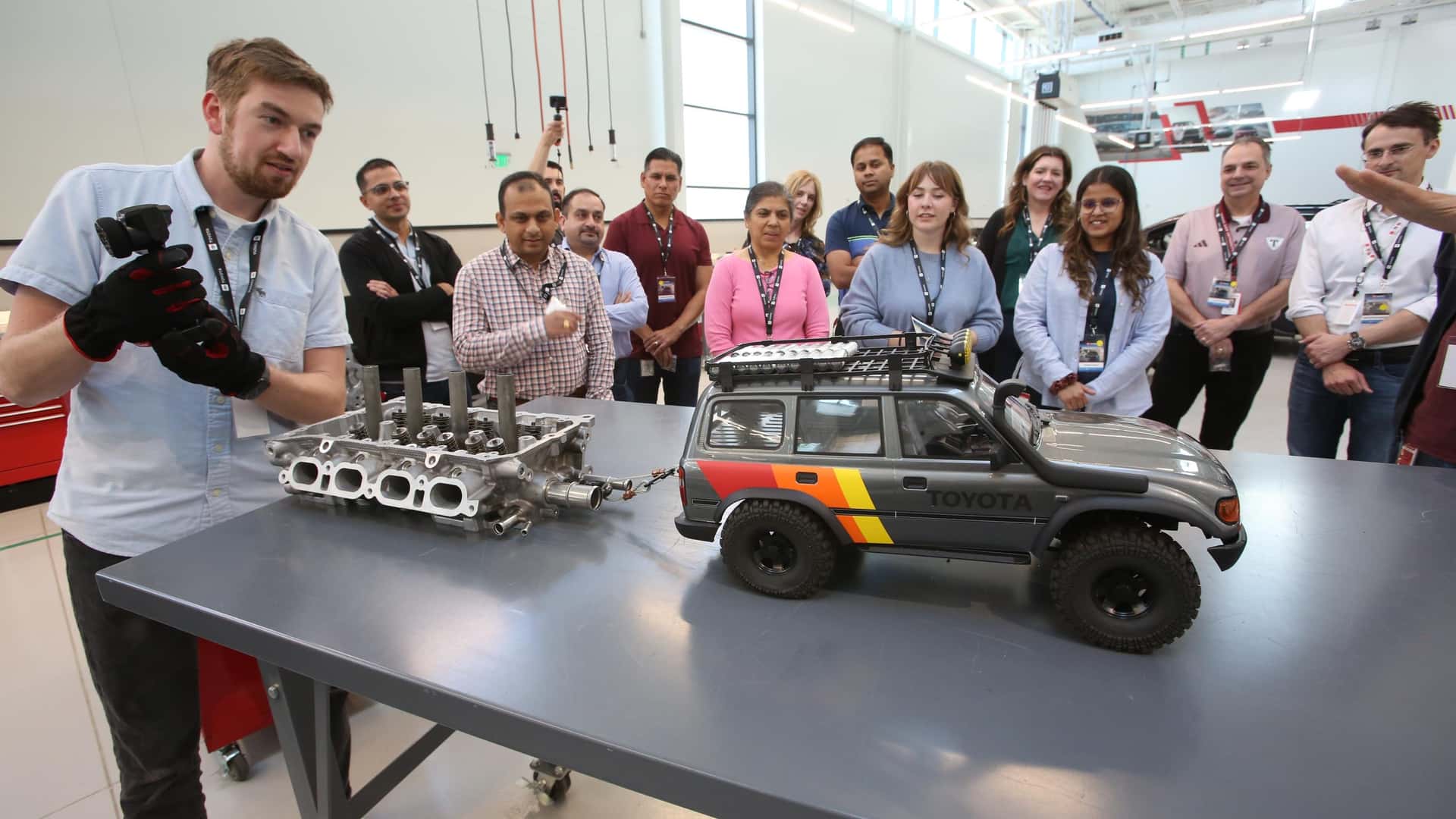
A particularly memorable demonstration involved showcasing the instantaneous torque capabilities of an EV motor. This was illustrated using a miniature, remote-controlled Land Cruiser to effortlessly tow a cylinder head weighing over 30 pounds, offering a tangible experience of the power and efficiency inherent in electric propulsion systems.
The Simplicity and Efficiency of Electric Motors
The overarching lesson derived from the interactive sessions was unequivocally clear: electric motors represent an extraordinary technological advancement. A presenter vividly demonstrated this by contrasting a stripped-down version of a Toyota V-6 engine, replete with its complex array of accessories and intricate components, with an equivalent electric motor. The electric motor, despite its significantly smaller physical footprint, was capable of generating greater power through a remarkably simpler design.
Even when electric motors are integrated into conventional gasoline powertrains, as seen in Toyota’s sophisticated hybrid systems, they contribute to reduced mechanical complexity by eliminating the need for finicky transmissions. The core message was that incorporating electric propulsion into any vehicle architecture enhances efficiency with minimal compromises.
Furthermore, the program conveyed that as vehicles progress further along the electrification spectrum, from hybrids to pure battery electric vehicles, the overall system design tends to simplify. By the time a true battery electric vehicle is realized, there are inherently fewer moving parts, which translates to a reduced likelihood of mechanical malfunctions and decreased maintenance requirements.
However, Toyota representatives also maintained that electrification is not yet a fully resolved scientific domain. The company articulated its desire to see substantial advancements in battery chemistry and a significant expansion of charging infrastructure before considering pure EVs as a universally applicable solution. Yet, the palpable underlying objective of the program was to cultivate enthusiasm among its employees for a future increasingly dominated by all-electric mobility solutions.
Cultivating Internal Advocacy for an Electric Future
The cultivation of an informed and enthusiastic workforce is paramount for facilitating long-term strategic decision-making within the company. Without a comprehensive understanding of the enduring benefits of electrification, individuals in corporate roles, such as procurement, might solely perceive the immediate challenges: the increased costs associated with new component designs or the administrative complexities of integrating novel suppliers. Such a limited perspective could understandably lead to resistance against change, a common human tendency.
However, by generating genuine excitement and understanding, employees become more willing to navigate short-term complexities in pursuit of long-term organizational goals, thereby encouraging others to embrace this transformative objective. This dynamic was exemplified by Brigette Armato, a Toyota employee who participated in the Electrification 101 program.
Armato candidly admitted that she possessed “nothing” about EVs and hybrids prior to attending the training. Post-program, her perspective has shifted dramatically, transforming her into an advocate. She explained, “I work with our lease experience team, so I’m actually working with the customers and the vehicles. This was extremely helpful because now I can have an educated conversation with them and maybe convince them to go for an electric vehicle, whereas before I don’t think I had that skill.”
Her newfound conviction extends beyond her professional interactions. Armato is now seriously considering an electric vehicle for her personal use, despite her current attachment to her Toyota 4Runner. She articulated a clear desire for more electric options across the brand’s entire product line: “I wish we would gravitate more towards electric vehicles across the lineup.”
This sentiment, shared by many proponents of electrification, reflects a growing internal consensus. With hundreds of employees attending these pivotal training sessions, and a substantial waiting list for upcoming iterations, the number of internal “EV believers” within Toyota’s North American headquarters is steadily expanding. It is evident that the previous hesitations were not rooted in active resistance but rather in a pervasive lack of comprehensive understanding, a challenge shared by a significant portion of the broader car-buying public.
FAQ
What is Toyota’s “Electrification 101” program?
Toyota’s “Electrification 101” is an internal training initiative designed to educate its employees, including those in non-automotive roles, on the fundamental principles of various electrified vehicle technologies, such as hybrids, plug-in hybrids, battery electric vehicles (BEVs), and hydrogen fuel cell electric vehicles (FCEVs). It aims to bridge knowledge gaps within the company.
Why did Toyota introduce this training program?
Toyota introduced the program because many of its employees, regardless of their role or enthusiasm for cars, lacked in-depth knowledge about electrification. The company recognized the need to inform its workforce about its multi-pathway strategy and the benefits of electric vehicle technology to foster internal understanding and advocacy.
What is Toyota’s “multi-pathway” approach to electrification?
Toyota’s “multi-pathway” approach is a strategy that emphasizes developing and offering a diverse range of electrified vehicles. This includes a current focus on hybrid electric vehicles (HEVs), alongside the ongoing development of plug-in hybrid electric vehicles (PHEVs), battery electric vehicles (BEVs), and hydrogen fuel cell electric vehicles (FCEVs). It aims to provide various customer choices and optimize battery resource utilization.
Did the training address common myths about EVs?
Yes, a significant portion of the Electrification 101 program was dedicated to dispelling common myths surrounding electric vehicles. It highlighted the advantages of electrification, such as increased efficiency and environmental cleanliness, drawing parallels to historical automotive transitions to illustrate how new technologies overcome initial infrastructure and understanding hurdles.
What kind of interactive elements were included in the training?
The interactive segment of the training included hands-on activities where employees built a simple electric motor using basic components like a screw, magnet, battery, and wire. Participants also created a rudimentary potato battery and witnessed demonstrations of electric vehicle torque, using a remote-controlled Land Cruiser to pull a heavy object.
What was the main takeaway regarding electric motor technology?
The primary takeaway was that electric motors represent an incredible technological advancement. They offer greater power in a smaller footprint with a simpler design compared to traditional internal combustion engines. This simplicity also leads to reduced complexity when integrated into hybrid systems and, ultimately, fewer potential points of failure in pure battery electric vehicles.
How is employee education impacting Toyota’s electrification goals?
Employee education is crucial for Toyota’s electrification goals as it transforms staff members into informed advocates. By understanding the long-term benefits and vision, employees are more likely to support and drive electrification initiatives, overcoming short-term complexities, and educating customers, ultimately accelerating the company’s transition towards an electrified future.