
Key Takeaways (TL;DR)
- Toyota’s “Electrification 101” program reveals a significant knowledge gap among its own employees regarding electric vehicles (EVs) and hybrid technologies.
- The initiative aims to educate a diverse workforce, from corporate accountants to app developers, who may not inherently be automotive enthusiasts or experts in advanced powertrains.
- The curriculum covers various electrified vehicle types, dispels common EV myths, and highlights the efficiency and simplicity of electric motors compared to traditional internal combustion engines.
- Despite a focus on Toyota’s “multi-pathway” strategy encompassing hybrids and hydrogen, the training actively promotes the benefits of a fully electric future.
- The program successfully transforms employees into advocates for electrification, enhancing their ability to engage with customers and foster internal support for sustainable mobility solutions.
In an automotive landscape increasingly dominated by discussions around electric vehicles, it is often assumed that employees within leading car manufacturers possess an inherent, deep understanding of these burgeoning technologies. This presumption, however, received a significant reality check at Toyota Motor North America’s recent “Electrification 101” program, revealing a surprising knowledge gap among its own staff. The revelation underscores a critical internal education initiative by the global automaker, designed to align its workforce with the accelerating shift towards sustainable mobility.

While industry critics and enthusiasts immerse themselves daily in the nuances of electrification strategies, battery chemistries, and charging infrastructures, the experience at “Toyota Electrification 101” highlighted that this level of detail is far from universal, even within the corporate confines of the world’s largest automaker. This observation, initially startling, now appears to be a strategic opportunity for Toyota as it navigates the complex transition to an electrified future.
Bridging the Knowledge Gap in the Automotive Industry
The conventional image of an automotive company employee often conjures a dedicated car enthusiast, deeply knowledgeable about every facet of vehicle technology. Yet, the modern automotive industry, particularly at the scale of Toyota, employs a vast and diverse workforce, many of whom are drawn by factors beyond a passion for cars. For numerous individuals in roles such as corporate accounting, software development, or human resources at Toyota’s Plano, Texas, campus, the allure might be the robust benefits, career stability, respectful corporate culture, or the prestige associated with a global brand.
Consequently, assuming every employee with a Toyota badge is an expert on electrification is a misconception. Even among those with a general interest in automobiles, the highly technical distinctions between battery chemistries like Nickel Manganese Cobalt (NCM) and Lithium Iron Phosphate (LFP) or the intricacies of advanced hybrid systems are not common knowledge. This specialized information is often foreign to even seasoned enthusiasts whose primary interest might lie in traditional V8 muscle cars or classic vehicles.

Recognizing this internal educational need, Toyota strategically developed the “Toyota Electrification 101” program. This initiative marks the second such internal training; an earlier program introduced employees to fundamental automotive concepts, further indicating that comprehensive product knowledge is not an innate characteristic of every team member. These programs are vital for fostering a shared understanding and enthusiasm across the organization, crucial for successful corporate transformation.
Toyota’s Multi-Pathway Strategy Unveiled
The very name of the program, “Electrification 101” rather than “EV 101,” is a deliberate reflection of Toyota’s overarching “multi-pathway” approach to sustainable mobility. This strategy emphasizes a diverse portfolio of technologies, with a strong focus on hybrids in the immediate term, while simultaneously advancing battery electric vehicles (BEVs) and exploring the long-term potential of hydrogen fuel cell electric vehicles (FCEVs).
Recent sales figures underscore this strategy: in the last quarter, 56.8% of Toyota’s total vehicle sales were electrified. This significant percentage encompasses hybrids, BEVs, plug-in hybrid electric vehicles (PHEVs), and FCEVs. However, pure BEVs constituted a smaller fraction of these sales, representing only 1.7% of the total electrified vehicles. This data highlights Toyota’s current market positioning and its incremental transition towards a fully electric future, supporting its argument for a diversified approach.
Dispelling Myths and Exploring Advantages
The “Toyota Electrification 101” curriculum systematically covered the fundamentals of all these powertrain types, meticulously explaining the differences between conventional hybrids and plug-in hybrids. A substantial portion of the classroom time was dedicated to addressing and dispelling common misconceptions surrounding BEVs. The program drew parallels to the early 20th century, when gasoline cars faced challenges related to infrastructure, public education, servicing, and evolving regulations, arguing that similar hurdles are inherent to any transformative technology, but ultimately overcome.
Discussions highlighted the myriad advantages of electrification, primarily focusing on enhanced efficiency and environmental cleanliness. The program also articulated Toyota’s rationale for its multi-pathway strategy, positing it as not merely offering customer choice but as the most effective method for utilizing finite battery resources. While this perspective remains a point of debate, with much research suggesting that BEVs generally offer the cleanest option on a life cycle basis, it reflects Toyota’s internal strategic viewpoint.
Evidence That EVs Are The Cleanest Option
EV Myth Busted: No, They’re Not ‘Dirtier’ Than Gas Cars, Even If You Use Fossil Fuel Power
Yes, EVs Really Are Cleaner Than Gas Cars. Here’s By How Much
One section, however, proved contentious: the comparative advantages of each powertrain type. This segment tended to overemphasize the limitations of BEVs without equally addressing the maintenance demands or noise, vibration, and harshness (NVH) of gasoline cars. It also maintained a notably bullish stance on hydrogen technology. For example, a slide asserted that hydrogen “can reduce ‘range anxiety’ as number of stations grow,” citing the Mirai’s up to 402 miles per tank. While impressive in the early days of EVs, this range is now surpassed by at least eight BEV models currently available in the U.S. market, with more long-range options continuously emerging.
Beyond these specific points, the general in-classroom content of “Toyota Electrification 101” was highly informative. It covered essential concepts such as fundamental battery chemistries, various charging standards, core electrical measurements like kilowatts and kilowatt-hours, and provided an overview of ongoing battery recycling initiatives. This foundational knowledge is crucial for a workforce increasingly involved in the electric vehicle ecosystem.
An Interactive Learning Experience
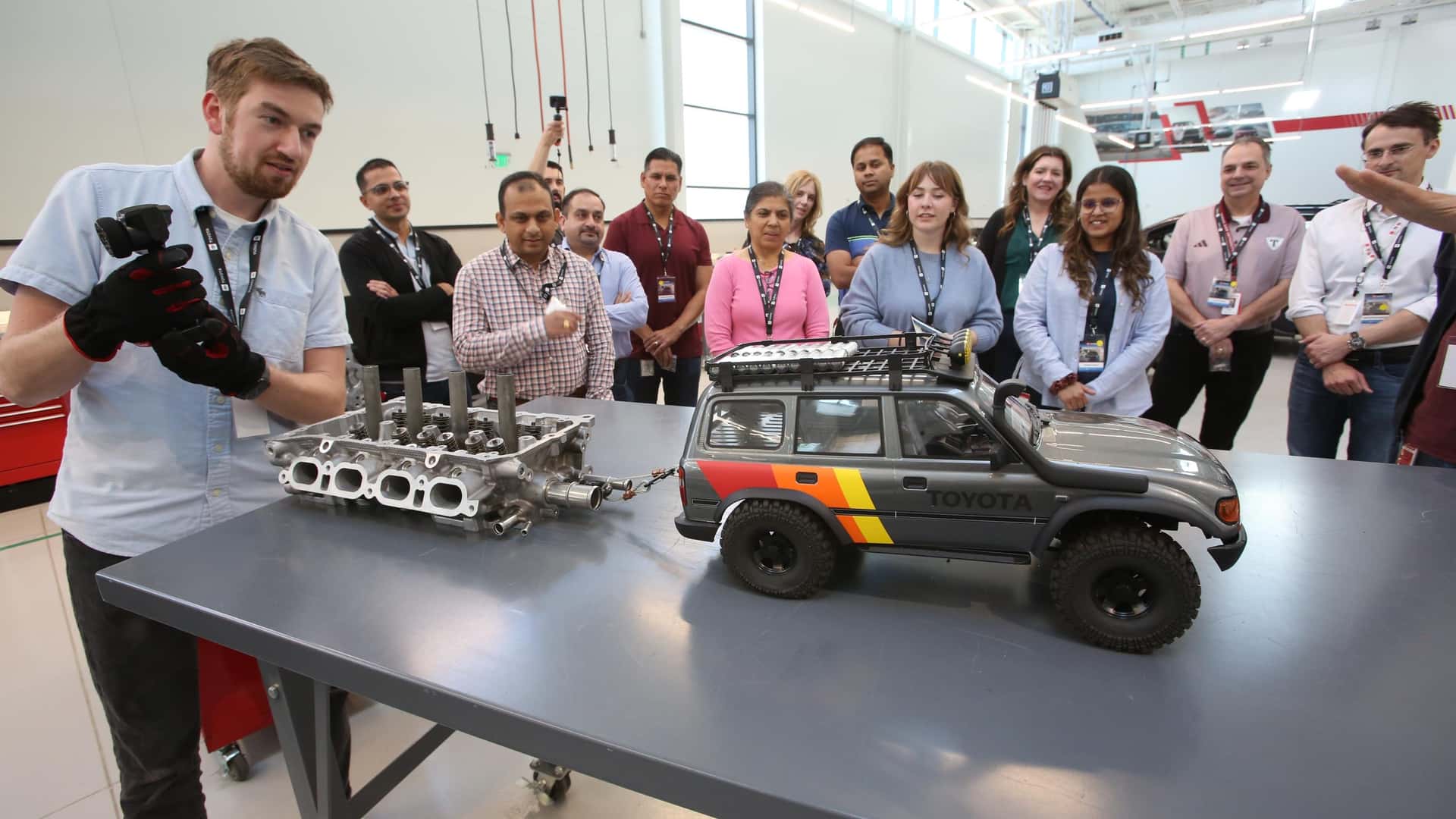
The most engaging aspect of the “Toyota Electrification 101” program was its interactive session, designed to provide hands-on experience with electric propulsion. Participants engaged in practical exercises, including constructing a basic electric motor using only a screw, a magnet, a AA battery, and a piece of wire. They also assembled a rudimentary potato-based battery and observed different charging outputs in real-time. A memorable demonstration involved a tiny remote-controlled Land Cruiser effortlessly pulling a cylinder head weighing over 30 pounds, vividly illustrating the instant torque capabilities of an EV motor.
The Engineering Marvel: Simplicity and Efficiency
The profound lesson from these interactive demonstrations and the accompanying lectures was the inherent engineering brilliance of electric motors. Presenters showcased a stripped-down Toyota V-6 engine, highlighting its intricate components and complex accessories. This was juxtaposed with an equivalent electric motor, which demonstrated superior power output within a significantly smaller footprint and a fundamentally simpler design. The training emphasized that integrating electric propulsion, even through Toyota’s hybrid systems, inherently reduces mechanical complexity by potentially eliminating intricate transmissions.
The core message was clear: electric propulsion enhances efficiency across any powertrain, with minimal compromises. As one progresses further towards a fully battery electric vehicle, the complexity further diminishes, translating into fewer potential points of failure. This simplification in design and operation presents a compelling argument for the long-term viability and advantages of electrification.
While Toyota representatives acknowledged that significant advancements in battery chemistry and charging infrastructure are still necessary before BEVs can be considered a universal solution, the underlying intent of the “Toyota Electrification 101” program was unmistakable: to instill enthusiasm among its employees for an all-electric future. The rapid introduction of new EV models by Toyota, including the C-HR, bZ Woodland, updated bZ, Highlander, Lexus ES, and TZ in the past 18 months alone, further signals the company’s commitment to this direction.
Cultivating Internal Advocates for Electrification
The strategic importance of programs like “Toyota Electrification 101” extends far beyond technical knowledge transfer. For employees in corporate procurement or other support functions, an incomplete understanding of electrification’s long-term benefits might lead them to perceive only the immediate challenges—such as increased costs for new component designs or the complexities of integrating new suppliers. Without a clear vision of the future, resistance to change within large organizations is a common phenomenon.
However, by generating genuine excitement and understanding, such initiatives empower employees to embrace short-term complexities in pursuit of long-term strategic goals, becoming internal champions for change. This transformation was vividly illustrated by Brigette Armato, a Toyota employee who participated in the class. She candidly admitted to knowing “nothing” about EVs and hybrids prior to the training. Post-program, her perspective shifted dramatically.
“I work with our lease experience team, so I’m actually working with the customers and the vehicles. This was extremely helpful because now I can have an educated conversation with them and maybe convince them to go for an electric vehicle, whereas before I don’t think I had that skill,” Armato stated. Her newfound confidence and advocacy extend beyond customer interactions; she is now seriously considering an EV for herself, expressing a desire for an electric alternative to her current Toyota 4Runner.
The Road Ahead: Challenges and Opportunities
Armato’s sentiment, “I wish we would gravitate more towards electric vehicles across the lineup,” echoes a growing internal desire within Toyota. The success of the “Toyota Electrification 101” program, evidenced by hundreds of attendees and a lengthy waitlist for future sessions, signals a significant internal cultural shift. This initiative is effectively cultivating a growing cadre of EV proponents within Toyota’s North American headquarters.
It wasn’t a matter of active resistance to electric vehicles previously; rather, it was a widespread lack of comprehensive understanding, a challenge not dissimilar to that faced by many car buyers globally. By proactively educating its workforce, Toyota is not only enhancing its internal capabilities but also laying the groundwork for more informed decision-making and a more cohesive transition towards a sustainable, electrified automotive future. The journey towards widespread EV adoption within the company reflects the broader industry’s evolution, driven by education and growing conviction in the technology.
Frequently Asked Questions About Toyota’s Electrification Strategy
What is the primary goal of Toyota’s “Electrification 101” program?
The primary goal of the “Toyota Electrification 101” program is to educate its diverse employee base on the fundamentals of electrified vehicle technologies. This includes hybrids, plug-in hybrids, battery electric vehicles, and fuel cell vehicles, aiming to bridge existing knowledge gaps and foster internal advocacy for Toyota’s multi-pathway approach to sustainable mobility.
Why is internal employee education on electrification crucial for Toyota?
Internal employee education is crucial because a well-informed workforce is better equipped to support corporate strategic goals. Employees, particularly those not directly involved in R&D, might lack detailed knowledge. Educating them ensures better decision-making, improved customer interaction, and a more cohesive internal drive towards electrification, overcoming potential resistance to change.
What does Toyota mean by its “multi-pathway” approach to electrification?
Toyota’s “multi-pathway” approach refers to its strategy of developing and offering a diverse range of electrified powertrains. This includes conventional hybrids, plug-in hybrids, battery electric vehicles (BEVs), and hydrogen fuel cell electric vehicles (FCEVs). The company believes this offers customers choice and optimizes the use of limited battery resources during the transition to a carbon-neutral future.
How does the “Toyota Electrification 101” program address common EV myths?
The program addresses common EV myths by providing factual information on battery chemistries, charging infrastructure, and the environmental benefits of electric propulsion. It draws historical parallels to the early adoption of gasoline cars, suggesting that initial challenges are part of any technological shift. It emphasizes EV advantages like efficiency and reduced complexity.
Are Toyota employees becoming advocates for EVs after attending the training?
Yes, the program has shown success in transforming employees into advocates. Testimonials from attendees indicate a significant increase in understanding and enthusiasm for electrified vehicles. Employees feel more confident discussing these technologies with customers and are often inspired to consider purchasing an EV for personal use, demonstrating the program’s effectiveness.
What were some key interactive components of the “Electrification 101” training?
Key interactive components included hands-on activities like building a basic electric motor using simple materials (screw, magnet, AA battery, wire) and assembling a rudimentary potato-based battery. Another demonstration showcased the impressive instant torque of an EV motor by using a remote-controlled vehicle to pull a heavy object, providing tangible experience of the technology.
Does Toyota view EVs as the ultimate solution for sustainable mobility?
While the “Toyota Electrification 101” program promotes the benefits of EVs, Toyota representatives indicated that the company views EVs as a part of a broader solution. They emphasized that significant improvements in battery chemistry and charging infrastructure are needed before EVs can be considered a universal, one-size-fits-all approach for sustainable mobility across all regions and customer needs.