
Key Takeaways:
- Toyota Motor North America launched an ‘Electrification 101’ program to educate its employees on electric vehicle (EV) technologies.
- The initiative highlights a crucial insight: not all automotive industry employees are deeply familiar with electrification’s nuances.
- The training covers various powertrain types, including hybrids, plug-in hybrids (PHEVs), battery electric vehicles (BEVs), and hydrogen fuel cell vehicles (FCEVs).
- A significant portion of the course addresses common myths about EVs and emphasizes the advantages of electric propulsion.
- The program aims to foster internal advocacy for electrification, transforming employees into informed proponents of sustainable automotive solutions.
- This internal education is vital for driving long-term strategic decisions and accelerating the company’s multi-pathway approach to decarbonization.
As the global automotive industry navigates a transformative shift towards sustainable mobility, a common assumption prevails: those working within these companies are inherently experts on every facet of vehicle technology, especially emerging fields like electrification. However, a recent initiative by Toyota Motor North America has offered a surprising reality check, revealing a significant knowledge gap even within a leading automaker’s ranks.

Toyota’s innovative ‘Electrification 101’ training program, designed for its employees, underscores that familiarity with the broader automotive landscape does not automatically translate into deep understanding of electric propulsion systems. This finding is not a setback but rather a crucial revelation that highlights the necessity of internal education to foster widespread adoption and strategic alignment for the future.
Understanding the Electrification Imperative
The journey towards an electrified future is complex, involving rapid technological advancements and evolving consumer perceptions. For individuals outside the core engineering and product development teams, the intricacies of electric vehicles (EVs) and related technologies can be as unfamiliar as for the general public.
Many Toyota employees, like those in corporate finance, app development, or human resources, are drawn to the company for its stability, benefits, and reputable culture, rather than a specific passion for automotive mechanics or emerging powertrain technologies. Even ardent car enthusiasts within the company might primarily be passionate about traditional internal combustion engines, lacking detailed knowledge of battery chemistries like NCM versus LFP, or the distinctions between various hybrid systems.

Recognizing this, Toyota has strategically invested in programs like ‘Electrification 101’. This is not the company’s first foray into foundational employee education; an earlier initiative provided an introduction to general automotive principles, further illustrating the diverse backgrounds and expertise levels within its workforce.
The Multi-Pathway Approach to Electrification Training
Toyota’s training program, aptly named ‘Electrification 101’ rather than ‘EV 101’, reflects the company’s stated ‘multi-pathway’ strategy. This approach emphasizes a pragmatic focus on hybrids in the immediate term, while simultaneously exploring the potential of battery electric vehicles (BEVs) and, notably, hydrogen fuel cell electric vehicles (FCEVs) for the future.
During the last reported quarter, 56.8% of Toyota’s sales comprised electrified vehicles, a category that includes hybrids, plug-in hybrid electric vehicles (PHEVs), and FCEVs. However, pure BEVs constituted a smaller fraction, accounting for only 1.7% of those electrified sales, highlighting the company’s current strategic emphasis.
The four-hour classroom-based course meticulously covered the foundational aspects of all these powertrain types. A key segment involved clarifying the differences between conventional hybrids and PHEVs, which, while seemingly basic to industry veterans, can be new information for many employees.
Dispelling Myths and Highlighting Advantages
A significant portion of the program was dedicated to dispelling common misconceptions surrounding electric vehicles. Presenters drew parallels to the early 20th century, when gasoline cars faced challenges like nascent infrastructure, a lack of public education, limited service networks, and undefined road rules, making horse ownership seem simpler at the time. Yet, cars ultimately triumphed.
The training underscored the numerous advantages of electrification, focusing on enhanced efficiency and environmental benefits. It also articulated Toyota’s rationale for its multi-pathway strategy, arguing that it represents the most effective utilization of finite battery resources and offers customers a wider range of choices. While the premise that different powertrains optimally utilize limited battery resources can be debated, and various research suggests BEVs are often the cleanest option over their lifecycle, the company’s commitment to diverse solutions is clear.
During the session, some specific points regarding EV limitations were noted, such as range anxiety in FCEVs. For instance, the Toyota Mirai, a hydrogen fuel cell vehicle, offers up to 402 miles per tank. While this figure was impressive in the early days of EVs, several BEVs currently available in the U.S. market now exceed this range, with more advanced models continuously emerging.
Beyond these specific comparisons, the bulk of the classroom instruction focused on fundamental concepts, including different battery chemistries, various charging types, and essential metrics like kilowatts and kilowatt-hours. The program also provided an overview of ongoing battery recycling efforts, emphasizing a holistic approach to electrification.
Interactive Learning: Bringing Electrification to Life
Perhaps the most impactful segment of the ‘Electrification 101’ program was its interactive component. Employees engaged in hands-on activities, such as constructing a rudimentary electric motor using only a screw, a magnet, a AA battery, and a piece of wire. Participants also assembled a simple potato-based battery and observed different charging outputs in real-time.
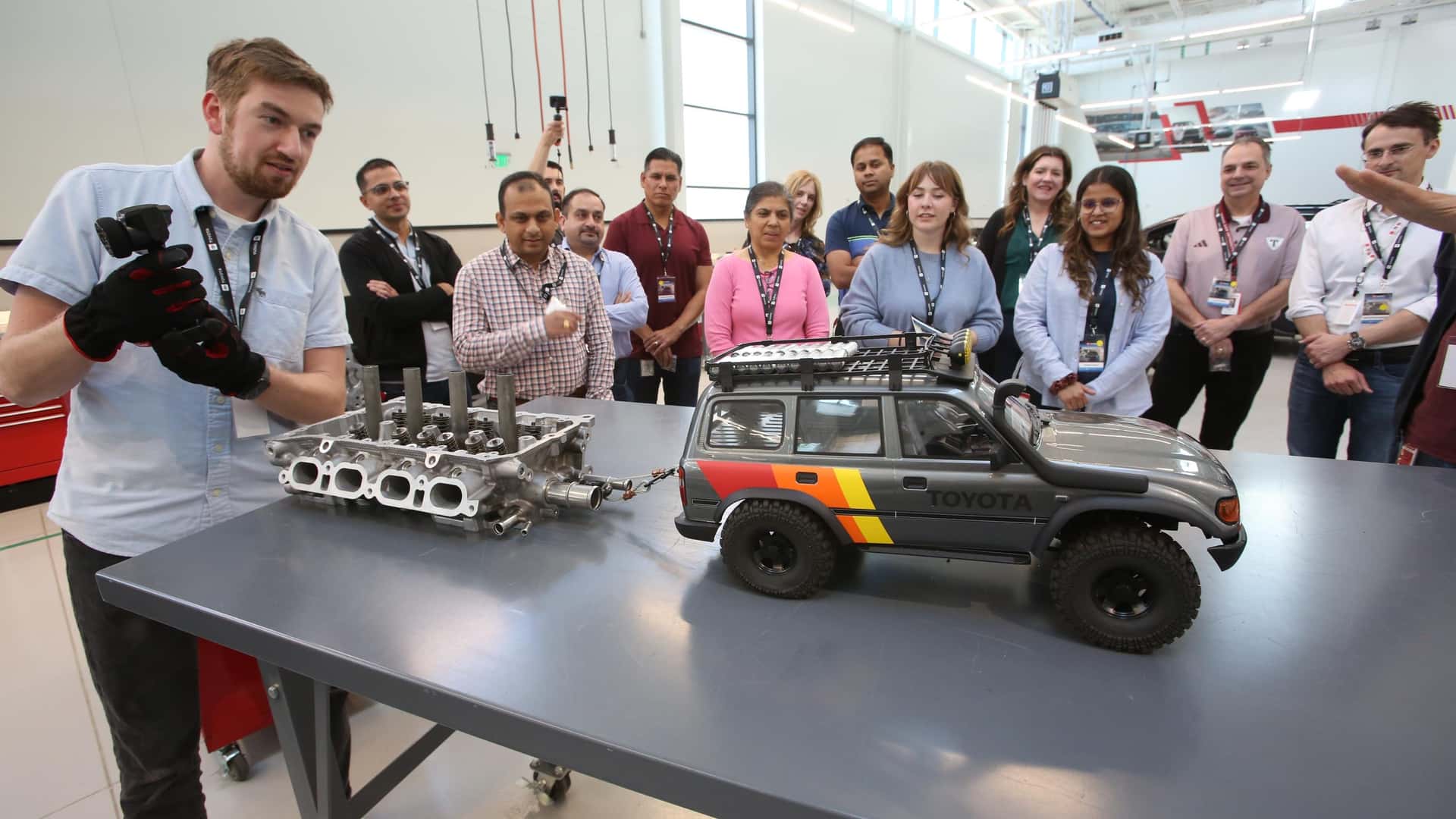
A particularly engaging demonstration showcased the instant torque of an EV motor, where a miniature remote-controlled Land Cruiser effortlessly towed a cylinder head weighing over 30 pounds. These practical exercises provided tangible evidence of the power and simplicity inherent in electric propulsion technology.
The Simplicity and Efficiency of Electric Motors
A core lesson from the training highlighted the inherent efficiency and simplicity of electric motors. Presenters contrasted a complex, stripped-down Toyota V-6 engine, replete with its numerous accessories and intricate components, with an equivalent electric motor. The electric motor, despite its far smaller footprint and simpler design, demonstrated superior power output.
Even when integrated into a gasoline powertrain, as seen in Toyota’s hybrid systems, electric propulsion reduces overall complexity by minimizing the reliance on traditional, often finicky, transmissions. The clear message was that incorporating electric drive, in any form, enhances efficiency with minimal compromises. As the transition moves further towards pure battery electric vehicles, the potential for reduced mechanical complexity and fewer points of failure becomes even more pronounced.
Toyota representatives reiterated the company’s stance: significant improvements in battery chemistry and charging infrastructure are essential before BEVs can become a universal solution. However, the underlying message of the training was unequivocally clear: to inspire enthusiasm among its employees for a future increasingly powered by electric drive.
Fostering Internal Advocacy for Electric Vehicles
The value of this internal education extends beyond technical understanding; it is critical for fostering long-term strategic decisions. An employee in corporate procurement, for instance, might initially perceive electrification as merely an added cost or a logistical challenge associated with new component designs and supplier onboarding. Without a deeper appreciation for the long-term benefits, such individuals might naturally resist change.
By cultivating enthusiasm and understanding, Toyota aims to empower its workforce to embrace and advocate for electrification. Brigette Armato, a Toyota employee who participated in the program, exemplifies this transformation. Admitting she knew “nothing” about EVs and hybrids beforehand, she emerged from the training as an informed proponent.
“I work with our lease experience team, so I’m actually working with the customers and the vehicles. This was extremely helpful because now I can have an educated conversation with them and maybe convince them to go for an electric vehicle, whereas before I don’t think I had that skill,” Armato stated after the class. Her newfound knowledge not only enables her to better assist customers but has also spurred her personal consideration of an EV, despite her current attachment to a Toyota 4Runner.
“I wish we would gravitate more towards electric vehicles across the lineup,” she expressed, echoing the sentiments of many EV advocates. With hundreds of employees attending these ‘Electrification 101’ classes and a substantial waitlist for future sessions, Toyota is steadily cultivating a growing cadre of EV believers within its North American headquarters. This internal shift in perception is pivotal, transforming what was once a knowledge gap into a powerful force for change, much like many car buyers who simply needed to be informed.
FAQ Section
What is Toyota’s ‘Electrification 101’ program?
Toyota’s ‘Electrification 101’ is an internal training program designed to educate its employees about various electric propulsion technologies. It covers foundational concepts of hybrids, plug-in hybrids, battery electric vehicles, and hydrogen fuel cell vehicles, aiming to bridge knowledge gaps within the company’s diverse workforce.
Why did Toyota launch this employee training program?
Toyota launched the program to address the realization that not all employees, regardless of their role within the automotive industry, are knowledgeable about electrification. The goal is to inform and excite staff about electric technologies, fostering internal advocacy and supporting strategic long-term decisions for sustainable mobility.
What types of electrified vehicles does Toyota’s program cover?
The program covers Toyota’s comprehensive ‘multi-pathway’ approach, including conventional hybrids, plug-in hybrid electric vehicles (PHEVs), battery electric vehicles (BEVs), and hydrogen fuel cell electric vehicles (FCEVs), providing an overview of each powertrain’s characteristics and applications.
Does the training address common myths about electric vehicles?
Yes, a significant portion of the ‘Electrification 101’ program is dedicated to dispelling common myths and misconceptions about electric vehicles. It highlights the efficiency and cleanliness advantages of electrification, drawing historical parallels to the early adoption of gasoline cars.
How does this training impact Toyota’s long-term electrification strategy?
By educating its workforce, Toyota aims to ensure that employees across all departments understand the benefits and potential of electrification. This internal alignment is crucial for driving strategic long-term goals, fostering innovation, and preparing the company for a future dominated by diverse electric propulsion solutions.
What kind of hands-on activities are part of the ‘Electrification 101’ course?
The program includes interactive segments where employees build basic electric motors using simple components like screws, magnets, and batteries. Participants also create rudimentary potato-based batteries and witness demonstrations of an EV motor’s instant torque, providing tangible experience with electric principles.