
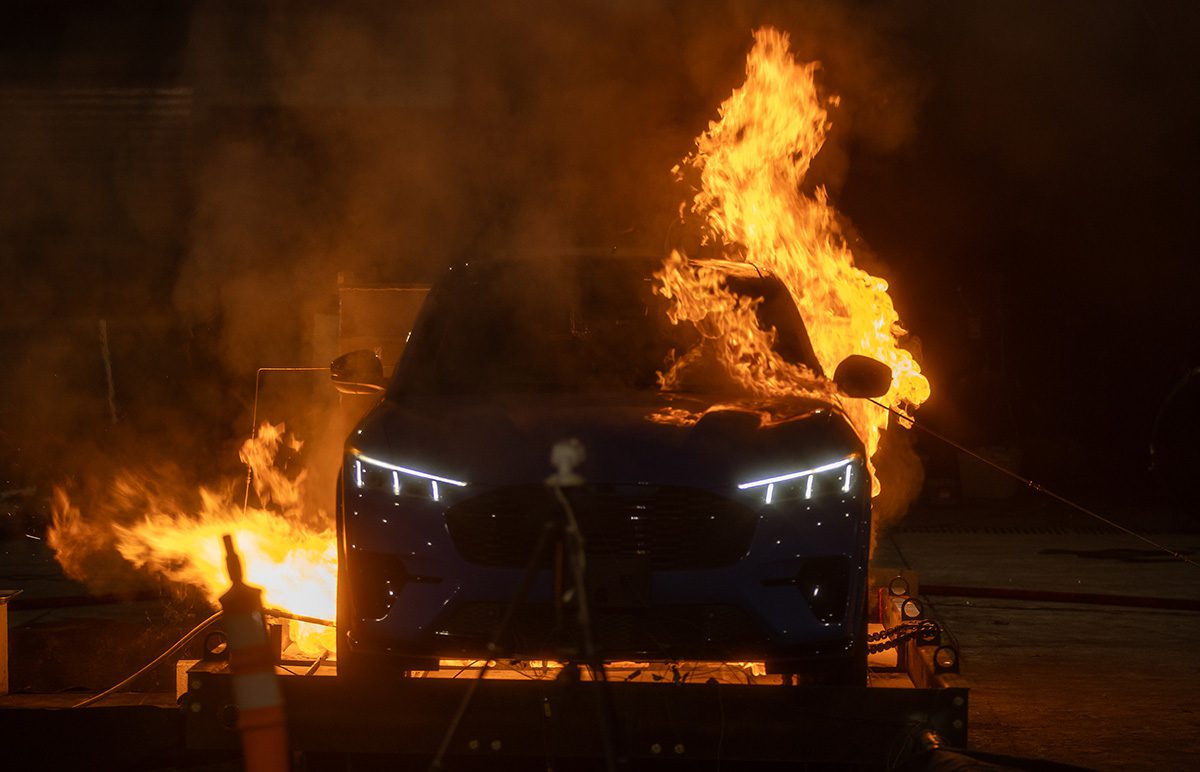
As electric vehicle (EV) adoption accelerates globally, ensuring the safety of both drivers and emergency personnel during incidents involving these innovative vehicles becomes paramount. A groundbreaking study by UL Research Institutes’ Fire Safety Research Institute (FSRI) has delivered crucial insights into electric vehicle fire response, offering comprehensive EV fire safety guidelines for firefighters.
The institute’s latest report, titled “Full-Scale Electric Vehicle Fire Experiments and Recommendations for Fire Incident Response,” details an extensive research initiative involving the controlled burning of 18 electric vehicles. This rigorous study aimed to dissect the nuances of EV fires, compare them with traditional gasoline vehicle fires, and evaluate the effectiveness of various suppression tactics.
Key Takeaways for EV Fire Safety Guidelines (TL;DR)
- EV and gasoline vehicle fires exhibit similar initial growth rates, peak fire sizes, and durations.
- Water remains a highly effective tool for suppressing cabin fires and managing initial flaming from thermal runaway in EVs.
- No tested suppression technique, including specialized agents, completely halted battery thermal runaway once initiated; the battery eventually burns itself out.
- EV fire blankets require careful deployment due to a potential explosion hazard from flammable gas accumulation beneath them and should not replace water-based suppression.
- Firefighters must consistently use full personal protective equipment (PPE) and self-contained breathing apparatus (SCBA) throughout any EV fire incident.
- A new EV Fire Tactical Decision Aid has been developed to enhance fireground decision-making.
Unpacking the Research Methodology: Real-World Scenarios
The FSRI’s research methodology was meticulously designed to simulate real-world fire incidents. Researchers conducted full-scale burns of 18 vehicles, segmenting the experiments into two distinct phases to gather comprehensive data on electric vehicle fire response.
The initial phase involved nine “free burns” – experiments conducted without any active fire suppression. This crucial step allowed researchers to observe the natural progression of EV fires, charting their growth rate, peak intensity, and overall duration. These baseline observations were essential for drawing comparisons with fires involving internal combustion engine (ICE) vehicles.
Following the free-burn experiments, the team proceeded to burn an additional nine electric vehicles. This second phase focused on evaluating common suppression tactics employed by fire services worldwide. The tested methods included the application of water only, the deployment of specialized EV fire blankets, and the use of water enhanced with an added suppression agent.
To ensure consistency and replicate challenging conditions, all EVs involved in the study were fully charged before the experiments. Battery fires were intentionally initiated using a propane burner, allowing for controlled and repeatable ignition. Crucially, a six-minute delay was implemented before suppression efforts began. This delay was strategically chosen to accurately replicate the standard fire response time commonly experienced in North America, adding a layer of authenticity to the findings on electric vehicle fire response.
Similarities and Distinct Challenges in EV Fires
A significant revelation from the free-burn experiments indicated that, from an initial perspective, EV and ICE vehicle fires share notable similarities. The data showed comparable fire growth rates, peak fire sizes, and overall fire durations. This finding suggests that the immediate response to an EV fire might not differ drastically from a conventional vehicle fire in its nascent stages, allowing first responders familiar initial tactics.
However, the research underscored the distinct challenges posed by the high-voltage battery systems in electric vehicles, particularly the phenomenon of thermal runaway. While initial fire characteristics might be similar, the sustained nature of a battery fire once thermal runaway begins presents a unique hazard. The energy density and chemical composition of EV batteries mean that once this process starts, it generates its own heat and oxygen, making it extremely difficult to interrupt.
Effectiveness of Suppression Tactics: Water as a Primary Tool
The FSRI’s investigation into suppression tactics provided invaluable EV fire safety guidelines. For most EV fire incidents, water emerged as a highly effective agent. It can successfully suppress cabin fires, limit exposure to adjacent structures or vehicles, and control the initial flaming that results from thermal runaway.
The study found that while water can manage the external flames, none of the tested suppression techniques — including specialized water additives or fire blankets — were capable of halting thermal runaway once it had commenced within the battery pack. This critical insight reinforces the understanding that, currently, the battery pack in an EV fire incident may need to burn itself out, even as external flames are controlled.
Furthermore, the research determined that an added suppression agent, when used with water, was no more effective at stopping thermal runaway or extinguishing the sustained battery fire than water alone. This suggests that the complexity lies within the battery’s internal chemical reaction rather than a lack of external extinguishing power.
The Cautious Approach to EV Fire Blankets
EV fire blankets have been introduced as a potential tool for containing electric vehicle fires. However, the ULRI study advises that these blankets should be used with significant caution. While they proved effective in controlling vehicle flaming by smothering the external fire, researchers observed a concerning hazard: the potential for an explosion. This risk arises when flammable gases, produced during the battery’s combustion and thermal runaway, accumulate underneath the deployed blanket.
Such gas buildup creates a dangerous environment, emphasizing that EV fire blankets should not be considered a replacement for water-based suppression methods. Instead, they might serve as a containment tool under very specific, controlled circumstances, with full awareness of the associated risks and the need for ongoing monitoring.
Prioritizing Firefighter Safety and Enhanced Decision-Making
The rigorous nature of EV fires necessitates stringent safety protocols for first responders. The FSRI report unequivocally states that full personal protective equipment (PPE) and self-contained breathing apparatus (SCBA) are mandatory throughout any EV fire incident. This requirement is non-negotiable, given the potential for toxic fumes, intense heat, and the aforementioned explosion hazard associated with specific suppression techniques.
Beyond individual protection, the research team also developed a crucial resource: an EV Fire Tactical Decision Aid. This step-by-step tool is meticulously designed to assist firefighters in analyzing complex fireground situations, developing effective response strategies, and improving overall decision-making during the high-stress environment of an electric vehicle fire incident. It serves as a practical guide, translating the research findings into actionable intelligence for front-line personnel.
Expert Perspective on Managing New Fire Hazards
Commenting on the findings, Adam Barowy, Principal Research Engineer for the Fire Safety Research Institute, underscored the transformative impact of the study. “This research moves us closer to understanding how batteries change the fire environment and helps equip first responders to adequately address fires involving this new source of fuel,” Barowy stated.
He further added, “Our findings demonstrate that when it comes to EVs, first responders can effectively manage the hazard with familiar tools and tactics.” This expert perspective offers reassurance, highlighting that while electric vehicle fire response presents new challenges, these can be managed effectively through enhanced knowledge, training, and appropriate tools, reinforcing the need for clear EV fire safety guidelines.
Driving Confidence in the EV Future
The comprehensive research from UL Research Institutes plays a pivotal role in bolstering public confidence in electric vehicle technology. By demystifying EV fire dynamics and providing clear, evidence-based EV fire safety guidelines, it addresses critical safety concerns that might otherwise hinder widespread EV adoption. This proactive approach ensures that as transportation evolves, the safety infrastructure for emergency response keeps pace, protecting communities and enabling a smoother transition to sustainable mobility.
The continuous development of resources like the EV Fire Tactical Decision Aid and ongoing research into advanced suppression techniques will be vital for refining these guidelines further. Equipping firefighters with the most current understanding and practical tools is fundamental to managing the unique challenges of electric vehicle fire response effectively and safely.
Source: UL Research Institutes
Frequently Asked Questions About EV Fire Safety
What makes electric vehicle fires different from gasoline car fires?
While initial fire characteristics like growth rate and peak size can be similar, EV fires present the unique challenge of thermal runaway within the battery pack. Once started, this self-sustaining reaction is difficult to stop with conventional methods and may require the battery to burn itself out, even as external flames are controlled.
Is water an effective method for suppressing an EV fire?
Yes, water is highly effective for suppressing cabin fires in EVs, limiting exposures to surroundings, and controlling external flaming from thermal runaway. However, the UL Research Institutes’ study found that water, even with added agents, does not halt the internal thermal runaway of the battery itself once it has begun.
Can EV fire blankets completely extinguish an electric vehicle fire?
EV fire blankets can control external flaming by smothering the fire. However, the research cautions that they do not replace water-based suppression and carry a significant risk: flammable gases can accumulate underneath the blanket, potentially leading to an explosion hazard. They should be used with extreme caution and not as a primary extinguishing agent.
What personal protective equipment (PPE) is required for firefighters responding to EV fires?
Firefighters must always wear full personal protective equipment (PPE) and self-contained breathing apparatus (SCBA) throughout any electric vehicle fire incident. This is crucial due to the potential presence of toxic fumes, intense heat, and the specific hazards associated with battery combustion and thermal runaway.
What is the EV Fire Tactical Decision Aid?
The EV Fire Tactical Decision Aid is a practical, step-by-step tool developed by the Fire Safety Research Institute. It is designed to assist first responders in analyzing incident scenarios, developing sound tactical plans, and enhancing their overall decision-making processes when confronted with complex electric vehicle fire emergencies.
Did the study find any method to stop thermal runaway once it started?
No, the extensive research conducted by UL Research Institutes found that none of the tested suppression techniques, including water, water with added agents, or EV fire blankets, were capable of halting thermal runaway once it had started within an electric vehicle’s battery pack.