
Key Takeaways:
- The Jeep Recon’s 222-mile range has drawn criticism, but it reflects deliberate engineering compromises prioritizing extreme off-road capability over maximum on-road efficiency and lower cost.
- Achieving superior off-road prowess in any vehicle type—be it internal combustion or electric—inherently involves design choices that negatively impact fuel or energy efficiency.
- Features like high ground clearance, aggressive all-terrain tires, a robust four-wheel-drive system, heavy skid plates, and low gearing significantly reduce an EV’s range.
- Comparative analysis with the street-focused Jeep Wagoneer S, the versatile Rivian R1S, and the high-end Mercedes G580 EQ demonstrates that increased off-road capability universally translates to reduced range and higher costs in the current EV market.
- As battery technology and charging infrastructure advance, the necessity for these range-vs-capability trade-offs in off-road electric vehicles is expected to diminish.
The unveiling of the all-electric Jeep Recon Moab, with its reported 222-mile range, has ignited considerable debate among automotive journalists and potential buyers. Many expressed disappointment, contending that an electric vehicle (EV) of its stature should offer a more extended range at a more accessible price point.

However, this perspective, while understandable from a consumer standpoint, often overlooks the intricate engineering trade-offs inherent in developing a truly capable off-road machine. The notion that Jeep could deliver greater range and lower cost without sacrificing capability is largely a misconception within the complex automotive industry.
Vehicle design, particularly for specialized segments like off-roading, is a delicate art of compromise. Conflicting objectives such as superior off-road prowess, competitive pricing, and extensive driving range cannot all be simultaneously maximized. The Jeep Recon’s 222-mile range and its $66,995 starting price are, in fact, direct consequences of design decisions made to enhance its rugged capabilities.
The Inherent Trade-Off: Capability Versus Efficiency
The fundamental principles governing vehicle efficiency remain consistent across powertrains, whether gasoline or electric. Off-road vehicles, by their very nature, incorporate design elements that are antithetical to aerodynamic and rolling efficiency, directly impacting their range.

Consider a traditional gas-powered, body-on-frame 4×4 truck equipped with lifted suspension and aggressive gearing. Such vehicles typically achieve less than 20 miles per gallon (mpg), often closer to 10 or 15 mpg. This reduced fuel economy is an accepted reality among off-road enthusiasts.
Several design characteristics contribute to this inefficiency. Tall suspension systems provide crucial ground clearance for navigating challenging terrains, but they also significantly increase aerodynamic drag. This heightened air resistance becomes particularly pronounced at higher speeds, consuming more energy.
Similarly, knobby, large all-terrain (AT) tires are indispensable for traction in mud, sand, or over rocks. However, their aggressive tread patterns and heavier construction generate substantially more rolling resistance and noise compared to street-focused tires, leading to considerable energy loss at highway speeds.
A robust four-wheel-drive (4×4) system, while essential for slippery conditions, also introduces additional frictional losses within the drivetrain. Even when not fully engaged, the presence of these components contributes to overall vehicle weight and complexity, further impacting efficiency.
Finally, aggressive gearing is critical for off-road performance. It multiplies torque at the wheels, dramatically improving climbing ability and low-speed control. However, this same gearing typically results in the engine or electric motors spinning at higher revolutions per minute (RPM) for a given road speed, leading to increased fuel or energy consumption during cruising.
The contrast between a fuel-efficient Toyota Prius and a rugged Jeep Wrangler perfectly illustrates this dichotomy. One is meticulously engineered for maximum efficiency, while the other prioritizes uncompromising off-road capability. Any attempt to enhance the off-road prowess of a Prius—such as lifting it, adding larger tires, or modifying its aerodynamic profile—would inevitably result in a significant decrease in its impressive 50 mpg fuel economy.
Jeep Recon’s Engineering Choices: Decoding the Range
The principles of efficiency versus capability translate directly to electric vehicles. For an EV designed for extreme off-road use, features such as high ground clearance, powerful dual motors, large off-road tires, a distinctive boxy shape, and specific gearing choices all contribute to reduced efficiency and, consequently, a shorter driving range.
These elements are not merely desirable for an off-roader; many are fundamental necessities. A vehicle cannot genuinely claim off-road capability if it offers minimal ground clearance or is fitted with thin, road-biased tires. Jeep’s design of the Recon reflects a clear prioritization of these rugged attributes.
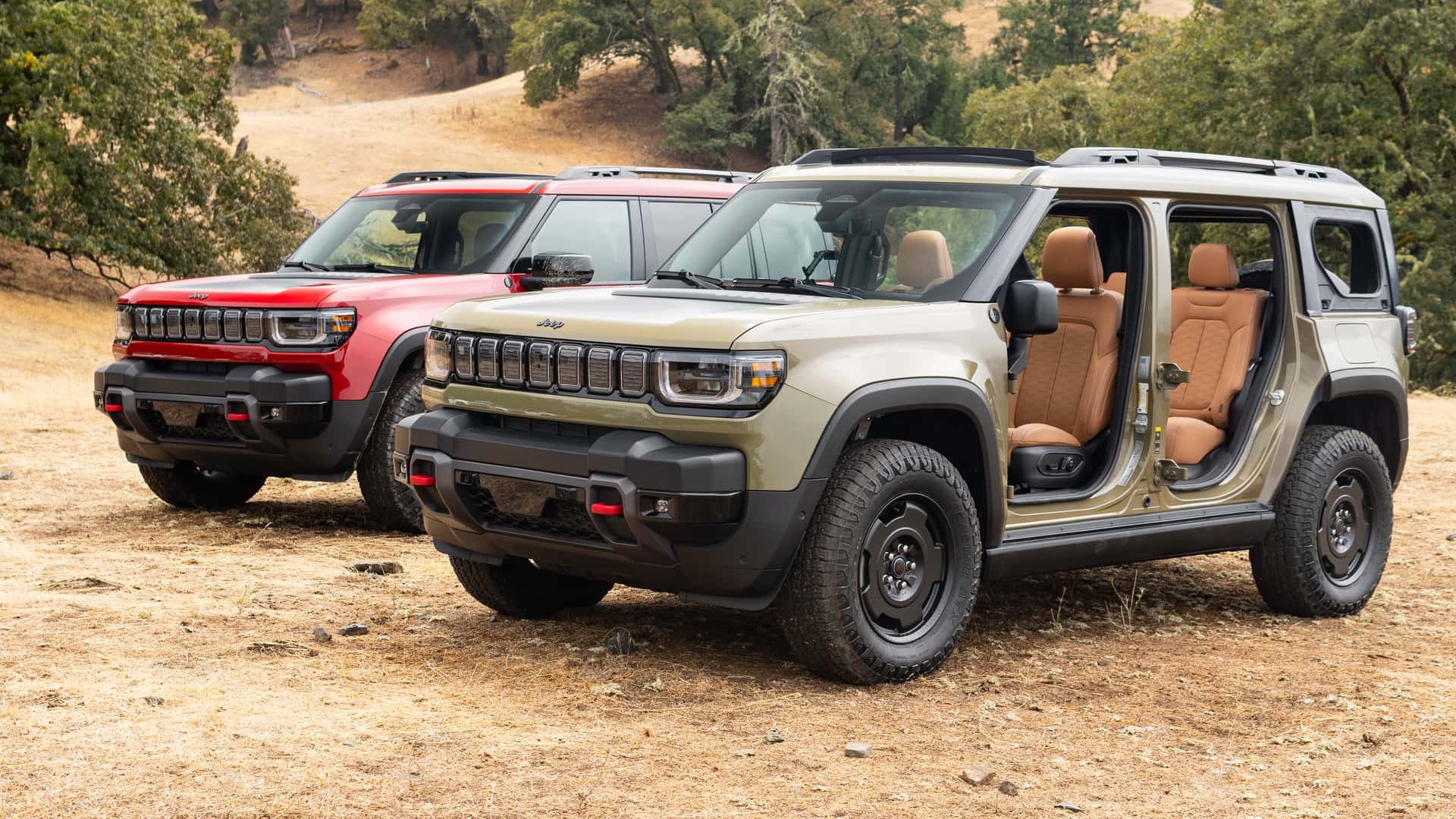
The Jeep Recon’s 222-mile range is directly linked to its off-road specifications. It boasts a substantial 9.1 inches of ground clearance, enabling it to navigate obstacles effectively. Furthermore, it is equipped with heavy skid plates for underbody protection and rides on robust 33-inch all-terrain tires, which enhance grip in challenging environments but increase rolling resistance.
The vehicle’s upright and boxy design is optimized for superior approach and departure angles, crucial for traversing steep inclines and declines. However, this aerodynamic profile significantly increases drag compared to sleeker, more aerodynamically efficient vehicles.
Perhaps one of the most significant, yet often overlooked, factors in the Recon’s efficiency is its gearing. While EVs do not have multi-speed transmissions like internal combustion engine (ICE) vehicles, they still utilize gear ratios that dictate how motor torque is delivered to the wheels. Taller ratios (e.g., 9:1 for an EV) are generally optimized for higher speeds and better efficiency.
Conversely, shorter gearing ratios—such as the 15:1 ratio employed in the Recon’s rear motor—are specifically designed to maximize torque at the wheels from a standstill. This provides immense low-end grunt, which is paramount for climbing steep grades, crawling over rocks, and pushing through tough obstacles. This engineering decision, while hugely beneficial for off-roading, inherently makes the vehicle less efficient at sustained higher speeds.
During test drives, the Recon exhibited an efficiency of approximately 2.5 miles per kilowatt-hour (kWh). This figure underscores how its robust off-road design, including the specialized gearing, significantly impacts energy consumption. The strategic choice to prioritize low-end torque for superior off-road performance directly influences the Jeep Recon’s 222-mile range.
Comparative Landscape: How Other Off-Road EVs Stack Up
To fully appreciate the design philosophy behind the Jeep Recon’s 222-mile range, it is instructive to compare it with other electric vehicles, both within and outside the off-road segment.
Jeep Wagoneer S: A Tale of Two Jeeps
Jeep itself offers a compelling contrast with the Wagoneer S, an EV built on the same 100.5 kWh battery platform as the Recon. Unlike the Recon, the Wagoneer S is designed with a focus on on-road comfort and efficiency, featuring 6 inches of ground clearance and street-biased tires.
As a result of these urban-focused design choices, the Wagoneer S achieves an impressive estimated range of up to 294 miles—nearly 70 miles more than the Recon—despite utilizing the identical battery pack. This clearly illustrates that range is not solely determined by battery size but profoundly by vehicle design and intended use.
Rivian R1S: Balancing Capability and Range
The Rivian R1S, another prominent electric adventure vehicle, generally demonstrates better efficiency than the Recon, even when fitted with all-terrain tires. However, Rivian’s own product strategy highlights the same compromises.
For instance, the company does not offer all-terrain tires on models equipped with its base 108 kWh battery pack. Customers desiring AT tires must opt for the larger 140 kWh version, which, while offering a greater overall range, still sees a drop from 410 miles to 370 miles when the less efficient tires are fitted. This premium capability comes with a price tag around $96,000.
Furthermore, while capable, the Rivian R1S typically features taller gearing and lacks a locking rear differential, which are key advantages found in the Recon for extreme off-road scenarios. This again underscores the trade-offs between maximizing on-road range and optimizing for deep off-road performance.
Mercedes G580 with EQ Technology: The Pinnacle of Electric Off-Roading
At the top end of the electric off-road spectrum is the Mercedes G580 with EQ Technology. This formidable vehicle offers even greater off-road capability than both the Recon and the R1S, featuring sophisticated hardware like separate low-range gears for each of its four motors.
This innovative design allows the G580 to excel in climbing challenging terrain and then switch to higher gears for more efficient on-road cruising. However, even with this advanced engineering, a substantial 116 kWh usable battery capacity, and a luxury price tag of $163,000, its EPA estimated range is only 239 miles.
It is important to note that for all these off-road focused EVs, highway range often falls significantly below combined range estimates. The factors contributing to inefficiency, such as aerodynamic drag and rolling resistance, compound at higher speeds, further reducing practical driving distances.
Implications for the Electric Vehicle Industry
The discussions surrounding the Jeep Recon’s 222-mile range underscore a critical lesson for the evolving EV industry: the electrification of inherently inefficient vehicle segments presents unique challenges. Vehicles that are large, boxy, heavy, and designed for rugged performance—like the Volkswagen ID. Buzz or the Jeep Recon—will naturally offer shorter ranges compared to their sleeker counterparts.
Equipping such vehicles with an absurdly large battery pack to compensate for inefficiency is a prohibitively expensive proposition, significantly driving up the final cost. Even a substantial 91- or 100-kWh battery pack, while not small, simply cannot propel a large, aerodynamically challenged vehicle with aggressive tires and low gearing as far as it would a more conventional EV.
These challenges are not insurmountable but require a realistic understanding of current technological limits. As battery technology continues to advance, offering greater energy density at lower costs, and as charging infrastructure expands with faster charging speeds, many of these existing compromises will undoubtedly diminish. However, for the immediate future, consumers seeking serious electric off-roading capabilities will likely need to adjust their expectations regarding both driving range and purchase price.
Frequently Asked Questions (FAQ)
Why is the Jeep Recon’s range considered low compared to other EVs?
The Jeep Recon’s 222-mile range is a direct result of its design prioritizing extreme off-road capability. Features like high ground clearance, heavy skid plates, aggressive 33-inch all-terrain tires, a boxy aerodynamic profile, and low-ratio gearing for maximum torque significantly increase energy consumption, leading to a shorter range despite a substantial battery.
Does off-road capability always reduce an EV’s range?
Yes, universally. Design elements crucial for off-roading, such as lifted suspensions, heavy-duty components, large and knobby tires, and torque-enhancing gearing, all contribute to increased aerodynamic drag, rolling resistance, and frictional losses. These factors inherently reduce the energy efficiency and thus the range of any electric vehicle.
How does the Jeep Recon’s gearing impact its range?
The Recon uses a 15:1 gearing ratio on its rear motor to maximize low-end torque, essential for climbing and overcoming obstacles off-road. While this enhances capability and acceleration, it makes the vehicle less efficient at higher speeds, as the motors spin faster for a given velocity, directly contributing to its 2.5 miles per kWh efficiency and shorter range.
How does the Jeep Recon compare to the Wagoneer S in terms of range?
Despite using the same 100.5 kWh battery, the street-focused Jeep Wagoneer S achieves up to 294 miles of range, compared to the Jeep Recon’s 222-mile range. This difference highlights how design choices—like lower ground clearance and street tires on the Wagoneer S—significantly impact efficiency and range for the same battery capacity.
Are other off-road EVs like Rivian R1S or Mercedes G580 also affected by range compromises?
Yes, similar compromises are evident. The Rivian R1S offers reduced range when fitted with all-terrain tires, and the high-end Mercedes G580, despite its advanced low-range gearing and 116 kWh battery, still delivers only 239 miles of EPA range. This illustrates that optimizing for off-road performance inherently limits range across the electric vehicle spectrum, regardless of price point or battery size.
Will EV off-roaders eventually offer longer ranges?
Future advancements in battery technology, leading to higher energy density and lower costs, alongside improvements in charging speeds and infrastructure, are expected to mitigate these range compromises. As these technologies mature, off-road EVs may offer more extended ranges without sacrificing their core capabilities, making the segment more appealing to a broader audience.