
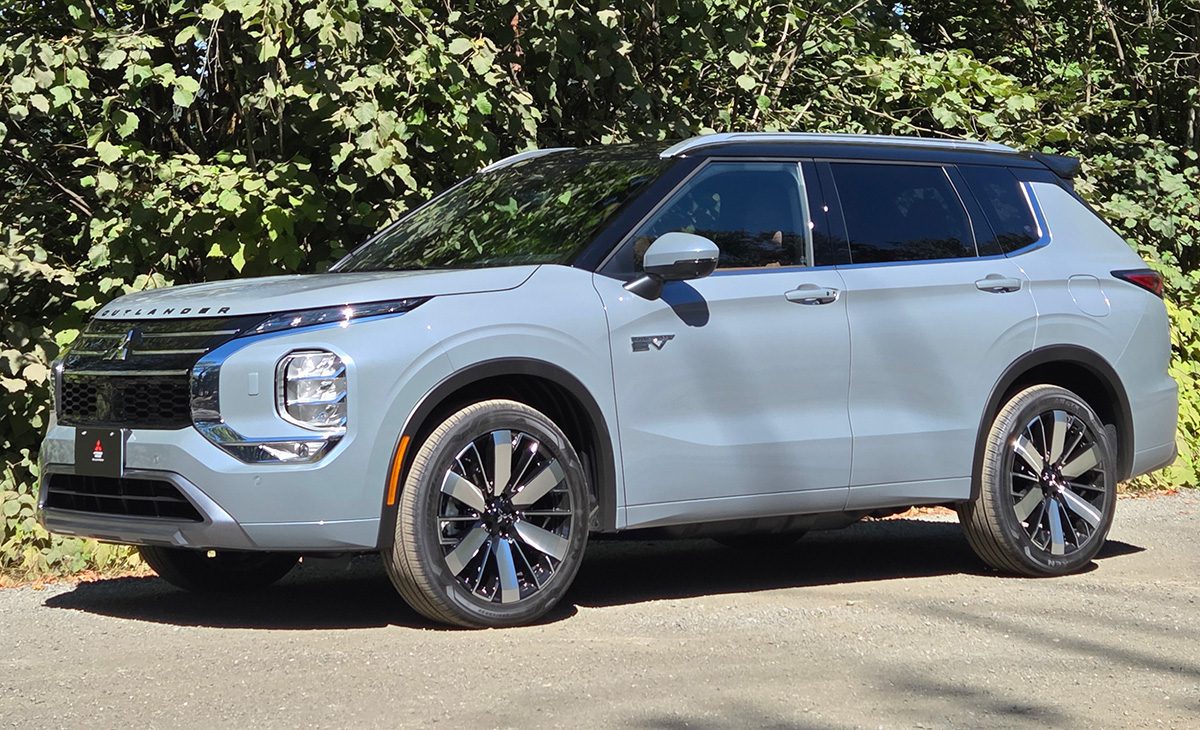
The 2026 Mitsubishi Outlander PHEV emerges as a compelling option in the compact SUV segment, offering a nominal third row and a significantly enhanced 45 miles of all-electric range. This updated plug-in hybrid SUV presents a viable electric vehicle alternative, particularly for owners committed to regular charging.
Midway through its second-generation model life, the 2026 Mitsubishi Outlander PHEV introduces a higher-capacity battery pack, extending its electric driving capability. Alongside increased range, it features several refinements to its appearance, trim, and digital equipment. While the exterior design largely remains consistent, the electric powertrain components have undergone substantial upgrades.

Key Takeaways: 2026 Mitsubishi Outlander PHEV
- The 2026 Mitsubishi Outlander PHEV now boasts an EPA-rated 45 miles of all-electric range, up from 38 miles, thanks to a larger 22.7 kWh battery pack.
- Total powertrain output has increased from 248 horsepower to 297 horsepower, enhancing performance without changes to the electric motors.
- The vehicle has shifted from Nissan’s AESC battery cells back to GS-Yuasa prismatic cells, a move that improves power delivery and reduces internal resistance.
- Despite industry trends, the 2026 Mitsubishi Outlander PHEV retains a CHAdeMO DC fast-charging port on select trims, offering a reduced 29-minute charge to 80 percent.
- Pricing for the updated model ranges from $44,990 for the ES trim to $55,440 for the Black Edition, including a mandatory delivery fee.
- The Outlander PHEV’s powertrain offers a complex array of driver-configurable settings, including multiple drive modes, regen levels, and traction options.
- The vehicle’s engineering reflects a return to Mitsubishi’s own components, replacing Nissan’s engine and battery cells from earlier versions.
A Legacy of Plug-in Hybrid Innovation
For a significant portion of the 2010s, the Mitsubishi Outlander PHEV held the distinction of being the world’s best-selling plug-in hybrid. Its first-generation model, introduced to the European market as incentives and tailpipe emission limits were taking shape, achieved remarkable sales figures. It sold approximately 300,000 units across 60 countries between 2013 and 2021, establishing Mitsubishi’s early leadership in the PHEV segment.
The Second Generation’s Journey
The second-generation Outlander PHEV made its debut in the United States as a 2023 model. This iteration represented a notable evolution from its predecessor, offering improved aesthetics, extended electric range, and significantly upgraded interior appointments. Approximately 22,000 units of this model have been sold in the US through June of this past year, indicating a continued, albeit more competitive, presence in the market.
Now, as it approaches the midpoint of its lifecycle, the second-generation Outlander PHEV has received a substantial refresh. These updates aim to solidify its position by enhancing its electric capabilities and overall appeal. The focus of this refresh has been primarily on the powertrain, ensuring the 2026 Mitsubishi Outlander PHEV remains competitive in a rapidly evolving market.
Significant Powertrain and Battery Enhancements
The core of the 2026 Mitsubishi Outlander PHEV‘s update lies in its powertrain. As before, the system employs a sophisticated arrangement of a front motor and generator, and a rear motor, allowing for both series and parallel hybrid operations. This flexibility enables the vehicle to select the most energy-efficient mode to propel the car, with transitions designed to be largely imperceptible to the driver.
Regenerative braking is a fundamental component of the Outlander PHEV’s efficiency, recapturing energy that would otherwise be dissipated as heat during braking. The system offers an extensive array of configuration options for drivers, perhaps even an overwhelming number, to tailor the driving experience. These include various powertrain settings, drive modes, and traction control options, designed to optimize performance across different conditions.
Driving Dynamics and Configurable Experience
Powertrain settings for the 2026 Mitsubishi Outlander PHEV include the default ‘Normal’ mode, ‘EV’ for electric-only operation, ‘Save’ to preserve battery charge, and ‘Recharge’ to use the engine as a generator. Complementing these are three drive modes: Normal, Eco, and Power, along with four traction options: Tarmac, Gravel, Snow, and Mud, catering to diverse driving environments.
Further personalization is available through five levels of regenerative braking, from B1 to B5, with B0 allowing for coasting without regen. The ‘Innovative Pedal’ (i-Pedal) function offers even stronger deceleration by blending regenerative and friction brakes. Kevin Sittner, manager of EV powertrain engineering for Mitsubishi Motors North America, characterized it, stating: “Think of it as about B8.” However, it does not enable true one-pedal driving, requiring the driver to use the brake pedal for a complete stop below approximately 8 mph. An ‘Auto Hold’ function can eliminate idle creep, enhancing convenience.
During a recent drive of the 2026 Mitsubishi Outlander PHEV outside Seattle, the vehicle demonstrated handling characteristics largely consistent with the 2023 model. It proved to be a quiet and comfortable compact crossover. Engine starts remained largely unnoticed, and the SUV maintained exclusive battery power for most driving scenarios. Only under significant demand, such as accelerating up a steep incline with a fully charged battery, did the engine engage. A pedal detent helps drivers avoid inadvertently activating the engine, preserving electric operation.
While the Outlander PHEV drives as a pleasant and comfortable compact crossover, it conveys a ‘larger’ feel compared to the 2027 Mitsubishi Eclipse Sportback battery-electric hatchback. The Outlander’s designation as a large compact SUV is partly due to its inclusion of a third row, though its practicality for adult passengers remains limited.
Navigating the Alliance and Mitsubishi’s Reassertion
The development of the current generation Outlander coincided with Mitsubishi’s integration into the Nissan-Renault-Mitsubishi Alliance. This strategic partnership, which aimed to unite a major Japanese manufacturer with a large French counterpart and a smaller Japanese firm, ultimately faced significant challenges. At one point, Nissan held a 34 percent controlling interest in Mitsubishi, granting it veto power under Japanese law, which heavily influenced vehicle development.
Consequently, the gasoline-powered Outlander was built upon the Nissan Rogue’s underpinnings and utilized its 2.5-liter engine. However, the PHEV variant maintained Mitsubishi’s own 2.4-liter Atkinson Cycle engine, transplanting the first-generation PHEV’s powertrain onto the Rogue platform. Even the 20-kilowatt-hour battery pack, originally rated for an EPA-estimated 38 miles of range, shifted from Mitsubishi’s long-standing partner Lithium Energy Japan (a joint venture with GS Yuasa) to Nissan’s battery joint venture, AESC.
Shifting Component Sourcing
Corporate shifts within Nissan, including the high-profile arrest and subsequent escape of CEO Carlos Ghosn, led to significant restructuring. This included plant closures, staff reductions, and a reduction in Nissan’s stake in Mitsubishi to 24 percent. These changes appear to have facilitated a return to Mitsubishi’s own engineering in both updated Outlander versions.
The gasoline version of the Outlander has now replaced the Nissan 2.5-liter engine with a 1.4-liter Mitsubishi engine, previously seen in the Eclipse Cross small SUV, augmented by a 48-volt mild-hybrid system. More pertinent to the plug-in hybrid model, the 2026 Mitsubishi Outlander PHEV has reverted to GS-Yuasa prismatic cells for its updated battery pack. These cells, utilized throughout the first generation of the PHEV, are optimized for power delivery, making them highly suitable for hybrid applications rather than pure battery-electric vehicles.
Mitsubishi reports that these newer cells feature 33 percent less internal resistance, enabling the battery to deliver up to 60 percent more power than its predecessor. This increased power capacity allows for a reduction in engine engagement at speeds above 25 mph and supports more extensive electric-only operation, even at highway speeds. The battery capacity has also increased to 22.7 kWh, translating to a new EPA-rated range of 45 miles. Concurrently, the total powertrain output has significantly risen from 248 horsepower to 297 hp, a gain attributed by Kevin Sittner to updated control software that safely draws more power from the larger battery pack, rather than changes to the motors themselves.
Charging Infrastructure: The CHAdeMO Conundrum
The previous Outlander PHEV featured a J-1772 port for Level 1 and Level 2 AC charging on its left-rear fender. Uniquely, it also included a DC fast-charging port using the CHAdeMO connector on its right-rear fender. This configuration persists in the 2026 Mitsubishi Outlander PHEV, making it the sole vehicle sold in the US market to offer a 50-kilowatt CHAdeMO port. While the automotive industry rapidly transitions from CCS to the North American Charging Standard (NACS) for EVs, Mitsubishi’s decision to retain CHAdeMO is notable, though the company downplayed its mention during presentations, listing it primarily in specifications.
Charging Performance and Owner Behaviour
The 2026 Mitsubishi Outlander PHEV benefits from reduced resistance and improved cooling in its new battery, which allows the vehicle to sustain its maximum charging rate for a longer duration through the charge curve. Despite these improvements, Level 1 charging from 0 to 100 percent remains a lengthy process, taking 16.5 hours for the 2026 model, a negligible reduction from the previous version. Level 2 charging time also remains consistent at 6.5 hours, largely due to the unchanged 3.3-kW onboard charger.
For owners who manage to locate a CHAdeMO fast-charging station, the DC fast-charging time to 80 percent has improved, falling from 38 minutes to 29 minutes. This offers a quicker turnaround for those needing rapid power boosts on longer journeys. Mitsubishi has also begun collecting preliminary data on the charging habits of 2023-2025 Outlander PHEV owners in the US. This data is crucial, especially considering the $7,500 federal incentive previously available for leased EVs, which might have attracted buyers primarily interested in the discount rather than consistent plug-in behavior. Further insights from this data are anticipated to provide a clearer picture of real-world usage.
Trim Levels and Market Positioning
The 2026 Mitsubishi Outlander PHEV is offered across three distinct trim levels, starting with the ES model. This entry-level variant comes equipped with 18-inch wheels, dual 12.3-inch displays (one for instrumentation and a central touchscreen), LED headlights and taillights, an auto-dimming rear-view mirror, and heated front seats, providing a robust foundational package.
Stepping up, the mid-grade SE model adds several premium features. These include 20-inch alloy wheels, an option for a light grey interior, a suite of semi-autonomous safety and driving assistance features, a hands-free power liftgate, rain-sensing automatic wipers, and heated and folding mirrors. An optional Tech Package for the SE trim further enhances the offering with a power panoramic sunroof and a premium 12-speaker Yamaha Ultimate audio system, elevating the in-cabin experience.
At the top of the range, the Outlander SEL offers luxurious upgrades such as leather seating, ventilated front seats, a heated steering wheel, a power panoramic sunroof, and the notable DC fast-charging option. A Premium Package for the SEL trim introduces refined leather upholstery, the advanced Yamaha audio system, a head-up display, a digital rear-view mirror, and aesthetic touches like illuminated scuff plates. New for 2026 is the ‘Black Edition’ appearance model, which darkens all body chrome and various other trim elements. This edition incorporates most of the SEL Premium equipment and adds massaging front seats for ultimate comfort.
Pricing Details for the 2026 Model
The 2026 Mitsubishi Outlander PHEV lineup ranges in price, starting at $44,990 for the ES trim. The top-tier Black Edition commands a price of $55,440. All listed prices include a mandatory delivery fee of $1,745. These Outlander models are imported directly from Japan, with the 2026 versions currently available for purchase. The strategic pricing and feature differentiation across trims aim to appeal to a broad spectrum of buyers seeking a versatile and efficient plug-in hybrid SUV.
Frequently Asked Questions (FAQ)
What is the all-electric range of the 2026 Mitsubishi Outlander PHEV?
The 2026 Mitsubishi Outlander PHEV offers an EPA-rated all-electric range of 45 miles. This significant improvement from its predecessor is attributed to a larger 22.7 kWh battery pack, allowing for more extensive emission-free driving on a single charge.
Has the powertrain been upgraded in the 2026 model?
Yes, the 2026 Mitsubishi Outlander PHEV features a more powerful powertrain. The total system output has increased from 248 horsepower to 297 horsepower. This enhancement comes from updated control software that efficiently draws more power from the new, higher-capacity battery.
What type of battery cells are used in the new Outlander PHEV?
The 2026 Outlander PHEV has transitioned to GS-Yuasa prismatic cells for its battery pack. These cells, previously used in the first-generation model, are designed for superior power delivery, which is ideal for hybrid applications, and contribute to lower internal resistance.
Does the 2026 Mitsubishi Outlander PHEV offer fast charging?
Yes, the 2026 Mitsubishi Outlander PHEV, specifically the SEL and Black Edition trims, includes a CHAdeMO DC fast-charging port. This allows for an 80 percent charge in approximately 29 minutes, offering quicker charging options despite the industry’s shift away from the CHAdeMO standard.
What are the key differences in trim levels for the 2026 model?
The 2026 Outlander PHEV is available in ES, SE, and SEL trims, along with a new Black Edition. Key differentiators include wheel sizes, interior materials (e.g., leather in SEL), advanced safety features, premium audio options, and luxury additions like ventilated seats and a panoramic sunroof in higher trims.
What is the starting price for the 2026 Mitsubishi Outlander PHEV?
The 2026 Mitsubishi Outlander PHEV starts at $44,990 for the ES trim. The pricing can go up to $55,440 for the top-tier Black Edition. All prices mentioned include a mandatory delivery fee of $1,745, offering a transparent cost structure for buyers.