
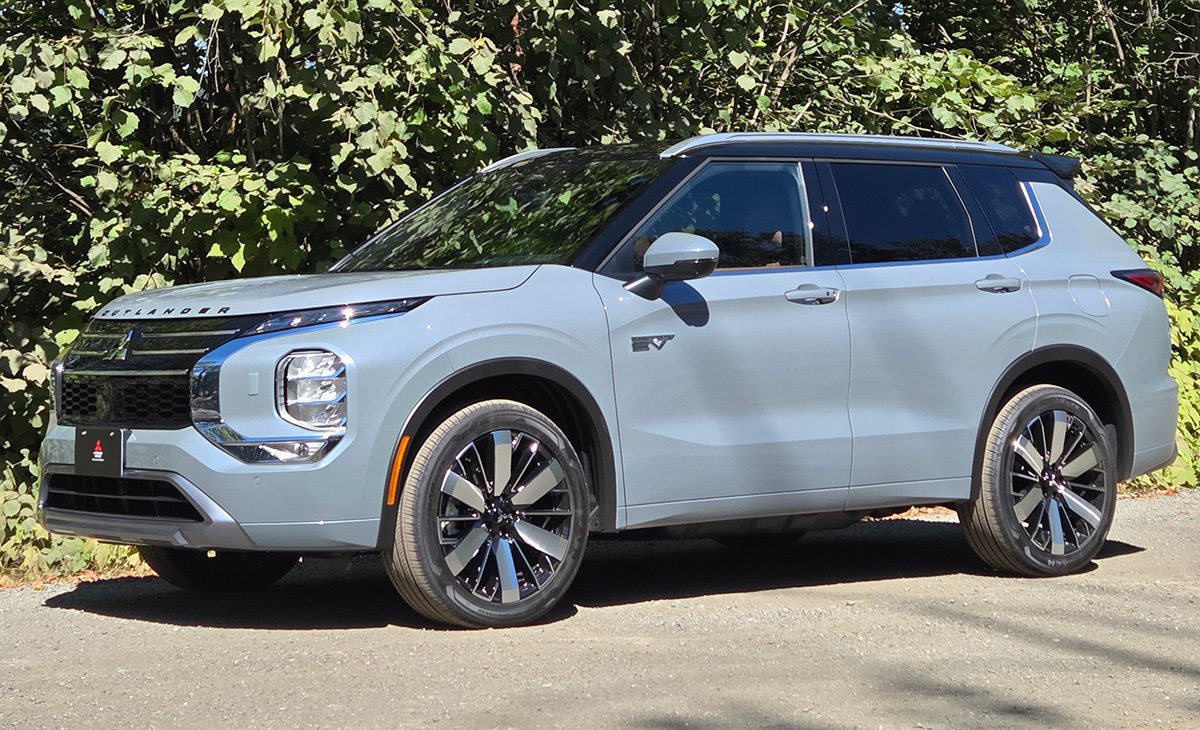
Key Takeaways:
- The 2026 Mitsubishi Outlander PHEV, a compact SUV with an optional third row, receives a significant refresh focused on its plug-in hybrid powertrain.
- It now offers an EPA-rated 45 miles of all-electric range, up from 38 miles, thanks to a larger 22.7 kWh battery pack.
- Total powertrain output has increased to 297 horsepower, a notable rise from the previous 248 hp.
- The model reverts to GS-Yuasa prismatic cells for its battery, favoring power delivery for hybrid applications.
- Uniquely, the 2026 Outlander PHEV retains a 50-kilowatt CHAdeMO DC fast-charging port on select trims, an anomaly in the evolving North American market.
- The vehicle features a complex powertrain offering multiple drive and regeneration modes, some of which do not ‘latch’ between ignition cycles.
- Available in ES, SE, SEL, and a new Black Edition trim, pricing ranges from $44,990 to $55,440, including delivery.
The Mitsubishi Outlander PHEV, a vehicle that once led global plug-in hybrid sales, has received a substantial refresh for its 2026 model year. This updated compact SUV aims to solidify its position as a compelling electric vehicle alternative, especially for drivers committed to regular charging. Boasting an extended all-electric range and enhanced power, the 2026 Mitsubishi Outlander PHEV builds upon the strengths of its second-generation predecessor while incorporating crucial engineering advancements and a return to Mitsubishi’s core component suppliers.
For much of the 2010s, the initial generation of the Outlander PHEV dominated the global market. Launched in Europe amidst favorable incentives and stringent tailpipe emission regulations, it achieved remarkable success, selling approximately 300,000 units across 60 countries between 2013 and 2021. Its pioneering role established Mitsubishi as a significant player in the burgeoning plug-in hybrid segment.
The second-generation Outlander PHEV made its debut in the U.S. as a 2023 model, marking a significant evolution. Over 22,000 units were sold through June of the current year, indicating a steady demand. This iteration, which debuted nearly four years prior to this refresh, was lauded for its aesthetic improvements, increased electric range, and notably upgraded interior appointments, setting a higher standard for the model line.
Significant Powertrain Enhancements for 2026
Midway through its lifecycle, the second-generation 2026 Mitsubishi Outlander PHEV undergoes a refresh centered on its electrified heart. While its exterior appearance remains largely consistent, the plug-in hybrid powertrain receives substantial upgrades. These include a new battery pack with a higher capacity, which translates directly into an increased all-electric driving range. Minor refinements to its trim and digital equipment further enhance the user experience, though the choice of fast-charging port remains a point of industry discussion.

The Outlander PHEV’s powertrain architecture continues its sophisticated blend of series and parallel operation. Depending on driving conditions and energy efficiency requirements, the front motor and generator, along with the rear motor, seamlessly transition between modes via the front transaxle. These transitions are engineered to be largely imperceptible to the driver, ensuring a smooth and refined driving experience, even during engine-start events.
Like all hybrids, the 2026 Mitsubishi Outlander PHEV incorporates regenerative braking, a crucial system for recapturing kinetic energy that would otherwise be dissipated as heat during deceleration. This energy is then converted back into electricity and stored in the battery, improving overall efficiency. However, Mitsubishi offers a multitude of ways for drivers to configure the driving experience, perhaps even an excessive number for some.
Navigating Driving Modes and Regeneration Levels
Drivers of the 2026 Mitsubishi Outlander PHEV can select from various powertrain settings. These include the default ‘Normal’ mode, ‘EV’ for exclusive electric-only operation, ‘Save’ to conserve battery charge for later use, and ‘Recharge’ which actively uses the gasoline engine as a generator to replenish the battery. Complementing these are three distinct drive modes: ‘Normal,’ ‘Eco,’ and ‘Power,’ alongside four traction options tailored for specific terrains: ‘Tarmac,’ ‘Gravel,’ ‘Snow,’ or ‘Mud.’
Further customization is available through five levels of regenerative braking, ranging from B1 to B5, with B0 representing pure coasting with no regeneration. For stronger deceleration, the ‘Innovative Pedal’ (i-Pedal) blends regenerative and friction brakes. Kevin Sittner, manager of EV powertrain engineering for Mitsubishi Motors North America, characterized it as equivalent to “about B8.” It’s important to note, however, that the i-Pedal does not offer true one-pedal driving, requiring the driver to apply the brake pedal for a complete stop from approximately 8 mph. An ‘Auto Hold’ function can eliminate the programmed idle creep, irrespective of the chosen regen level.
A common challenge in many battery-powered vehicles, including the 2026 Mitsubishi Outlander PHEV, is the retention of driver settings. While some functions, like Auto Hold, ‘latch’ and are remembered through ignition cycles, others, such as the selected drive mode, revert to ‘Normal’ each time the car is switched off. This forces drivers to re-select their preferred mode on every journey, a convenience feature that competitors like GM and Hyundai-Kia have successfully addressed in their electric vehicles.
On-Road Performance and Design Considerations
During initial test drives outside Seattle in early August, the 2026 plug-in Outlander demonstrated a driving character largely consistent with the 2023 model. Over more than 50 miles, the vehicle proved relatively quiet and comfortable, with engine starts often going unnoticed. It capably operated exclusively on battery power in most, if not all, typical driving scenarios. However, ascending a particularly steep incline did necessitate the activation of the gasoline engine, even with a fully charged battery. A thoughtfully designed pedal detent helps prevent unintentional engagement of engine power.
Overall, the 2026 Mitsubishi Outlander PHEV presents itself as a pleasant compact crossover. Its stature on the road is notably larger when compared to the 2027 Mitsubishi Eclipse Sportback battery-electric hatchback, a vehicle effectively positioned as a rebadged Nissan Leaf with mild styling updates. The Outlander, by contrast, is a substantial compact SUV, offering a nominal third row of seating, though accommodating adults in this rearmost row proved challenging.
A Return to Mitsubishi Engineering Roots
The design and engineering trajectory of the current generation Outlander was significantly influenced by Mitsubishi’s integration into the Nissan-Renault-Mitsubishi Alliance. This alliance, ultimately a complex and challenging endeavor, saw Nissan acquire a 34 percent stake in Mitsubishi, granting it a controlling interest under Japanese law. Consequently, the Outlander’s underlying platform was shared with the Nissan Rogue, and its gasoline-only variants initially utilized the Rogue’s 2.5-liter engine.
However, the Outlander PHEV model maintained its distinct Mitsubishi identity regarding its internal combustion engine. It continued to employ the 2.4-liter Atkinson Cycle engine, a powerplant carried over from the first-generation PHEV. The original 20 kWh battery pack in the second-generation model, offering an EPA-rated 38 miles of electric range, sourced its pouch cells not from Mitsubishi’s long-standing partner Lithium Energy Japan (a joint venture with GS Yuasa), but from Nissan’s own battery joint venture, AESC.
The automotive landscape has since shifted. Nissan’s corporate restructuring, including the high-profile arrest and subsequent escape of its CEO Carlos Ghosn, led to significant organizational changes. These included plant closures, staff reductions, and a strategic reduction of Nissan’s stake in Mitsubishi to 24 percent. This shift has seemingly allowed Mitsubishi to reassert more of its proprietary engineering into its updated models, including the 2026 Mitsubishi Outlander PHEV.
The updated gasoline version of the Outlander, for instance, has replaced the Nissan 2.5-liter engine with a 1.4-liter Mitsubishi engine, previously found in the Eclipse Cross small SUV, now augmented with a 48-volt mild-hybrid system. More pertinent to the 2026 Mitsubishi Outlander PHEV, the plug-in hybrid variant has reverted to using GS-Yuasa prismatic cells for its enhanced battery. These are the same type of cells that were employed throughout the first generation of the Outlander PHEV, signifying a return to a trusted partnership and component strategy.
Advanced Battery Technology and Charging
The newer GS-Yuasa cells in the 2026 Mitsubishi Outlander PHEV are optimized more for power delivery, making them highly suitable for hybrid applications where rapid energy discharge is often required, rather than the sustained energy capacity typically prioritized in battery-electric vehicles. Mitsubishi highlights that these updated cells boast 33 percent less internal resistance, enabling the battery to deliver up to 60 percent more power compared to its predecessor. This increased power output allows the vehicle to rely less on the engine above 25 mph and supports more extensive electric-only operation, even at highway speeds.
The battery capacity in the 2026 model has been increased to 22.7 kWh, translating to a significantly improved EPA-rated all-electric range of 45 miles. The total powertrain output has also seen a substantial boost, climbing from 248 horsepower in the previous model year to an impressive 297 hp. Kevin Sittner confirmed that this power increase is primarily due to updated control software that safely draws more power from the larger, more capable battery pack, rather than changes to the electric motors themselves.
The Persistent CHAdeMO Connector
One distinctive feature that sets the 2026 Mitsubishi Outlander PHEV apart in the North American market is its retention of a CHAdeMO DC fast-charging port. While the automotive industry in the region is rapidly transitioning from the CCS (Combined Charging System) standard to NACS (North American Charging Standard) for electric vehicles, the plug-in Outlander remains the sole vehicle sold in the U.S. equipped with a 50-kilowatt CHAdeMO port. This option is available on the SEL and Black Edition trim levels. Mitsubishi’s presentation on the new model notably omitted direct mention of this port, although it was duly listed in the specifications.
Despite the larger battery pack, the 2026 model benefits from reduced internal resistance and improved cooling, which allows it to sustain its maximum charging rate for a longer duration during the charge cycle. Level 1 charging (from a standard household outlet) remains a lengthy process at 16.5 hours for a 0 to 100 percent charge, only marginally quicker than before. Level 2 charging, facilitated by the 3.3-kW onboard charger, maintains a 6.5-hour charge time despite the increased battery capacity. For those able to locate a compatible CHAdeMO fast-charging station, the DC fast-charging time to 80 percent has improved, decreasing from 38 minutes to 29 minutes.
A crucial question for any plug-in hybrid is owner charging behavior. Mitsubishi has collected preliminary data on the plugging-in habits of 2023-2025 Outlander PHEV buyers in the U.S. It’s noteworthy that during the sale of the previous version, a $7,500 federal incentive was available for leased EVs. This incentive may have effectively offered a top-trim Outlander at a significant discount, potentially attracting buyers whose primary motivation was not necessarily maximizing electric-only driving. Further comprehensive data on charging patterns is anticipated.
Trim Levels and Market Positioning
The 2026 Mitsubishi Outlander PHEV is offered across four distinct trim levels, beginning with the ES. This base model comes equipped with 18-inch wheels, a dual 12.3-inch display setup (one for driver instrumentation and a central touchscreen for infotainment), LED headlights and taillights, an auto-dimming rearview mirror, and heated front seats, providing a solid foundation of features.
Stepping up to the mid-grade SE model introduces 20-inch alloy wheels, the option for a light grey interior, a suite of semi-autonomous safety and driving assistance features, a hands-free power liftgate, rain-sensing automatic wipers, and heated and folding mirrors, among other enhancements. An optional Tech Package for the SE trim further adds a power panoramic sunroof and a premium 12-speaker Yamaha Ultimate audio system, elevating the in-cabin experience.
The Outlander SEL trim builds upon these offerings with luxurious additions such as leather seating, ventilated front seats, a heated steering wheel, and the power panoramic sunroof as standard. Crucially, the SEL trim also includes the DC fast-charging option. A Premium Package, available for the SEL, incorporates even more high-end features: upgraded leather upholstery, the Yamaha audio system, a head-up display, a digital rearview mirror, and illuminated scuff plates for a refined touch. For 2026, a new ‘Black Edition’ appearance model joins the lineup. This trim distinguishes itself with blacked-out body chrome and darkened trim elements throughout the vehicle, and includes most of the SEL Premium equipment, alongside the addition of massaging front seats for ultimate comfort.
Pricing for the 2026 Mitsubishi Outlander PHEV models ranges from $44,990 for the ES trim to $55,440 for the Black Edition, with all prices inclusive of a mandatory $1,745 delivery fee. All Outlander models are imported from Japan, and the 2026 iterations are currently available for purchase.
FAQ Section
What is the all-electric range of the 2026 Mitsubishi Outlander PHEV?
The 2026 Mitsubishi Outlander PHEV offers an EPA-rated all-electric range of 45 miles. This represents an improvement over the previous model’s 38-mile range, largely due to its increased battery capacity of 22.7 kWh, enabling more extensive zero-emission driving.
What are the power output improvements in the 2026 Outlander PHEV?
The 2026 Outlander PHEV boasts a total powertrain output of 297 horsepower, a significant increase from the 248 hp of the prior model. This boost is achieved through updated control software optimizing power delivery from the larger, more efficient 22.7 kWh battery pack.
Does the 2026 Mitsubishi Outlander PHEV have fast-charging capabilities?
Yes, select trim levels (SEL and Black Edition) of the 2026 Outlander PHEV are equipped with a 50-kilowatt CHAdeMO DC fast-charging port. This allows the battery to charge from 0 to 80 percent in approximately 29 minutes, a quicker time than before.
What changes have been made to the battery technology?
For 2026, the Outlander PHEV returns to using GS-Yuasa prismatic cells for its battery pack. These newer cells offer 33 percent less internal resistance, allowing for up to 60 percent more power delivery and enhancing electric-only operation at higher speeds, suitable for hybrid performance.
What are the available trim levels and their price range?
The 2026 Mitsubishi Outlander PHEV is available in four trim levels: ES, SE, SEL, and the new Black Edition. Pricing, including a $1,745 delivery fee, ranges from $44,990 for the base ES model up to $55,440 for the top-tier Black Edition, offering various feature sets.
Does the 2026 Outlander PHEV offer one-pedal driving?
While the 2026 Outlander PHEV features an ‘Innovative Pedal’ (i-Pedal) that blends regenerative and friction braking for strong deceleration, it does not provide true one-pedal driving. Drivers are still required to use the brake pedal for a complete stop from approximately 8 mph.
How does the 2026 model compare to its predecessors in terms of engineering lineage?
The 2026 model marks a return to Mitsubishi’s core engineering, particularly in battery cell sourcing (GS-Yuasa) and engine choice for the gasoline variant, moving away from shared Nissan components that characterized the initial second-generation models during the Nissan-Renault-Mitsubishi Alliance period.
Are driver settings retained after turning off the vehicle?
Some driver settings, such as ‘Auto Hold,’ are retained through ignition cycles. However, certain preferences, like the selected drive mode, revert to ‘Normal’ when the car is switched off, requiring drivers to re-select them for each journey.