
The electric vehicle market continues its upward trajectory, with sales rising 11.4% in the first quarter of 2025 compared to the same period in 2024, according to Cox Automotive. While long-term forecasts predict sustained double-digit growth, the industry faces near-term volatility, including potential supply chain disruptions from fluctuating tariff plans. Amidst these market dynamics, engineers are prioritizing the optimization of current EV battery technology to enhance safety, durability, and energy density, as transformative technologies like solid-state batteries remain years away.
Addressing Key EV Battery Thermal Management Challenges
A critical aspect of battery optimization lies in effective thermal management. Batteries operate as complex ecosystems requiring precise temperature regulation for optimal performance and to mitigate risks during extreme events. This involves maintaining ideal temperatures by warming cells when too cold and cooling them when too warm.

The Three Pillars of Battery Thermal Requirements
Battery thermal management encompasses three primary needs:
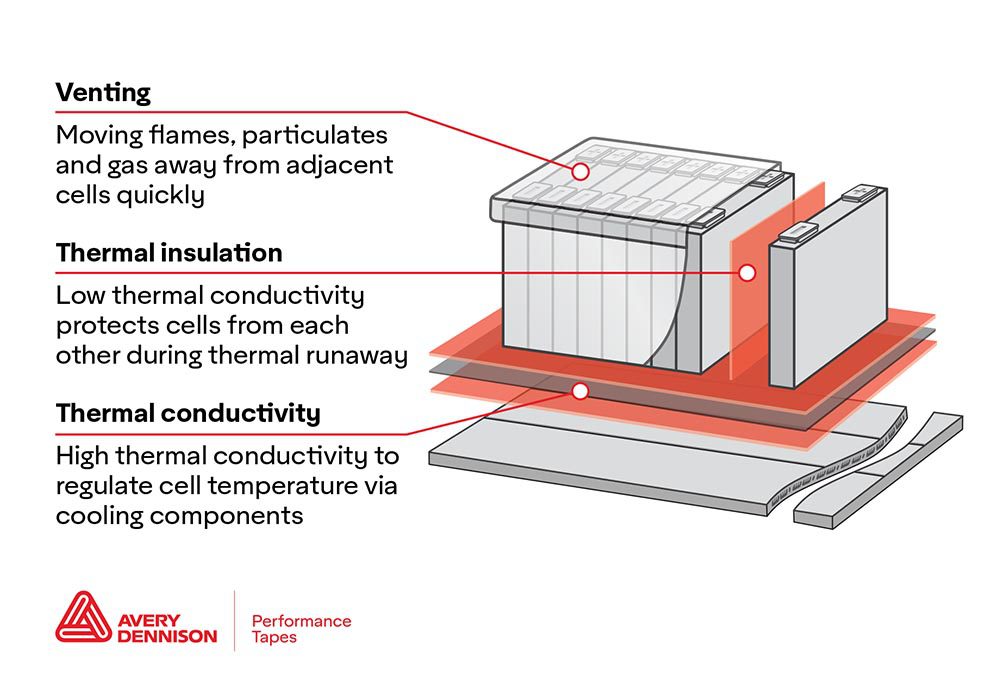
- Thermal Insulation: Low-conductivity materials are essential to shield normally operating cells from overheating, thereby preventing dangerous thermal runaway events.
- Thermal Conductivity: High-conductivity materials, such as thermal interface materials (TIMs), are employed to connect cells with cooling systems and facilitate efficient heat transfer.
- Venting: Robust venting strategies are crucial for allowing the escape of hot gases from malfunctioning cells while simultaneously protecting adjacent cells. These strategies often incorporate specialized thermal materials.
Pressure-sensitive adhesive (PSA) tapes, when integrated with functional materials, offer a versatile, user-friendly, and cost-effective solution to address many of these engineering challenges.
PSA Tapes as Solutions for Thermal Management
The concept of thermal conductivity can be understood by comparing the difficulty of moving through dense forest terrain versus a well-maintained trail. Materials with low thermal conductivity act like the dense forest, impeding heat flow, while high conductivity materials resemble the clear trail, allowing heat to pass easily. PSA tapes, due to their thin profile, offer a short path for heat transfer. Furthermore, they can be integrated with low-conductivity materials, making them suitable for a wide array of thermal management applications within a battery pack.
Mitigating Thermal Runaway with Barrier Solutions
Thermal runaway, a cascading failure where an overheating cell ignites and spreads to adjacent cells, poses a significant safety risk. PSA tapes can be instrumental in preventing or delaying this chain reaction. By encapsulating insulating materials like mica, ceramic paper, or aerogels, these tapes can be strategically placed between cells and modules, or within the pack lid. Their thin nature allows for maximum insulation material thickness within confined spaces, providing crucial bonding while enhancing safety.
While these PSA-based solutions may not always prevent thermal runaway entirely, they can significantly slow its propagation, providing vital extra time for passenger evacuation.
Enhancing Venting Strategies with Flame-Retardant Tapes
When thermal runaway does occur, venting strategies manage the release of hot gases. However, these gases can infiltrate neighboring cells through their vent ports, initiating further runaway events. PSA tapes with anisotropic carriers offer an innovative solution. Applied over vent ports, the flame-retardant side of the tape protects adjacent healthy cells from the initial flames escaping a compromised cell. While this flame retardance is not permanent, it effectively delays the spread of fire, buying precious time for safety.
Dielectric Protection Against Arcing
Electrical arcing in high-voltage battery systems can also lead to fires, impacting thermal management. Polymer film PSA tapes offer high dielectric strength per unit thickness and inhibit heat flow, serving as an effective alternative to traditional dielectric coatings. Advanced PSA tape technologies are now available that can be applied to metal components before stamping and forming, streamlining assembly processes by eliminating the need for curing and cleaning associated with conventional coatings. Avery Dennison has detailed the benefits of such stampable dielectric PSA tape technology in a recent whitepaper.
Available Now: A Comprehensive Portfolio of PSA Tape Solutions
The PSA tape solutions discussed for thermal management, thermal runaway mitigation, and dielectric protection are readily available. Avery Dennison’s EV Battery Portfolio offers a range of engineered PSA tape-based solutions designed to help manufacturers optimize both workflow and design. These tapes can be custom-cut and stamped and are available at scale through local converters, ensuring manufacturers receive the necessary solutions even amidst industry volatility.
Despite potential near-term challenges, the future for electric vehicles remains promising. By leveraging advanced solutions like PSA tapes, manufacturers can confidently deliver products that meet consumer expectations for safety, reliability, and durability.