
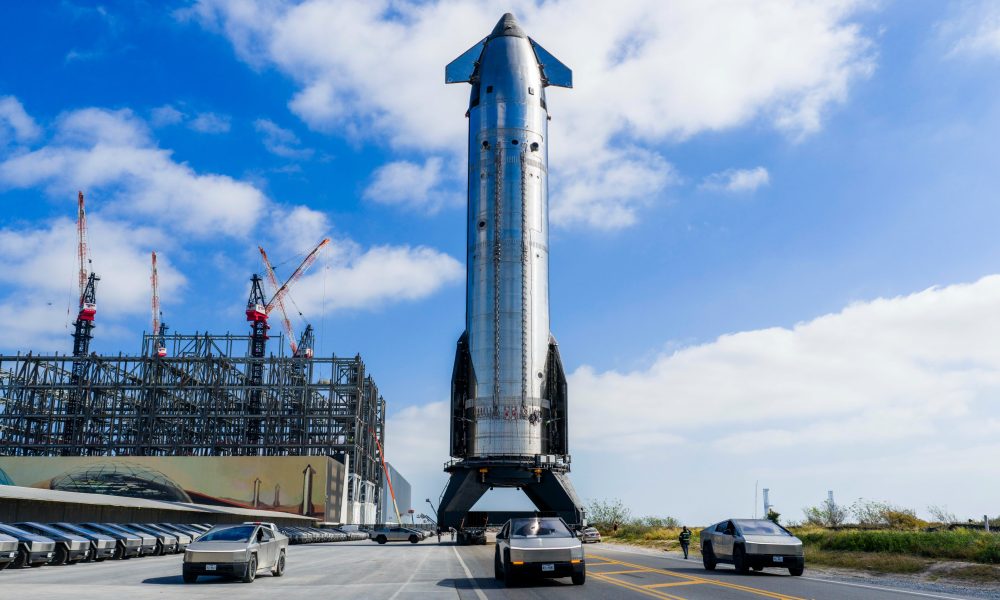
SpaceX Details Starship Tower Catch Attempt Strategy Amidst V3 Development
SpaceX CEO Elon Musk has provided a clearer timeline for the company’s ambitious plan to catch Starship’s upper stage using its launch tower. This update offers significant insight into the spacecraft’s recovery roadmap and the progression towards full reusability.
Starship V3 SN1 Poised for Ground Tests with Enhanced Reusability Focus
In recent communications on the social media platform X, Musk confirmed that Starship V3 Ship 1 (SN1) is undergoing preparation for ground tests. He expressed considerable optimism regarding the advancements in the V3 vehicle design, highlighting its potential to achieve complete reusability.

“Starship V3 SN1 headed for ground tests. I am highly confident that the V3 design will achieve full reusability,” Musk stated, underscoring the engineering focus on this iteration.
Phased Approach to Tower Catch Milestone
Musk elaborated on the specific conditions that must be met before SpaceX will attempt the first tower catch of the Starship upper stage. This crucial maneuver involves the launch tower’s robotic arms intercepting the ascending vehicle.
“Should note that SpaceX will only try to catch the ship with the tower after two perfect soft landings in the ocean. The risk of the ship breaking up over land needs to be very low,” Musk clarified in a subsequent post. This phased approach indicates a strategic effort to mitigate risks.

The implication of these remarks is that SpaceX is prioritizing a series of successful, controlled ocean landings. Only after demonstrating this level of reliability will the company proceed to the more complex land-based catch attempt. This represents a significant step towards the overarching goal of making the Starship system fully reusable.
Starship V3: A Critical Advancement for SpaceX’s Ambitious Goals
SpaceX is reportedly targeting March 2026 for the inaugural flight of the Starship V3. This iteration is widely considered a pivotal development in the company’s long-term vision for Starship, particularly concerning its goal of achieving full and rapid reusability.
The V3 design incorporates several key upgrades designed to enhance performance and operational efficiency. A significant enhancement includes the integration of SpaceX’s latest Raptor V3 engines. These engines are engineered to produce substantially higher thrust compared to their predecessors, while simultaneously reducing production costs and overall vehicle weight.
Furthermore, the V3 design is being optimized for improved manufacturability. This aspect is critical for SpaceX as it aims to scale up Starship production. High-volume manufacturing is essential to support a diverse range of missions, including the deployment of Starlink satellites, lunar exploration initiatives, and the eventual crewed missions to Mars.
Broader Implications for Space Exploration and Commerce
The successful development and implementation of the Starship system, including its tower catch mechanism, are fundamental to SpaceX’s ambitious objectives. Full reusability promises to drastically reduce the cost of access to space, enabling more frequent and ambitious missions.
A recovered and rapidly redeployable Starship could revolutionize space logistics, scientific research, and even off-world colonization efforts. The ability to catch and reuse the massive upper stage without extensive refurbishment would mark a paradigm shift in rocket technology.
SpaceX’s methodical approach, starting with ocean landings and progressing to tower catches, reflects a commitment to safety and reliability. This strategy aims to build confidence in the system’s robustness before undertaking more complex recovery operations over land.
The Road Ahead for Starship Development
The upcoming V3 flights will be closely watched by the aerospace industry and space enthusiasts alike. Successful ground tests and subsequent flight demonstrations, including the challenging tower catch, will be critical milestones.
SpaceX’s relentless pursuit of reusable rocket technology continues to push the boundaries of aerospace engineering. The progress with Starship, particularly the development of the V3 iteration and the refined recovery strategy, highlights the company’s determination to achieve its visionary goals for space travel and exploration.