
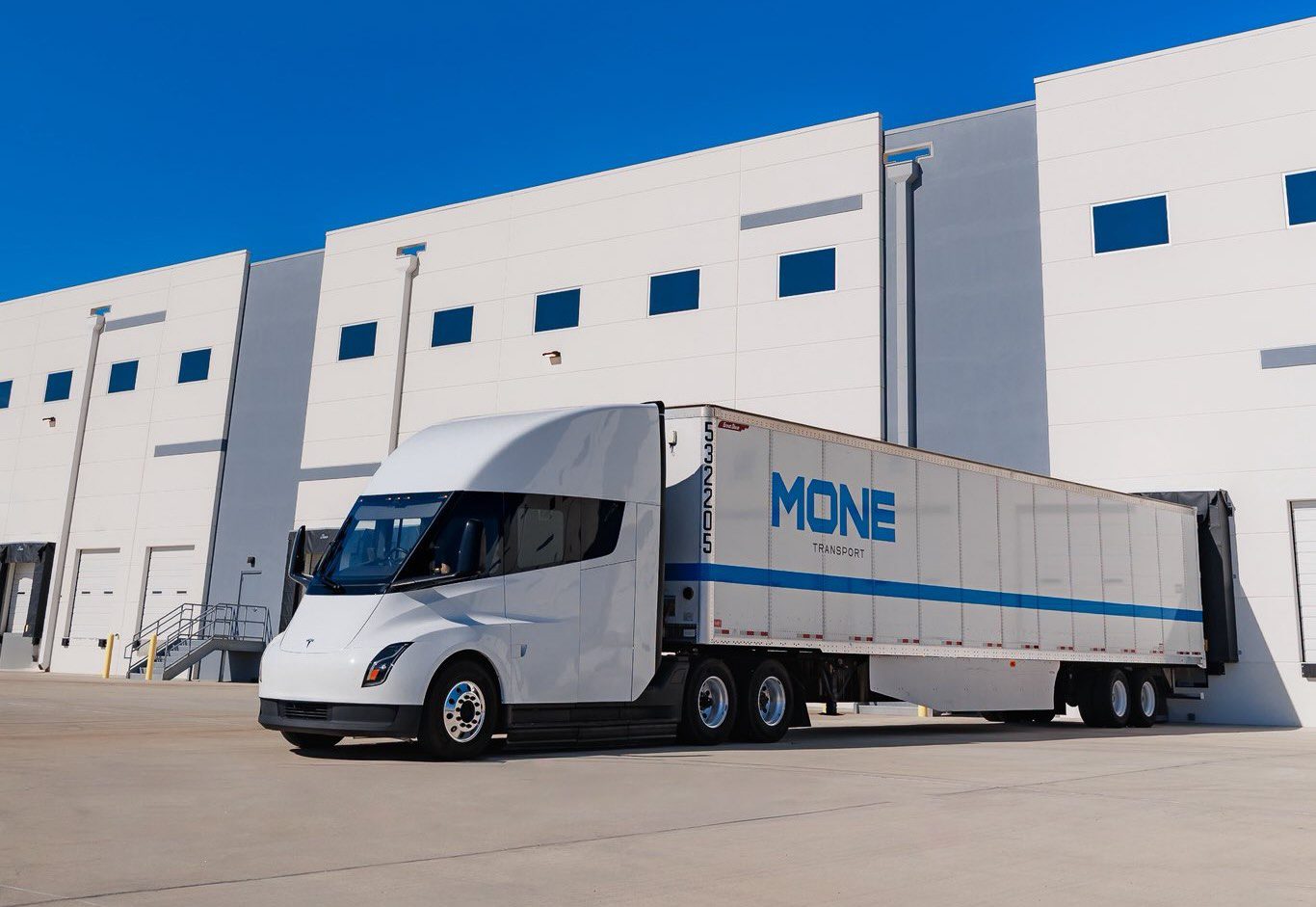
The electric truck sector is witnessing significant advancements, with Tesla’s Semi making notable strides in real-world operational efficiency. Logistics companies are actively participating in trials, providing crucial data on the vehicle’s performance under demanding conditions. Recent results from Mone Transport, a logistics provider, highlight the Tesla Semi’s impressive energy consumption, achieving just over 1 kWh per kilometre during extensive testing in Texas.
Mone Transport Trial Results Emerge
Mone Transport reported being highly satisfied with the Tesla Semi’s performance during its trial period. The company conducted over 7,500 kilometers of testing within its Texas operations, a substantial real-world evaluation.

The key finding from the Mone Transport trial is an energy consumption rate of approximately 1.64 kWh per mile, which translates to roughly 1 kWh per kilometre. This figure underscores the electric truck’s potential for significant operational cost savings and reduced environmental impact.
In a statement released on social media, Mone Transport expressed their enthusiasm: “Mone Transport recently had the opportunity to put the Tesla Semi to the test, and we’re thrilled with the results! Over 4,700 miles of operations at 1.64 kWh/mile in our Texas operation. We’re committed to providing zero emission transportation to our customers!”
Consistent Efficiency Across Trials
The efficiency reported by Mone Transport aligns closely with previous trial results from other major logistics players. Global logistics giant DHL had previously tested the Semi in 2025, reporting similar positive outcomes regarding its energy consumption and operational feasibility.

These consistent results from independent, real-world trials build a strong case for the Tesla Semi’s viability as a sustainable transport solution. The data suggests that electric heavy-duty trucks can meet the rigorous demands of the logistics industry.
PepsiCo’s Growing Electric Fleet
The Tesla Semi first entered a trial phase with PepsiCo, a major food and beverage company, in late 2022. This early adoption by a significant industry player provided valuable insights into the truck’s capabilities in a large-scale operational environment.
Demonstrating its confidence in the electric truck’s performance, PepsiCo announced in 2024 that it had expanded its fleet. The company took delivery of additional Tesla Semis, effectively doubling its electric truck fleet to 50 units. These trucks are primarily operating out of PepsiCo’s manufacturing and distribution facility in California, further validating the practicality of the Semi in daily logistics.
Tesla Semi: Updates and Future Potential
In recent months, Tesla has unveiled an updated version of the Semi, incorporating several key enhancements designed to boost performance and efficiency further.
The upgraded Semi features improved aerodynamics, contributing to better energy efficiency. It also boasts an increased payload capacity, making it more versatile for various logistics needs. Crucially, significant updates have been made to its charging capabilities.
These advancements have led to the truck now offering a projected range of over 800 kilometers on a single charge. The drivetrain specifications include an 800 kW system, with energy consumption rates as low as 1.06 kWh per kilometre. This is a notable improvement over earlier figures and pushes the boundaries for electric heavy-duty vehicle range.
Ultra-Fast Charging and Infrastructure Development
Addressing a critical aspect of electric vehicle adoption, Tesla is also focusing on charging infrastructure. The company is offering 1.2 MW ultra-fast charging for logistics operators using the Semi.
This capability will be enabled through Tesla’s established supercharging hardware, adapted to deliver the high power required for rapid charging of heavy-duty trucks. The development of this infrastructure is key to ensuring that electric trucks can be recharged quickly, minimising downtime and maximising operational efficiency.
Recent reports indicate that the first Megachargers, Tesla’s high-power charging stations designed for the Semi, are now coming online. This rollout is expected to accelerate in the coming months, with dozens of sites planned, signalling a significant step towards supporting widespread electric truck deployment.
Mass Production on the Horizon
The progress in trials and infrastructure development is complemented by advancements in manufacturing. Earlier this month, it was reported that mass production of the Tesla Semi is anticipated to commence soon at the company’s factory currently under construction in Nevada.
The Nevada facility is designed to scale up Semi production significantly, which will be crucial for meeting the growing demand from logistics companies looking to transition to electric fleets.
Decarbonising the Transport Sector
With trial results consistently demonstrating impressive efficiency figures and extended range capabilities, the Tesla Semi appears poised to play a pivotal role in decarbonising a significant segment of the transport industry.
The consistent performance data suggests that the Semi can achieve over 800 kilometers on a single charge in certain configurations. This capability addresses range anxiety, a common concern for heavy-duty trucking operations, and makes electric trucks a more practical alternative to diesel counterparts.
The ongoing trials and infrastructure development are critical components in the broader effort to reduce greenhouse gas emissions from transportation, a sector that remains a major contributor to climate change.