
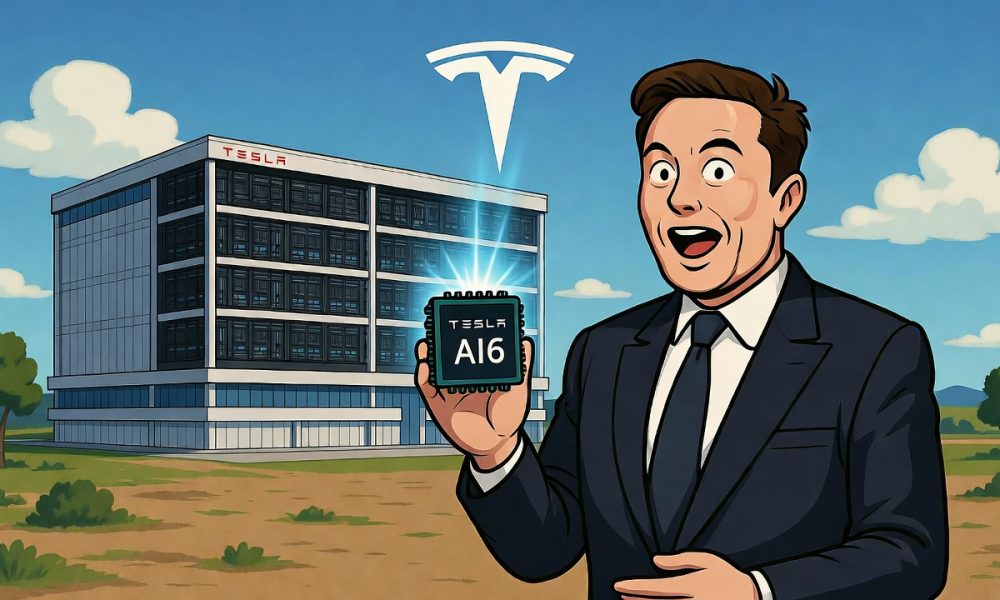
Tesla CEO Elon Musk has provided fresh insights into the company’s ambitious artificial intelligence (AI) hardware strategy, setting high expectations for the forthcoming AI6 self-driving chip. This advanced silicon, still two generations away from its predecessor, is central to Tesla’s long-term vision for autonomous vehicles, humanoid robotics, and robust data center operations.
Musk’s recent statements underscore Tesla’s relentless drive to innovate its in-house chip capabilities, aiming for rapid advancements that could redefine its technological landscape. The AI6 chip is poised to become a critical component in the company’s quest for full autonomy and widespread AI integration.
The Trajectory Towards AI6: A Look at Tesla’s Chip Design
The announcement regarding the Tesla AI6 chip comes as part of a broader, aggressive roadmap for AI hardware development. Tesla is not merely iterating on existing designs but is actively planning several generations ahead, signaling a profound commitment to silicon engineering.
Musk offered a specific timeline for the AI6 chip, stating on March 19, 2026, via social media platform X: “With some luck and acceleration using AI, we might be able to tape out AI6 in December.”
This declaration refers to the ‘tape-out’ stage, a critical milestone in chip development where the design is finalized and sent for manufacturing. An optimistic timeline for tape-out by December highlights Tesla’s intent to expedite its silicon capabilities significantly.

Building on the Foundations: The AI5 Predecessor
The ambitious targets for the Tesla AI6 chip are set against a backdrop of ongoing progress with its immediate predecessor, the AI5. Earlier in January, Musk confirmed that the AI5 design was “in good shape” and “almost done.”
He characterized the AI5 project as “existential” for Tesla, emphasizing its strategic importance and requiring his personal oversight even on weekends. This level of engagement underscores the critical role these custom chips play in the company’s future endeavors.
The AI5 chip is designed to offer substantial performance. Musk described it as roughly equivalent to Nvidia’s Hopper class performance in a single system-on-chip (SoC) configuration. Furthermore, he suggested that a dual AI5 configuration could achieve Blackwell-level performance, but crucially, at a significantly lower cost and reduced power consumption.
Musk highlighted that the AI5 “will punch far above its weight” due to Tesla’s deeply integrated AI software and hardware stack. This co-designed approach ensures maximal utilization of every circuit, optimizing efficiency and performance. While capable of data center training tasks, AI5 is primarily optimized for edge computing applications, specifically within Optimus robots and Robotaxi vehicles.
Anticipating the AI6’s Performance Leap
For the Tesla AI6 chip, Musk envisions even more substantial performance gains. He explained, “In the same half reticle and same process node, we think a single AI6 chip has the potential to match a dual SoC AI5.”
This statement implies that the AI6, despite using the same manufacturing process technology and occupying a similar physical footprint (a ‘half reticle’ refers to a standard area on a silicon wafer), is engineered to deliver the performance equivalent of two AI5 chips combined. This represents a significant leap in computational efficiency and power.
Tesla is targeting ambitious nine-month development cycles for future generations of its chips. This rapid iteration strategy is designed to accelerate progress towards AI7, AI8, and subsequent advancements, allowing the company to quickly integrate new learnings and technologies.
Musk reiterated the high priority of these projects, noting that AI5/AI6 engineering remains his top time allocation at Tesla. He characterized AI5 as “good” and AI6 as “great,” signaling confidence in the upcoming architecture.
Manufacturing Partnerships and Strategic Importance
The manufacturing strategy for these advanced chips involves key industry partners. Samsung is currently expected to produce the Tesla AI6 chips, following substantial deals valued in the billions. The AI5 chips, by contrast, will leverage production facilities from both TSMC and Samsung.
These custom-designed chips are foundational to Tesla’s overarching technological aspirations. They will serve as the backbone for the company’s Full Self-Driving (FSD) system, enhancing safety and capability in autonomous vehicles. Beyond FSD, they are crucial for enabling dexterous movements and advanced functions in the Optimus humanoid robots, as well as powering efficient inference operations within Tesla’s expanding data centers.
Dojo Supercomputer and Future Manufacturing Ambitions
In parallel with the chip development, Musk has also restarted work on the Dojo 3 supercomputer project, now that the AI5 chip is progressing steadily. Dojo is Tesla’s custom-built supercomputer designed for AI training, particularly for its vast datasets of real-world driving data.
Looking further ahead, Tesla has long-term plans for in-house manufacturing capabilities through its Terafab facility. This initiative aims to vertically integrate chip production, reducing reliance on external foundries and providing greater control over its supply chain and technological advancements.
Broader Implications for Tesla’s Ecosystem
By accelerating its chip development using AI tools, Tesla aims to mitigate its dependence on third-party Graphics Processing Units (GPUs), particularly from companies like Nvidia. This strategy allows Tesla to deliver high-performance, energy-efficient solutions precisely tailored to its unique ecosystem of autonomous vehicles, robotics, and AI infrastructure.
The successful development and deployment of the Tesla AI6 chip could mark a pivotal moment in the company’s journey. It stands to solidify Tesla’s position not only as a leader in electric vehicles but also as a significant player in AI hardware and robotics. While the ambitious timelines remain subject to the complexities and realities of advanced manufacturing, the vision articulated by Musk underscores Tesla’s unwavering commitment to pushing the boundaries of artificial intelligence.