
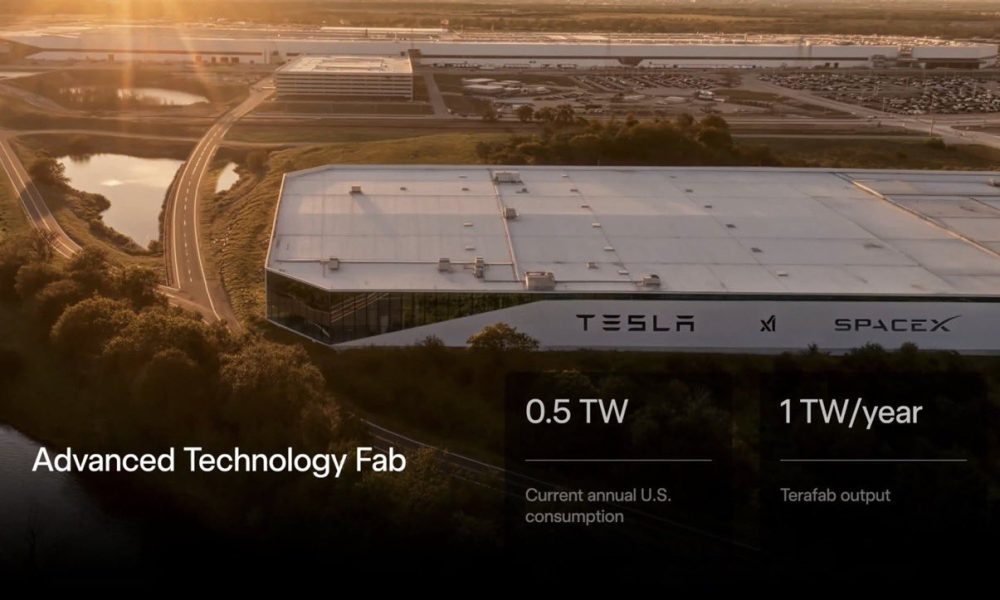
In a momentous announcement on Sunday, March 22, 2026, Elon Musk officially unveiled TERAFAB, an ambitious $20-25 billion joint venture poised to fundamentally transform the landscape of artificial intelligence compute. This monumental project brings together three of Musk’s most influential enterprises: Tesla, SpaceX, and xAI, signifying a deep vertical integration strategy.
Musk characterized TERAFAB as an undertaking of unprecedented magnitude, stating it would be “the most epic chip building exercise in history by far.” The initiative aims to achieve a staggering annual output of over one terawatt of AI computing power, a figure that dramatically eclipses the current global industry production of approximately 20 gigawatts per year.

This immense computational capacity is not merely an industrial goal; Musk articulated it as a critical stride towards an ambitious civilizational objective. He framed TERAFAB as “the next step towards becoming a galactic civilization,” positioning it as an indispensable element for humanity’s eventual expansion into a multi-planetary species.
Addressing the Global Chip Deficit
The genesis of TERAFAB stems from a pressing challenge facing the rapidly evolving AI sector: a profound and growing deficit in advanced semiconductor manufacturing capacity. Existing leading chip suppliers, including industry giants like TSMC, Samsung, and Micron, are struggling to expand their production capabilities quickly enough to keep pace with the explosive, accelerating demand for AI hardware.
For several quarters leading up to the announcement, Musk had consistently hinted at the eventual necessity for his companies to produce their own computing power. This forward-looking strategic shift was driven by the recognition that relying solely on external supply chains would ultimately constrain the growth and development of his various projects.

Musk articulated the situation with clarity, emphasizing the collaborative yet constrained nature of the current supply ecosystem. “We’re very grateful to our existing supply chain… but there’s a maximum rate at which they’re comfortable expanding. We either build the Terafab or we don’t have the chips, and we need the chips, so we build the Terafab,” he stated, underscoring the imperative behind this venture.
This sentiment was echoed by SpaceX, which affirmed the core mission of TERAFAB in a public statement: “We’re building TERAFAB to close the gap between today’s chip production & the future’s demand – a future among the stars.” The statement highlights the dual terrestrial and cosmic ambitions of the project.
Specialised Processors for Earth and Orbit
The TERAFAB facility is designed to manufacture two distinct, highly specialized chip families, each tailored to the unique requirements of Tesla’s and SpaceX’s advanced systems. This bespoke approach ensures optimal performance and efficiency for a diverse range of applications, from autonomous terrestrial systems to robust space-hardened platforms.
The first family comprises advanced edge-inference AI5 and AI6 processors. These chips are meticulously optimized for deployment in Tesla’s Optimus humanoid robots, enabling sophisticated real-time decision-making and interaction. Furthermore, they will power the Full Self-Driving (FSD) systems integrated into Tesla vehicles and the forthcoming Robotaxi fleets, providing the computational backbone for autonomous mobility.
The second category involves high-power D3 chips, engineered specifically to withstand the extreme conditions of space environments. These resilient processors are crucial for orbital applications, ensuring reliable operation in the vacuum, radiation, and temperature fluctuations characteristic of deep space missions and satellite constellations.
TERAFAB’s production goals are ambitious, targeting an annual output of between 100 and 200 gigawatts of terrestrial compute, primarily dedicated to robotics. This capacity is designed to support Musk’s vision of producing 1-10 billion Optimus units per year, reflecting a future where humanoid robots perform a vast array of physical labor.
A significant majority, approximately 80%, of the chips produced by TERAFAB will be dedicated to orbital AI data centers. Overall, the facility aims for an annual production of 100-200 billion custom AI and memory chips, cementing its role as a pivotal global semiconductor hub.
Unprecedented Scale and Phased Development
The sheer physical scale of the TERAFAB project is envisioned to be extraordinary, redefining industrial manufacturing complexes. Musk indicated after the presentation that even the entire Gigafactory Texas campus, an already vast industrial site, would be insufficient to accommodate the full operational footprint of the project.
The complete TERAFAB facility is projected to span approximately 100 million square feet, an area equivalent to the colossal size of 15 Pentagons combined, or roughly three times the area of New York City’s iconic Central Park. Such dimensions underscore the unprecedented ambition and logistical challenge of the undertaking.
The initial phase of construction will commence with an “advanced technology fab” located within the Giga Texas campus in Austin. This strategic placement will facilitate rapid iteration and accelerated development cycles, allowing for swift chip design, fabrication of lithography masks, production, and rigorous testing of wafers—all within a matter of days.
However, the full-scale TERAFAB will necessitate thousands of acres of land and demand over 10 gigawatts of electrical power, capacities far exceeding what the current Giga Texas site can possibly provide. Musk explicitly stated, “We couldn’t possibly fit the Terafab on the GigaTexas campus. It will be far bigger than everything else combined there.”
Consequently, multiple expansive sites are currently under active consideration to host the sprawling land mass required for this colossal project. The immense spatial and power requirements highlight the profound impact TERAFAB is expected to have on regional infrastructure and resource allocation.
Dual Applications: Revolutionising Terrestrial and Orbital AI
The chips manufactured by TERAFAB will serve a dual purpose, powering groundbreaking advancements in both terrestrial and orbital domains. This strategic division leverages the unique strengths of each environment to accelerate AI development and deployment on a galactic scale.
On Earth, TERAFAB’s processors will be the driving force behind autonomous vehicle fleets, enabling sophisticated navigation, decision-making, and safety features. Critically, these chips will also empower billions of Optimus robots, which are designed to perform a wide array of physical labor, potentially revolutionizing industries and daily life.
In the orbital realm, TERAFAB plays an even more futuristic role. SpaceX’s Starship will be instrumental in launching massive AI satellite constellations into low-Earth orbit. These constellations will commence with 100-kilowatt “Mini” units and are designed to scale significantly to larger Megawatt models, ultimately establishing what is envisioned to be the world’s largest data center in space.
Operating AI data centers in space offers several distinct advantages. Orbital platforms benefit from approximately five times greater solar irradiance compared to Earth’s surface, ensuring a consistent and abundant power supply. The vacuum of space also provides highly efficient heat rejection, a critical factor for managing the immense thermal loads generated by high-density computing clusters.
Furthermore, space-based data centers are liberated from the constraints and complexities of terrestrial grid infrastructure. To put this in perspective, the entire United States electricity generation currently totals just 0.5 terawatts, underscoring the scale of orbital power generation being pursued. Musk underscored the guiding principle behind this approach: “Quantity has a quality all its own,” highlighting the strategic value of vast, distributed computing power.
This ambitious orbital vision builds upon previous initiatives, including SpaceX’s filings with the FCC for plans concerning a network of one million orbital data centers, demonstrating a long-term strategy for space-based computation.
A Cornerstone for a Multi-Planetary Future
TERAFAB represents an unprecedented leap in vertical integration, seamlessly combining advanced AI hardware, sophisticated robotics, and cutting-edge orbital infrastructure into a singular, cohesive system. This comprehensive approach is designed to eliminate bottlenecks and accelerate innovation across Musk’s diverse ventures.
Elon Musk himself described TERAFAB as “the final missing piece of the puzzle,” indicating its foundational role in his broader, long-term strategic vision. With production slated to ramp up significantly towards 2027, the project is positioned to be a catalyst for a new era of technological abundance.
The establishment of TERAFAB is expected to bridge the gap between aspirational science fiction and tangible reality, propelling Musk’s companies to the forefront of innovation at a truly galactic scale. This venture is not just about manufacturing chips; it is about building the computational backbone for a future envisioned beyond Earth.
Ultimately, TERAFAB is more than a factory; it is an industrial manifestation of Musk’s grander ambitions for humanity, laying critical groundwork for the journey towards becoming a multi-planetary species and unlocking an era of technological capabilities previously confined to the realm of imagination.