
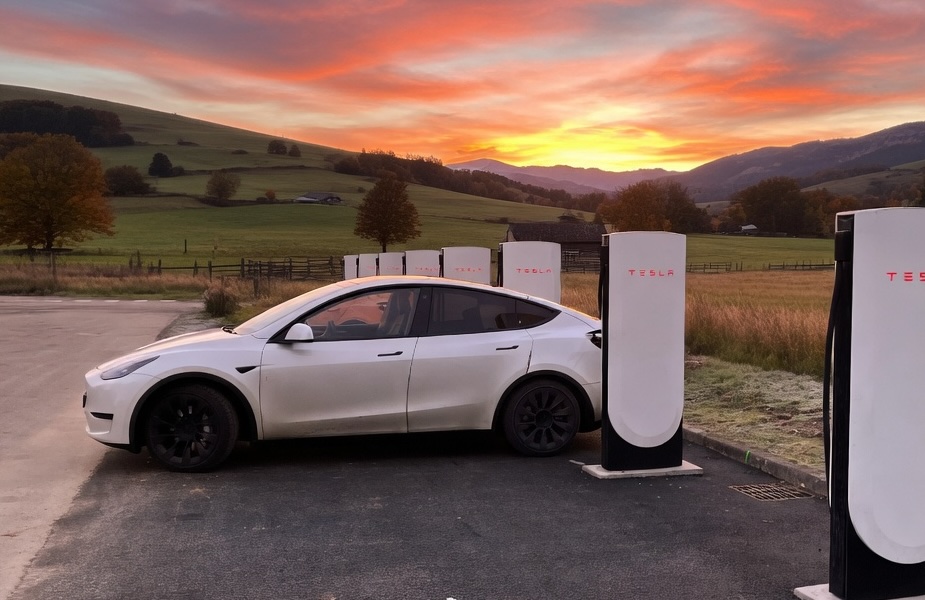
Tesla is embarking on its most ambitious charging infrastructure expansion to date, spearheaded by the introduction of a groundbreaking folding V4 Supercharger design. This engineering marvel is set to dramatically accelerate the deployment of charging stations worldwide, addressing critical logistical bottlenecks that have historically slowed the rollout of electric vehicle (EV) infrastructure.
The innovative folding mechanism for the V4 Supercharger allows for a remarkable 33% increase in units transported per single delivery truck. This significant enhancement in shipping efficiency translates directly into a 50% reduction in deployment time and an approximate 20% cut in overall installation costs, marking a pivotal moment for large-scale EV charging network development.

The Genesis of Innovation: Addressing Logistics Challenges
The core challenge in expanding any large-scale infrastructure, including EV charging networks, often lies not just in manufacturing the hardware but in efficiently transporting and installing it. Traditional Supercharger units, while highly effective, presented logistical hurdles, especially when multiple units were required for large sites or remote locations.
Tesla’s new folding V4 Supercharger directly confronts this issue. By enabling the units to collapse for transit and then unfold into their operational configuration upon arrival, the design fundamentally streamlines the supply chain. This innovation significantly lowers the logistical overhead, which is crucial for meeting the surging demand for reliable and accessible EV charging.
Streamlining Deployment: Impact on Time and Cost
The efficiencies gained from the folding design are manifold. Reducing the number of truckloads required means less fuel consumption, fewer labour hours for transportation, and a smaller carbon footprint for the deployment process itself. This focus on operational efficiency underscores Tesla’s holistic approach to infrastructure development, where every stage, from production to power delivery, is optimised for speed and cost-effectiveness.

Halving the deployment time is particularly impactful for rapidly growing EV markets. Faster installation means new Supercharger stations can come online more quickly, reducing wait times for drivers and alleviating range anxiety. The 20% cost reduction in installation further enables Tesla to build out its network more affordably, potentially accelerating its reach into underserved areas.
Next-Generation Power: The V4 Supercharger Cabinet
The introduction of the folding mechanism coincides with a broader generational leap in Tesla’s charging technology. In March 2026, Tesla’s Gigafactory New York completed its production of V3 Supercharger cabinets, ending a seven-year run that saw over 15,000 units manufactured. The factory has now pivoted entirely to the production of the advanced V4 cabinet, which forms the technical foundation for this accelerated expansion.
The V4 Supercharger cabinet itself represents a substantial upgrade over its predecessor. It is engineered to deliver up to 500 kW per stall for passenger vehicles, ensuring ultra-fast charging capabilities. For the Tesla Semi, the V4 cabinet can provide an impressive 1.2 MW of power, designed to support the demanding energy needs of commercial electric trucks.
Technical Prowess and Efficiency
Beyond raw power output, the V4 Supercharger design also boasts significantly improved density. Each V4 cabinet can support twice the number of stalls compared to the V3, all while offering three times the power density. This means more charging points can be packed into a smaller footprint, optimising land use and simplifying site planning for new locations.
A key architectural improvement in the V4 system is the elimination of the DC busbar between cabinets. As explained by Tesla Charging’s Director Max de Zegher, “Posts can peak up to 500kW for cars, but we need less than 1MW across 8 posts to deliver maximum power to cars 99% of the time.” He further elaborated on the improved design stating, “No more DC busbar between cabinets. Power comes from a single V4 cabinet to 8 stalls. Easier to install, cheaper, more reliable.” This simplification not only reduces complexity and cost but also enhances the overall reliability of the charging system.
The integrated design, where power flows directly from a single V4 cabinet to eight stalls, reflects Tesla’s ongoing commitment to maximising real-world throughput and user experience. The Twitter announcement from Tesla Charging on March 25, 2026, concisely summarised these advancements: “Introducing Folding Unit Superchargers – V4 cabinet with 500kW charging – 8 posts per unit – 2 units per truck – 2 configurations: folded, unfolded Faster. Cheaper. Better.”
Unprecedented Network Growth: Expanding Reach and Access
The strategic timing of the folding V4 Supercharger rollout aligns with a significant acceleration in Tesla’s broader network expansion efforts across multiple fronts. This includes not only increasing the number of Tesla-exclusive charging points but also significantly broadening access to non-Tesla electric vehicles, solidifying its position as a leading provider of EV charging infrastructure.
Boosting East Coast Infrastructure
The East Coast of the United States has seen notable developments in the Tesla V4 Supercharger network. March 2026 marked the opening of the first ‘true’ 500 kW V4 Supercharger in Kissimmee, Florida, demonstrating the tangible benefits of the new technology. This was swiftly followed by the activation of another new V4 site in Nashville, Tennessee, indicating a rapid geographical expansion strategy for the high-powered chargers.
Powering Commercial Fleets: The Megacharger Rollout
Beyond passenger vehicles, Tesla is also making significant strides in commercial vehicle charging. A public Megacharger, specifically designed for the Tesla Semi, was launched in Ontario, California, in early March. This milestone is part of an aggressive plan to complete 37 additional Megacharger sites by the end of the year, providing essential infrastructure for the electrification of heavy-duty transport and logistics.
Opening the Network: Broader EV Compatibility
Perhaps one of the most transformative aspects of Tesla’s current expansion phase is the increasing accessibility of its network to non-Tesla EVs. More than 27,500 Supercharger stalls are now available to a growing list of electric vehicle brands. This strategic move includes major automakers such as Ford, General Motors, Rivian, and Hyundai.
In March 2026, this interoperability further expanded to include vehicles from Stellantis brands, meaning owners of Dodge, Jeep, Ram, Fiat, and Maserati Battery Electric Vehicles (BEVs) can now utilise Tesla’s extensive and reliable Supercharger network. This broadening of access is crucial for fostering wider EV adoption, establishing the Supercharger network as an industry standard for fast and convenient charging.
Strategic Implications: Accelerating the EV Transition
The convergence of enhanced hardware, logistical efficiency, and expanded network access positions Tesla at the forefront of the global EV transition. The folding V4 Supercharger is more than just an incremental upgrade; it is a strategic tool designed to overcome the practical hurdles of large-scale infrastructure deployment.
This focus on deployment velocity, rather than solely on peak hardware performance, reflects a mature understanding of the EV ecosystem. Ultimately, the ability to get chargers on the ground faster, at a lower cost, and in greater volume per shipment, is as critical as the sheer kilowatts they can deliver. These innovations are set to significantly impact the pace at which electric vehicles become the dominant mode of transportation globally.