
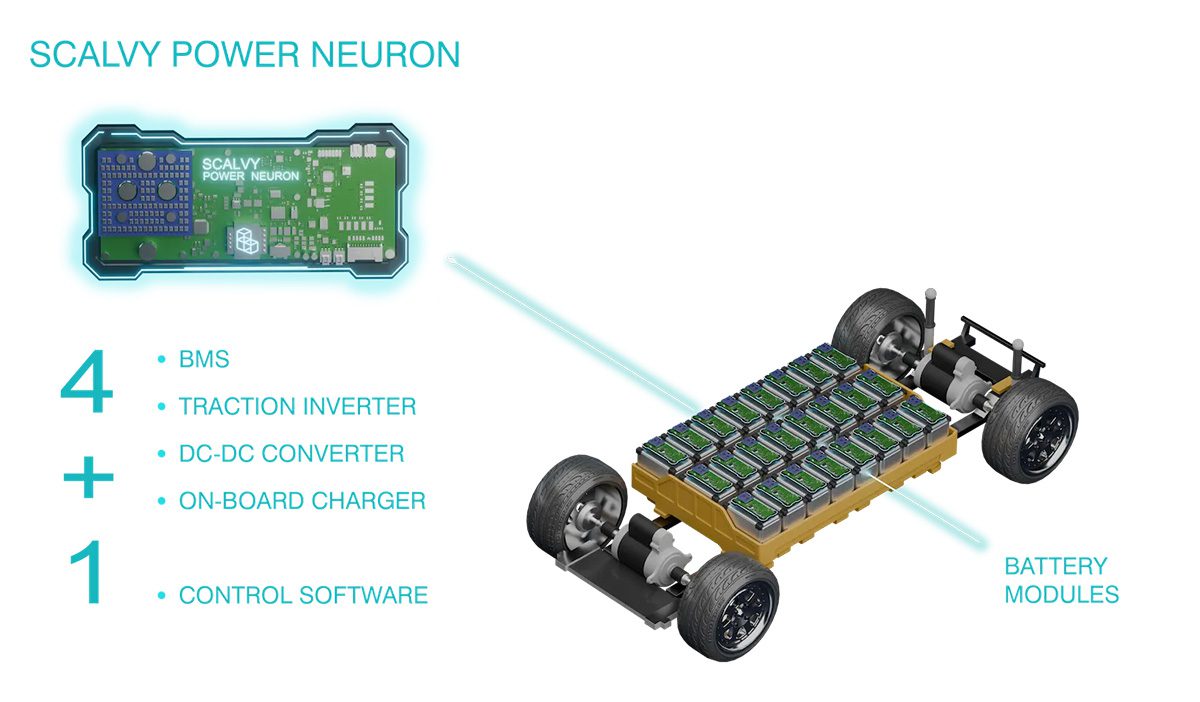
In a significant development for electric vehicle (EV) technology, Scalvy has announced that a joint concept evaluation with automotive giant Valeo has successfully validated its groundbreaking modular battery-integrated power architecture. Tested rigorously under Worldwide Harmonised Light Vehicle Test Cycle (WLTC) operating conditions, this validation marks a crucial step towards the automotive industry’s widespread adoption of Scalvy’s innovative distributed ‘Power Neuron’ platform.
The ‘Power Neuron’ platform represents a fundamental shift in EV power electronics. Traditionally, EVs rely on separate, centralised inverters, DC-DC converters, and onboard chargers. Scalvy’s unique approach instead integrates and distributes these critical functions into compact modules positioned at the edge of each battery pack. This architectural redesign aims to enhance overall system performance and efficiency, addressing some of the long-standing challenges in EV battery management.

Scalvy’s Distributed ‘Power Neuron’ Platform Unveiled
The core innovation of Scalvy’s system lies in its distributed nature. By moving power conversion functions closer to the battery cells, the architecture inherently reduces electrical switching and conduction losses. These losses, often dissipated as heat in conventional centralised systems, can diminish efficiency and accelerate component wear. The distributed design mitigates these issues, contributing to a more efficient and robust power delivery system.
Moreover, the modularity of this advanced EV battery architecture offers unparalleled scalability. This crucial feature allows the ‘Power Neuron’ platform to be adapted seamlessly across various vehicle classes—from compact urban cars to larger commercial vehicles—and to different battery chemistries, without requiring extensive redesigns. Such flexibility is vital for automakers looking to streamline development cycles and reduce manufacturing complexities in an rapidly evolving EV market.
Benchmark Performance and Thermal Management
The lab-based WLTC evaluation provided compelling evidence of the system’s capabilities. Scalvy reported that its architecture achieved a peak inverter efficiency of an impressive 98.3%. This figure was recorded under demanding conditions, specifically at 10,000 rpm and 65 Nm, highlighting the system’s ability to convert DC power from the battery into AC power for the motor with minimal energy loss. High inverter efficiency is a critical metric for EVs, directly impacting vehicle range and overall energy consumption.

Beyond energy conversion, the evaluation also demonstrated superior thermal management. During testing, the system successfully maintained motor temperatures below 62 °C and power-device temperatures below 65 °C. Crucially, Scalvy noted the complete absence of hotspot formation within the system. This controlled thermal performance is paramount for the longevity and reliable operation of both the electric motor and the sophisticated power electronics.
Extending Battery Life Through Advanced Balancing
A key aspect of Scalvy’s innovation is its sophisticated module-level state-of-charge (SOC) balancing. During the rigorous testing, this system consistently kept the SOC deviation between individual battery modules negligible. This precise balancing is vital because uneven SOC across modules can lead to accelerated degradation of the weakest cells, thereby reducing the overall lifespan of the entire battery pack.
The combination of this tight SOC balancing with the pulse-like distributed switching mechanism fundamentally reduces localised electrical and thermal stress on the battery cells and power components. This reduction in stress is a direct contributor to the system’s projected benefits: enabling faster charging capabilities and significantly extending the battery pack’s operational life. According to Scalvy, this could translate to an increase in battery life by up to 15%, offering substantial economic and environmental advantages for EV owners.
Industry Endorsement and Future Outlook
The encouraging results from the concept evaluation have been met with positive reception from industry partners. Farouk Boudjemai of Valeo commented that the findings were “highly encouraging,” underscoring the potential of Scalvy’s technology to advance the readiness level of next-generation EV power solutions. Valeo, a global automotive supplier,’s validation adds significant credibility to Scalvy’s claims, signalling a strong potential for broader industry acceptance.
Scalvy is currently progressing with field-testing the ‘Power Neuron’ technology with a selection of key customers. This practical application phase will further refine the system and gather real-world performance data. The company has set an ambitious target for commercial production of its modular EV battery architecture in 2027, indicating a clear path from concept validation to market deployment. This trajectory suggests a transformative impact on how EV power systems are designed, managed, and sustained in the coming years.
The Road Ahead for EV Technology
The demonstrated capabilities of Scalvy’s modular EV battery architecture, particularly its high inverter efficiency and extended battery life potential, address some of the most pressing concerns for electric vehicle adoption: range anxiety, charging times, and battery durability. As the automotive industry continues its aggressive transition towards electrification, innovations that enhance efficiency, prolong component life, and offer scalable solutions will be critical drivers of progress.
Scalvy’s ‘Power Neuron’ platform exemplifies how advancements in power electronics and battery management can collectively elevate the performance and appeal of electric vehicles. By decentralising power conversion and meticulously managing battery health, this technology not only promises a more efficient and longer-lasting EV experience but also sets a new benchmark for what is achievable in sustainable transportation solutions.