
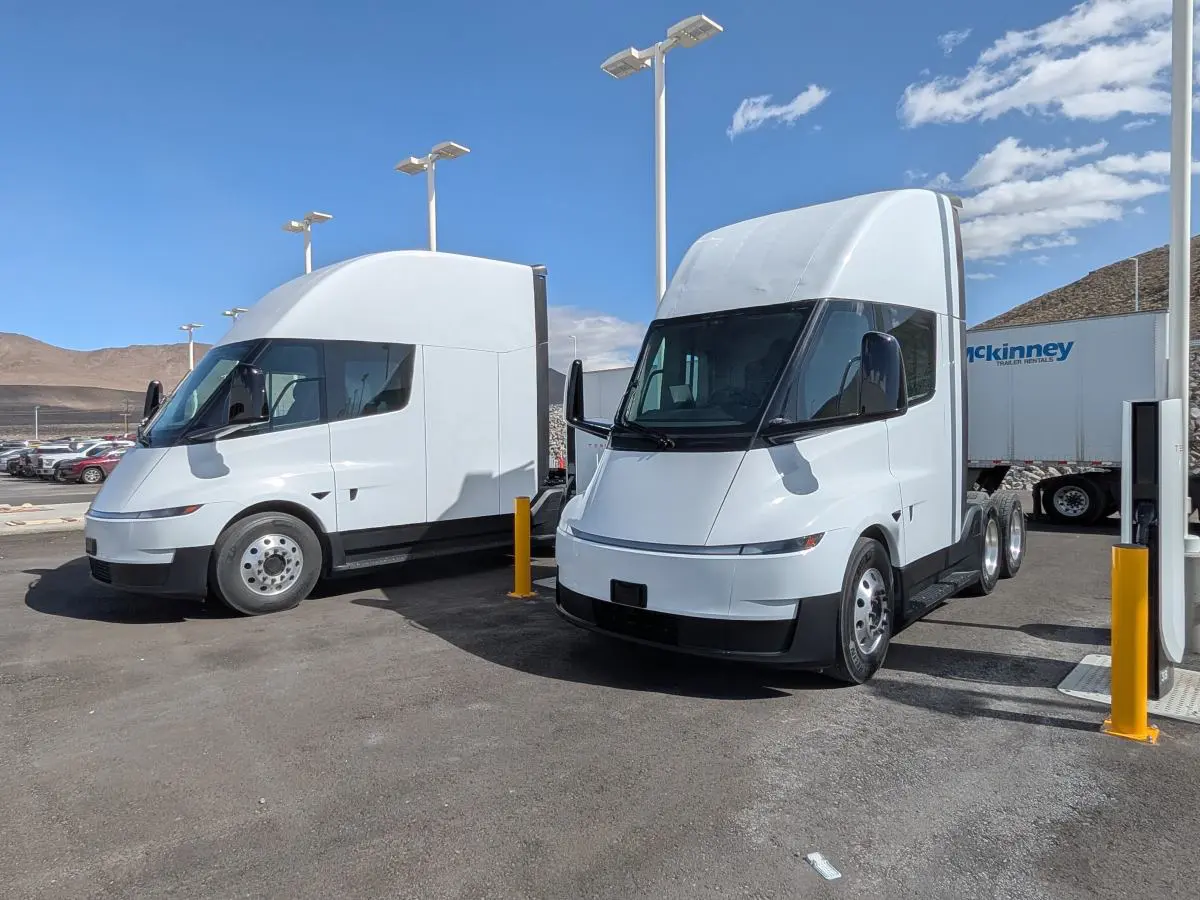
Tesla, a name synonymous with revolutionising the automotive landscape, has fundamentally shifted public perception of electric vehicles (EVs) by deploying millions of zero-emission automobiles worldwide. Extending this pioneering spirit into heavy-duty transport, the Tesla Semi program aims to replicate this success within the realm of transport logistics and long-distance trucking, promising substantial advancements for the industry.
Recent developments have brought the capabilities of the updated Tesla Semi into sharp focus, following the release of new footage from an extensive test drive. This latest video, featured on Jay Leno’s renowned vehicle-focused YouTube channel, offered an unprecedented look at the electric truck’s performance and highlighted several key upgraded features that had previously remained largely unpublicized.

Behind the Wheel: Jay Leno Explores Tesla Semi’s Evolution
The comprehensive video, spanning over 47 minutes, provides a detailed exploration of the Tesla Semi program’s progress, showcasing the electric truck’s impressive performance metrics. Jay Leno, known for his discerning eye for automotive innovation, received an in-depth tour and even took the wheel, offering firsthand insights into the vehicle’s operational characteristics.
Dan Priestley, who spearheads the Tesla Semi program, revealed crucial technological upgrades during the feature. A significant enhancement noted was the transition to a 48-volt architecture, a move that typically brings benefits such as reduced wiring harness complexity, lower weight, and increased power delivery efficiency within the vehicle’s electrical system.
Complementing this electrical system overhaul, the Tesla Semi now incorporates a fully electric steering system. This marks a departure from earlier iterations of the truck, which relied on a traditional hydraulic steering mechanism. The shift to an electric system often translates to improved fuel efficiency, reduced maintenance, and potentially more precise handling and driver assistance capabilities.

Unlocking Operational Efficiency: Significant Cost Reductions
A cornerstone of the Tesla Semi’s appeal to fleet operators lies in its economic advantages. Data shared by the company indicates that the electric truck is significantly more cost-effective to operate than its diesel counterparts. Specifically, the Tesla Semi is reported to be 50% cheaper to run in California when compared to traditional diesel semi-trucks.
This substantial reduction in running costs is a critical factor for freight and logistics companies constantly seeking to optimise their operational expenditures. With fluctuating and often high diesel prices, the predictable and lower cost of electricity presents a compelling financial incentive for transitioning to electric fleets.
Leno’s personal experience behind the wheel further underscored the Tesla Semi’s refined operational profile. He noted key distinctions between conventional diesel trucks and this electric alternative, describing the Tesla Semi’s ride as notably smooth, efficient, and remarkably comfortable. Such attributes not only contribute to driver satisfaction but also potentially reduce driver fatigue on long hauls, enhancing overall safety and productivity.
New Tesla Semi on Jay Leno’s Garage, w/ @danWpriestley & @woodhaus2 https://t.co/PXlj13Gvrs
— Tesla Semi (@tesla_semi) March 23, 2026
Pioneering Trials: PepsiCo’s Expanding Tesla Semi Fleet
The journey of the Tesla Semi into commercial operations commenced with initial deliveries as part of a trial program in late 2022. A prominent food and beverage giant, PepsiCo, was among the first companies to integrate these electric trucks into its logistics chain, marking a significant milestone for Tesla’s heavy-duty vehicle ambitions.
Following a successful initial trial period, PepsiCo publicly announced in 2024 its decision to significantly expand its electric truck fleet. The company placed additional orders for the Tesla Semi, effectively doubling its operational fleet to 50 electric trucks. These units are strategically deployed and operating out of PepsiCo’s key manufacturing and distribution facility located in California, a region known for its stringent emission regulations and supportive EV infrastructure initiatives.
This commitment from a major industry player like PepsiCo underscores the practical viability and economic benefits that the Tesla Semi offers, providing valuable real-world data and validating Tesla’s claims regarding the vehicle’s performance and cost-effectiveness.
Advanced Specifications and Enhanced Capabilities of the Tesla Semi
In recent months, Tesla has also unveiled an updated design for the Semi, incorporating several critical upgrades aimed at enhancing its overall performance and utility. These improvements span crucial areas such as range, charging specifications, aerodynamics, and payload capacity, solidifying the Tesla Semi’s position as a cutting-edge solution for modern logistics.
For charging, the updated Tesla Semi is designed to leverage 1.2 MW ultra-fast charging capabilities, specifically tailored for logistics operators requiring rapid turnaround times. This monumental charging speed will be achieved through Tesla’s advanced Supercharging hardware, known for its efficiency and widespread network. The availability of such high-power charging is paramount for long-haul operations, enabling trucks to quickly replenish their energy reserves and minimize downtime.
The infrastructure for these advanced charging capabilities is also progressing rapidly. Recent reports confirm the activation of the first Megachargers, paving the way for the deployment of dozens more such sites in the coming months. This expansion of the Megacharger network is essential for supporting the widespread adoption and seamless operation of the Tesla Semi across diverse routes and operational demands.
Beyond charging, the updated Tesla Semi boasts improved aerodynamics, a critical factor for enhancing efficiency, particularly for large vehicles traversing long distances. Better aerodynamic performance translates directly into lower energy consumption, thereby extending range and reducing running costs. Simultaneously, updates have also increased the truck’s payload capacity, allowing operators to transport more goods per trip, further boosting economic efficiency.
These collective enhancements have enabled the Tesla Semi to deliver an impressive operational range of over 800 kilometers on a single charge. This extended range is supported by an 800 kW drivetrain, ensuring robust power and performance. Furthermore, the truck demonstrates remarkable energy consumption efficiency, achieving figures as low as 1.06 kWh per kilometer, a testament to its advanced engineering and design.
Mass Production on the Horizon and Industry Implications
The culmination of these advancements and successful trials points towards a critical juncture for the Tesla Semi program. Earlier this month, reports indicated that mass production of the Tesla Semi is anticipated to commence shortly at the company’s new factory currently under construction in Nevada. This move signifies Tesla’s readiness to scale up production and meet the growing demand for electric heavy-duty vehicles.
With mass production around the corner and the continued volatility and high prices of diesel fuel, the economic argument for transitioning to electric trucks becomes increasingly compelling. Many freight and logistics companies are now actively considering or planning to integrate electric trucks, specifically the Tesla Semi, into their operational fleets.
The significant upgrades highlighted in Jay Leno’s recent video underscore the Tesla Semi’s potential to deliver substantial operational savings for fleet operators. This blend of reduced running costs, advanced technological features, improved driver comfort, and a strong commitment to sustainable transport positions the Tesla Semi as a transformative solution in the global logistics industry. The prospect of substantial financial savings during operations is an undeniable advantage that many fleet operators will find hard to overlook, marking a new era for freight transport.