
In the rapidly evolving landscape of autonomous vehicles, where groundbreaking battery advancements and significant autonomy milestones frequently capture global attention, even a seemingly minor design alteration can carry profound implications. Tesla, a company synonymous with pushing technological boundaries, has subtly unveiled a visual update to its much-anticipated Cybercab, signaling a calculated shift in its public presentation of the upcoming autonomous fleet.
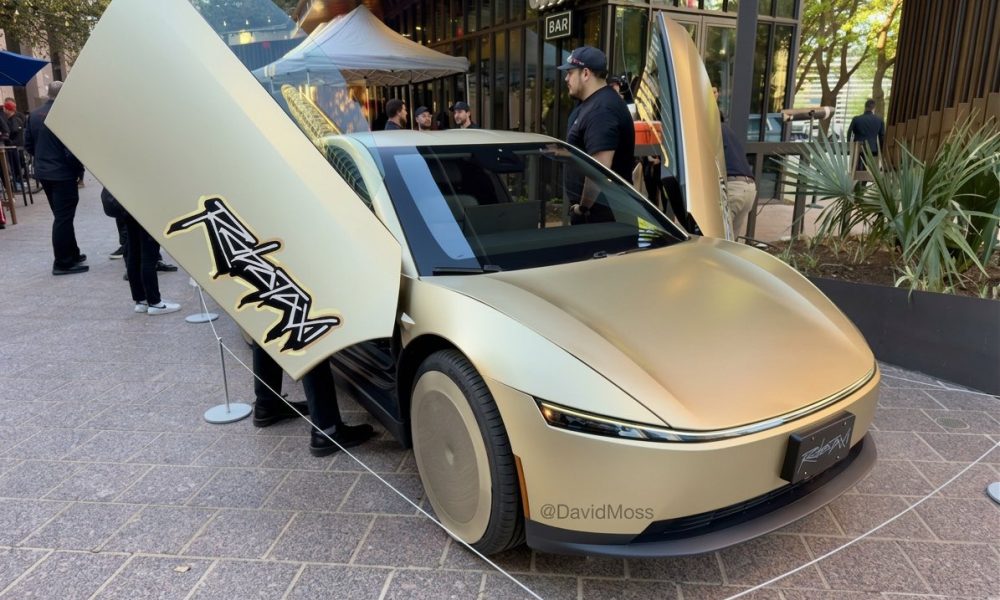
Last week, keen observers in downtown Austin, Texas, caught sight of a notable modification on the Tesla Cybercab. The vehicle, displayed at Tesla’s Autonomy Popup event, now proudly sports a refreshed ‘ROBOTAXI’ logo graphic on its doors. While the change might appear to be a simple aesthetic tweak at first glance, it represents a deliberate and strategic rebranding effort, offering insights into how Tesla envisions its advanced robotaxi service integrating into the fabric of daily urban life.

A Bold New Visual Statement for Urban Mobility
The updated ‘ROBOTAXI’ lettering marks a distinct departure from Tesla’s established design ethos. The new graphic is characterised by its bold, graffiti-inspired aesthetic, exuding an unapologetically street-smart vibe. Rendered in a stark black with dynamic dripping white accents and a vibrant, glowing yellow outline, the font actively evokes a sense of urban energy and playful irreverence.
This fresh visual language contrasts sharply with the sleek, minimalist typography that defined earlier Cybercab prototypes. That previous design, in line with Tesla’s overall brand identity, conveyed a sense of precision engineering and sophisticated Silicon Valley innovation. The transition to this more expressive and almost rebellious script is a strategic move, transforming the autonomous pod from merely a futuristic mode of transport into what could be perceived as a dynamic piece of public art on wheels.
The new logo graphic achieves a striking visual pop against the Cybercab’s smooth, metallic body. This careful consideration of visual impact underscores a deeper understanding of brand perception in the highly competitive and nascent autonomous vehicle market.

The Psychology of Design: Shaping Perception for the Tesla Robotaxi
Design professionals widely acknowledge that fonts and visual identities serve as silent yet powerful brand ambassadors. They possess the inherent ability to shape public perception and influence consumer sentiment long before any direct interaction with a product or service. Tesla’s traditional sans-serif aesthetic has consistently projected an image of cutting-edge technology, meticulous engineering, and a distinctly modern, high-tech allure.
However, the new ‘ROBOTAXI’ script, with its more accessible and fun-oriented design, signals a different message. It suggests an approachability that aims to be inclusive rather than intimidating. For a service designed to ferry a diverse range of passengers through bustling city streets around the clock, cultivating an image of welcome and ease of use is paramount. This strategic design choice communicates that the Tesla Robotaxi is not an exclusive offering reserved solely for tech-savvy elites but is, in fact, intended for everyone.
This shift in visual branding plays a crucial role in mitigating potential public apprehension surrounding autonomous technology. By making the vehicle appear more approachable and less alien, Tesla aims to foster greater public acceptance and trust, essential ingredients for the widespread adoption of its self-driving fleet.
Strategic Timing: From Prototype Showcase to Fleet Deployment
The timing of this significant visual update is far from coincidental. It aligns perfectly with the advancing regulatory approvals for unsupervised autonomy across various jurisdictions and Tesla’s intensive preparations to scale up Cybercab production. The company is actively transitioning from showcasing concept prototypes and experimental models to the imminent phase of large-scale fleet deployment.
In this critical phase, a fresh and distinctive logo becomes indispensable. It helps to visually differentiate the Tesla Robotaxi vehicles within dense urban environments, which is crucial for rider recognition, ease of identification, and overall brand recall. This move also resonates deeply with Elon Musk’s long-standing philosophy: to ensure that the future, particularly one driven by advanced technology, feels inherently exciting and inviting, rather than sterile or daunting.
Small yet impactful changes of this nature frequently serve as harbingers of a broader strategic direction. Tesla has historically demonstrated an obsessive attention to detail, evident in everything from the tactile experience of door handles to the intuitive design of screen interfaces and even the ergonomic curvature of a steering wheel. The decision to update the Tesla Robotaxi font reflects this same meticulous care, now being applied to the consumer-facing aspects of its autonomous offerings.
This is more than just a superficial application of paint on metal; it is a clear statement. It asserts that the ride of the future, delivered by the Tesla Robotaxi, should evoke a sense of personal connection, be memorable, and possess an undeniably cool factor, encouraging widespread adoption and positive user experience.
Enhancing Public Acceptance and Trust in Autonomous Vehicles
The introduction of a new brand identity for the Tesla Robotaxi extends beyond mere aesthetics; it touches upon critical aspects of public perception and trust in autonomous vehicles. As self-driving technology matures and prepares for mass deployment, the visual language employed by companies like Tesla becomes a key determinant in how readily the public embraces these innovations.
An accessible and engaging design can demystify complex technology, making it feel less intimidating and more integrated into everyday life. By choosing a ‘graffiti-inspired’ and ‘street-smart’ look, Tesla is attempting to bridge the gap between cutting-edge technology and urban culture, making the autonomous future feel more relatable and less like a distant, clinical concept.
This rebranding effort for the Tesla Robotaxi is thus a testament to the company’s holistic approach to product development, where user experience and brand communication are considered as vital as the underlying engineering prowess. It highlights the understanding that successful integration of autonomous mobility depends not only on technological capability but also on how it is perceived and welcomed by the general public.
The Road Ahead for Tesla’s Autonomous Future
In an industry characterised by a relentless race toward the development and deployment of self-driving fleets, Tesla’s proactive willingness to evolve even the most granular visual cues demonstrates a profound confidence in its trajectory. While a new font alone will not singularly launch an expansive robotaxi network, it has the significant potential to play a pivotal role in encouraging millions of users to climb aboard with a sense of excitement and reassurance.
This strategic update to the Tesla Robotaxi’s branding is a clear indicator that the company is not just building vehicles; it is meticulously crafting an entire experience. By focusing on elements that resonate with a broad audience and enhance approachability, Tesla is laying crucial groundwork for widespread acceptance. As the company moves closer to a full-scale rollout of its autonomous services, this distinctive new identity is poised to become an iconic symbol of the future of urban transportation, one accessible to all.