
Key Takeaways:
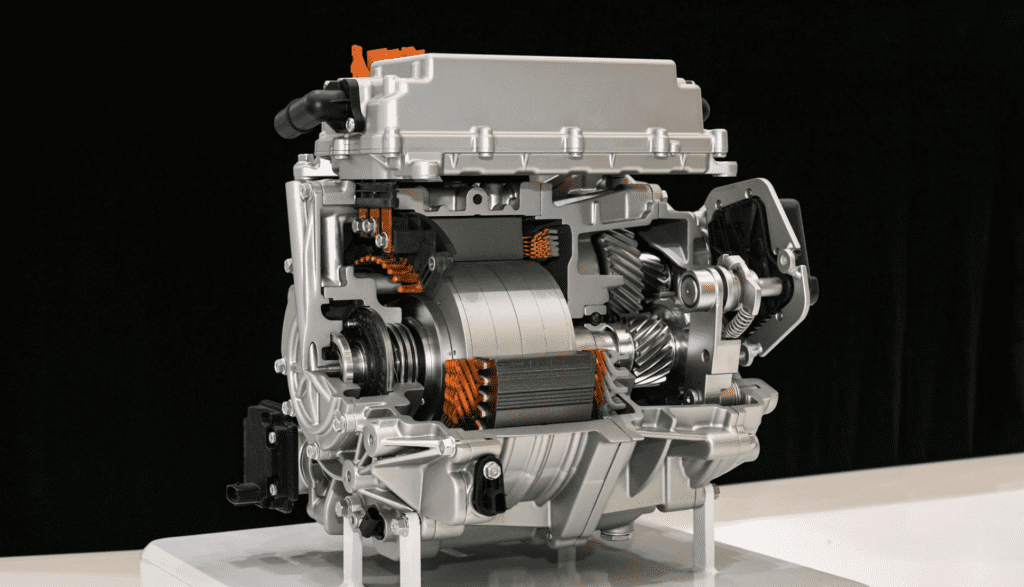
- Hyundai Mobis has developed a new 160 kW Power Electric (PE) system, integrating motor, inverter, and reduction gear into a single unit.
- This innovative EV drive system serves as a universal platform model, designed for standardization across multiple global OEM customers rather than a specific vehicle program.
- The system achieves a 16% improvement in specific power and a nearly 20% reduction in overall volume compared to previous designs.
- These gains are attributed to a modular design, standardized core components (drive motor stator, inverter, power module), and an advanced motor cooling structure.
- The 160 kW system (delivering 215 hp) is part of a scalable PE system lineup, complementing a 250 kW high-performance unit already completed and a 120 kW compact model slated for 2026.
- This platform approach offers significant advantages for OEMs, including reduced development costs, faster time-to-market, and greater flexibility in EV powertrain design.
SEO-optimized title: Hyundai Mobis Unveils Advanced 160 kW EV Drive System, Poised to Reshape Global EV Manufacturing
In a significant stride towards accelerating global electric vehicle (EV) adoption, Hyundai Mobis has officially completed the development of a state-of-the-art 160 kW Power Electric (PE) system. This advanced EV drive system is engineered as a universal platform model, marking a strategic shift from traditional vehicle-specific designs to a standardized approach intended for a diverse array of global OEM customers.

This groundbreaking integration combines the motor, inverter, and reduction gear into a singular, highly efficient unit. The move is expected to simplify EV manufacturing processes, enhance vehicle performance, and provide unprecedented flexibility for automotive manufacturers worldwide grappling with the complexities of electrification.
Advancing EV Performance and Efficiency
The newly developed 160 kW system is capable of delivering up to 215 horsepower, a power output that Hyundai Mobis affirms is ample for the majority of electric vehicles currently undergoing mass production. This robust performance is complemented by notable improvements in efficiency and packaging.
Compared to the company’s preceding technologies, the 160 kW EV drive system boasts an approximate 16% enhancement in specific power, a critical metric measuring output per unit weight. Furthermore, the overall volume of the system has been reduced by nearly 20%. These advancements are pivotal for EV design, allowing for lighter vehicles, improved energy consumption, and more flexible chassis configurations.
The ability to shrink the physical footprint of powertrain components translates directly into more interior space for passengers and cargo, or greater flexibility for battery placement, ultimately enhancing the overall vehicle architecture and user experience. This focus on efficiency and compactness underscores Hyundai Mobis’s commitment to pushing the boundaries of electric vehicle technology.
The Power of Modular Design and Standardisation
The remarkable gains in specific power and volume reduction are not coincidental. They are the direct result of a meticulous engineering strategy centered on modular design, the standardization of key components, and the implementation of an innovative motor cooling structure. These elements work in concert to deliver a highly optimized and adaptable powertrain solution.
Central to this standardization are three core components: the drive motor stator, the inverter, and the power module. By streamlining these fundamental elements across its product line, Hyundai Mobis has created an architecture that can be readily scaled to suit various vehicle classes. This negates the necessity for a complete powertrain redesign for each new vehicle program, a process that has historically consumed significant resources and time for global automakers and their suppliers.
This platform-based philosophy represents a departure from the conventional model where automakers typically co-developed component-specific systems with individual suppliers for unique vehicle projects. The universal platform model offers a streamlined, more cost-effective pathway to electrification for manufacturers looking to expand their EV portfolios rapidly and efficiently.
Scalability Across the EV Spectrum
The 160 kW system is not an isolated development but rather a strategic piece within Hyundai Mobis’s broader vision for a comprehensive range of Power Electric systems. The company had already successfully completed a 250 kW high-performance PE system last year, catering to more demanding vehicle segments requiring substantial power output.
Looking ahead, a 120 kW model is currently in development, with completion anticipated in the first half of 2026. This compact system is specifically engineered for smaller vehicles and emerging markets, where minimized size, weight, and cost are paramount considerations. Its design ensures accessibility and efficiency for a broader demographic of EV users.
With the 120 kW, 160 kW, and 250 kW systems forming a cohesive lineup, Hyundai Mobis is poised to offer a full spectrum of EV powertrain solutions. This range effectively spans diverse mobility needs, from small, economical urban transporters to high-performance electric vehicles designed for exhilarating driving experiences. The flexibility of the 160 kW EV drive system is further highlighted by its ability to double its output to 320 kW when two units are deployed, one on the front axle and one on the rear, demonstrating its versatility for all-wheel-drive performance applications.
High-Efficiency Power Semiconductors: The Core of Innovation
A critical enabler of the system’s enhanced efficiency and compact design is the integration of high-efficiency power semiconductors within the power module. These advanced semiconductors play a pivotal role in minimizing energy losses during the conversion of electrical power, directly contributing to improved range and overall system performance in any EV drive system.
By reducing heat generation and enabling higher switching frequencies, these power semiconductors allow for smaller, lighter, and more efficient inverters, which are crucial components in managing power flow between the battery and the electric motor. This technological backbone ensures that the PE system operates at peak efficiency, translating into tangible benefits for the end-user.
Strategic Implications for Global OEMs and the EV Market
The universal platform approach championed by Hyundai Mobis carries profound implications for global automotive manufacturers. In a rapidly evolving EV market, the ability to leverage standardized, pre-validated powertrain components significantly shortens development cycles and reduces the massive capital investment typically associated with designing new electric vehicles from the ground up.
This model offers OEMs the agility to respond more swiftly to market demands and competitive pressures, facilitating a quicker rollout of new EV models across various segments. It also provides a robust and reliable foundation, backed by Hyundai Mobis’s extensive experience and expertise in automotive component manufacturing, thereby strengthening the trustworthiness of the components.
Hyundai Mobis reports that overseas customers have already expressed substantial interest in these new PE systems. This early indication of market demand underscores the strategic value and perceived benefits of this advanced EV drive system architecture, suggesting a potential paradigm shift in how electric vehicle powertrains are sourced and integrated globally. The development enhances Hyundai Mobis’s position as an authoritative and experienced supplier in the competitive EV component market, signaling its readiness to support the global automotive industry’s electrification journey.
The Road Ahead: Supporting Sustainable Mobility
As the global automotive industry continues its accelerated transition towards sustainable mobility, innovations in core EV components like the PE system are paramount. Hyundai Mobis’s latest development not only showcases engineering excellence but also addresses key industry challenges related to efficiency, cost-effectiveness, and design flexibility.
By offering a scalable and standardized EV drive system, Hyundai Mobis is empowering automakers to overcome technical hurdles and accelerate their EV strategies. This move solidifies the company’s role as a leading innovator in electric vehicle engineering, contributing significantly to the broader goal of a cleaner, more electrified transportation future.
FAQ Section
What is the primary innovation of Hyundai Mobis’s new PE system?
The primary innovation is a 160 kW Power Electric (PE) system designed as a universal platform model, integrating the motor, inverter, and reduction gear into a single, standardized unit for global OEM adoption rather than a specific vehicle.
How does this new EV drive system improve performance?
It significantly improves performance by delivering up to 215 hp, increasing specific power by about 16%, and reducing overall system volume by nearly 20% compared to previous designs, contributing to better efficiency and packaging.
What technologies contributed to the system’s gains?
The gains were achieved through a modular design, the standardization of core components like the drive motor stator, inverter, and power module, and the implementation of an advanced motor cooling structure, alongside high-efficiency power semiconductors.
How does the universal platform model benefit global OEMs?
This model offers global OEMs reduced research and development costs, faster time-to-market for new EV models, and greater flexibility in designing and integrating powertrains across various vehicle classes, departing from traditional co-development.
What other PE systems are part of Hyundai Mobis’s lineup?
Beyond the 160 kW system, Hyundai Mobis has completed a 250 kW high-performance PE system and plans to complete a 120 kW model for compact vehicles and emerging markets by the first half of 2026, offering a comprehensive range of solutions.
Can the 160 kW system be used for higher power requirements?
Yes, by deploying two 160 kW units, one on the front and one on the rear axle, the combined output can be doubled to 320 kW, making it suitable for high-performance or all-wheel-drive EV applications.
Why is volume reduction important for EV design?
Volume reduction is crucial for EV design as it allows for more efficient use of space, enabling larger battery packs, increased passenger or cargo room, and greater flexibility in vehicle architecture, ultimately improving overall vehicle performance and appeal.