
KEY TAKEAWAYS
- The Rivian AI voice assistant is now available for R1S and R1T models through a recent over-the-air software update.
- It features advanced natural language processing for more intuitive in-vehicle commands and interactions.
- Unlike typical phone-mirroring systems, the Rivian Assistant is deeply integrated into the vehicle’s hardware and software, leveraging both in-house and external AI models.
- Capabilities include adjusting drive modes, viewing vehicle cameras, providing contextual information, and processing complex multi-step commands.
- A significant agentic feature is its integration with Google Calendar, allowing voice-activated management of appointments and navigation.
- The advanced voice assistant requires an active connectivity subscription and will be extended to the upcoming R2 model upon its launch.
Rivian, the burgeoning electric vehicle manufacturer, has announced the immediate rollout of its highly anticipated in-house AI voice assistant. Initially slated for an early 2026 debut, the feature is now reaching Rivian R1S and R1T vehicles via the company’s latest over-the-air software update, marking a significant acceleration in its technological deployment schedule. This advancement positions Rivian at the forefront of integrating sophisticated artificial intelligence into the automotive user experience.
The introduction of the Rivian AI voice assistant is poised to redefine how drivers interact with their SUVs and trucks, moving beyond basic commands to offer a more natural, intuitive conversational interface. This development is part of a broader industry trend where car manufacturers are aggressively adopting AI chatbot technology to enhance in-vehicle voice capabilities, aiming for greater convenience and functionality for occupants.
The Evolving Landscape of In-Vehicle AI
The automotive sector is witnessing a rapid integration of artificial intelligence, particularly in voice command systems. Major players are enhancing their offerings to meet the growing consumer demand for seamless digital interaction within their vehicles. This shift reflects a strategic move to differentiate products and elevate the overall driving experience.
For instance, General Motors, alongside European counterparts Volvo and Polestar, recently declared that their vehicles would gain access to Google Gemini, a powerful AI model. Concurrently, newer Tesla models are incorporating xAI’s Grok, demonstrating a diverse approach to AI integration across the electric vehicle market. These initiatives highlight the competitive race to embed advanced AI functionalities that go beyond rudimentary voice recognition.
Rivian’s Unique Approach to Deep Integration
What distinguishes the Rivian AI voice assistant is its profound integration directly into the vehicle’s core systems. Unlike many voice command tools that primarily function through phone-mirroring applications, Rivian’s solution is native to its hardware and software architecture. This fundamental design choice empowers the assistant with unparalleled control over various vehicle functions and a deeper understanding of contextual commands.
In a press release, the company articulated its distinctive advantage: “Unlike basic voice command tools found in phone-mirroring systems, Rivian Assistant is built directly into your vehicle’s hardware and software, providing the unique power to talk to every aspect of the vehicle and get things done for you.” This deep integration allows the system to operate more efficiently and comprehensively, leveraging both proprietary in-house AI models and selected external AI technologies to perform diverse tasks.
Natural Language and Contextual Understanding
The Rivian AI voice assistant significantly elevates the standard for in-vehicle voice commands by embracing natural language processing. This technology enables the system to understand and respond to conversational speech patterns, eliminating the need for rigid, pre-set phrases typically associated with older voice recognition systems.
Drivers can now initiate commands simply by saying “Hey Rivian” or by pressing a dedicated button on the steering wheel. This natural interaction extends to a wide array of vehicle functions, from adjusting drive modes to displaying feeds from vehicle cameras. The assistant’s ability to interpret nuanced requests marks a substantial leap forward in user interface design, making in-cabin technology more accessible and user-friendly.
Beyond Basic Queries: Complex Tasks and Vehicle Encyclopedia
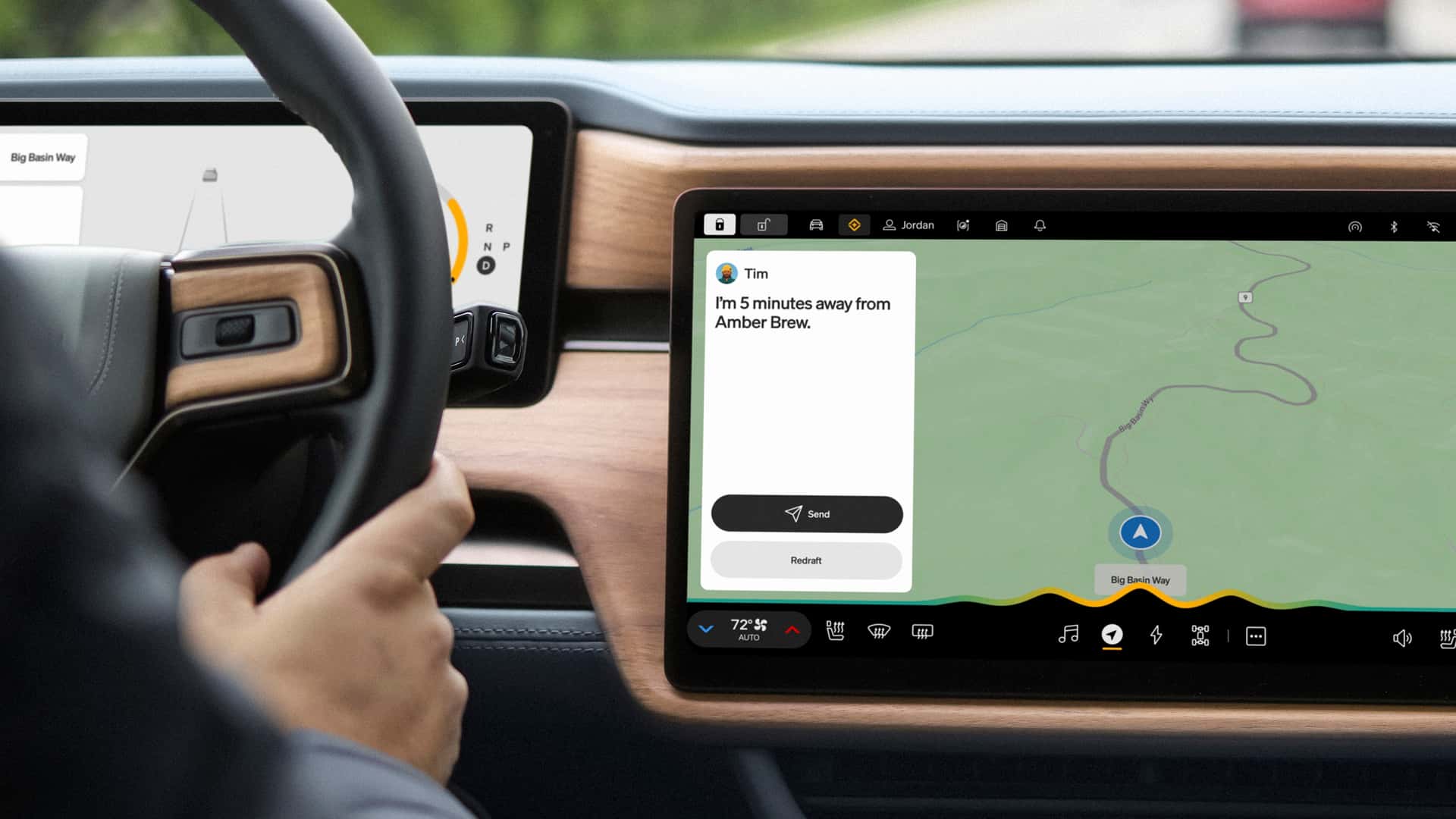
The capabilities of the Rivian AI voice assistant extend far beyond simple, one-step instructions. It is engineered to handle intricate, multi-step commands, significantly enhancing the utility and convenience for drivers and passengers. For example, users can request the assistant to simultaneously send a friend a list of restaurant recommendations and their estimated time of arrival from the navigation system, all through a single voice prompt.
A crucial feature is the assistant’s ability to retain context from previous interactions. This means it can follow up on a conversation, remembering prior details to provide more relevant and seamless assistance. Furthermore, the Rivian AI voice assistant is equipped to answer general knowledge questions, akin to popular AI chatbot tools like ChatGPT, offering instant information without diverting the driver’s attention from the road.
Your Vehicle’s Built-in Knowledge Hub
Rivian also positions its assistant as an “encyclopedia for your vehicle.” This innovative function aims to replace the traditional owner’s manual by allowing drivers to verbally query their vehicle about operational aspects or maintenance procedures. Instead of sifting through pages of a manual, an owner can simply ask the Rivian AI voice assistant practical questions, such as “How do I change a tire?” or “What does this dashboard light mean?” This instantaneous access to vehicle-specific information is a game-changer for driver support and education.
Agentic Capabilities and Google Calendar Integration
A defining characteristic that truly distinguishes the Rivian AI voice assistant is its “agentic capability.” This feature enables the assistant not just to retrieve information or execute simple commands but to actively perform tasks by connecting with various external services. Rivian has plans to integrate a multitude of services over time, continuously expanding the assistant’s functional ecosystem.
The inaugural integration in this sphere is with Google Calendar, offering immense practical benefits for Rivian owners. By securely connecting their Google accounts, drivers can manage their schedules entirely through voice commands while on the move. This includes the ability to reschedule meetings, receive directions to upcoming appointments, and relay calendar information to contacts via text messages. This hands-free management of personal and professional commitments underscores the advanced utility of the Rivian AI voice assistant.
Availability and Future Outlook
The Rivian AI voice assistant is being deployed to all Gen 1 and Gen 2 Rivian R1S SUVs and R1T pickup trucks. To access these advanced features, owners must have an active connectivity subscription for their vehicle. This prerequisite ensures that the vehicles can receive the necessary over-the-air updates and maintain seamless access to the cloud-based AI models that power the assistant.
Looking ahead, Rivian has confirmed that the AI voice assistant will also be a core feature of the highly anticipated Rivian R2 model, which is expected to launch to customers in the coming weeks. This strategic integration into future models underscores Rivian’s commitment to embedding cutting-edge AI technology across its entire product line, promising an enhanced and more connected experience for all its electric vehicle users. The rapid deployment of such sophisticated in-vehicle AI highlights Rivian’s agility and ambition in the competitive electric vehicle market.
FAQ Section
What is the Rivian AI voice assistant?
The Rivian AI voice assistant is an in-house developed artificial intelligence system integrated into Rivian vehicles. It provides natural language processing capabilities, allowing drivers to interact with their vehicles using conversational commands, manage various functions, and access information more intuitively than traditional voice recognition systems.
Which Rivian models currently support the AI voice assistant?
The Rivian AI voice assistant is currently rolling out to all Gen 1 and Gen 2 R1S SUVs and R1T pickup trucks. It will also be a standard feature in the upcoming R2 model once it launches to customers, extending its reach across Rivian’s electric vehicle lineup.
What are the primary functions of the Rivian AI voice assistant?
Key functions include adjusting drive modes, viewing vehicle cameras, providing points of interest, answering general knowledge questions, and serving as a vehicle encyclopedia for operational queries. It can also handle complex multi-step commands and retains contextual understanding throughout conversations.
How does Rivian’s AI assistant differ from other in-vehicle voice systems?
Unlike basic voice command tools that often rely on phone-mirroring systems, Rivian Assistant is deeply embedded directly into the vehicle’s hardware and software. This native integration provides it with unique power to control and interact with virtually every aspect of the vehicle, using a blend of in-house and external AI models.
Does the Rivian AI voice assistant require a subscription?
Yes, to utilize the full capabilities of the Rivian AI voice assistant, owners must have an active connectivity subscription for their Rivian vehicle. This subscription ensures access to the necessary over-the-air updates and cloud-based AI processing required for its advanced functionalities.
Can the Rivian Assistant integrate with external services?
Yes, the Rivian AI voice assistant features “agentic capability” allowing it to connect with external services. Its initial integration is with Google Calendar, enabling drivers to manage meetings, navigate to appointments, and relay calendar information via text, all through voice commands.