
Key Takeaways
- The Rivian Assistant, an advanced AI voice assistant, is now rolling out to R1S and R1T vehicles via the latest over-the-air software update.
- This in-house developed system offers natural-language interaction, allowing drivers to control vehicle functions and access information more intuitively.
- Unlike basic phone-mirroring voice tools, the Rivian Assistant is deeply integrated into the vehicle’s hardware and software, leveraging both internal and external AI models.
- Key functionalities include adjusting drive modes, viewing vehicle cameras, providing points of interest, executing complex multi-step commands, retaining conversational context, answering general knowledge queries, and serving as a digital owner’s manual.
- A significant feature is its agentic capability, starting with Google Calendar integration, enabling voice-controlled meeting management and navigation.
- The Rivian Assistant is available to all Gen 1 and Gen 2 R1S and R1T owners with an active connectivity subscription, with plans for the R2 model upon its launch.
Rivian, the American electric vehicle manufacturer, has officially commenced the rollout of its innovative in-house AI voice assistant, dubbed the Rivian Assistant. This significant technological advancement is being delivered to existing R1S SUVs and R1T pickup trucks through the company’s latest over-the-air software update, marking a pivotal moment in enhancing the user experience within their electric vehicles.
Initially projected for an early 2026 release as announced during Rivian’s Autonomy & AI Day in December, the company has expedited its development and deployment, making the sophisticated feature available to its customer base much sooner than anticipated. This rapid integration underscores Rivian’s commitment to leveraging artificial intelligence for a more intuitive and connected driving environment.
Transforming In-Vehicle Interaction with Natural Language
The primary objective of the Rivian Assistant is to revolutionize how owners interact with their vehicles. By introducing advanced natural-language capabilities, the system aims to move beyond rigid, command-based interfaces, allowing for a more fluid and human-like conversational exchange. This means drivers can speak to their Rivian vehicles in a manner that feels more natural and less prescriptive.
This initiative places Rivian at the forefront of a burgeoning trend within the automotive industry, where major players are increasingly integrating sophisticated AI chatbot technology into their in-vehicle systems. The move reflects a broader industry recognition of the potential of AI to enhance safety, convenience, and overall driver satisfaction.
Industry-Wide Shift Towards Advanced Voice AI
The automotive landscape is witnessing a rapid evolution in voice assistant technology. Rivian’s entry with the Rivian Assistant follows similar advancements by other prominent manufacturers.
For instance, General Motors, Volvo, and Polestar recently announced plans to incorporate Google Gemini, Google’s advanced AI model, into their vehicles. Concurrently, newer Tesla models are integrating xAI’s Grok, demonstrating a clear industry-wide embrace of powerful artificial intelligence to augment in-car functionalities.
However, Rivian’s approach distinguishes itself through its deep integration strategy. The company asserts that its assistant is not merely an overlay or a phone-mirroring solution, but rather an intrinsic component of the vehicle’s core architecture.
“Unlike basic voice command tools found in phone-mirroring systems, Rivian Assistant is built directly into your vehicle’s hardware and software, providing the unique power to talk to every aspect of the vehicle and get things done for you,” the company stated in its official press release. This fundamental difference suggests a more seamless and comprehensive control over vehicle systems.
The development of the Rivian Assistant harnesses a combination of in-house and external AI models. This hybrid approach likely allows Rivian to tailor specific functionalities to its unique vehicle ecosystem while also benefiting from the vast capabilities and continuous improvements of broader AI platforms.
Core Capabilities of the Rivian Assistant
During demonstrations at Rivian’s technology event last year, the comprehensive capabilities of the Rivian Assistant were showcased, highlighting its significant leap beyond conventional voice recognition systems.
Typically, older voice recognition features are limited to a predetermined set of vehicle functions and demand precise, often rigid, phrasing from the user. The Rivian Assistant, conversely, offers a much broader and more flexible range of interactions.
Users can activate the Rivian Assistant by simply uttering the wake phrase “Hey Rivian” or by pressing a designated button on the steering wheel. This initiates a dialogue through which drivers can execute a multitude of commands.
Enhanced Vehicle Control and Information Access
The system provides direct control over crucial vehicle settings. Drivers can, for example, issue commands to adjust various drive modes, instantly adapting the vehicle’s performance characteristics to different terrains or driving preferences. Similarly, accessing vehicle cameras to check surroundings or monitor specific areas can be done through simple voice commands, enhancing situational awareness and safety.
Beyond vehicle mechanics, the Rivian Assistant also serves as an informative co-pilot. It can provide details about points of interest along a route, offering spontaneous insights into nearby landmarks, attractions, or essential services, enriching the travel experience.
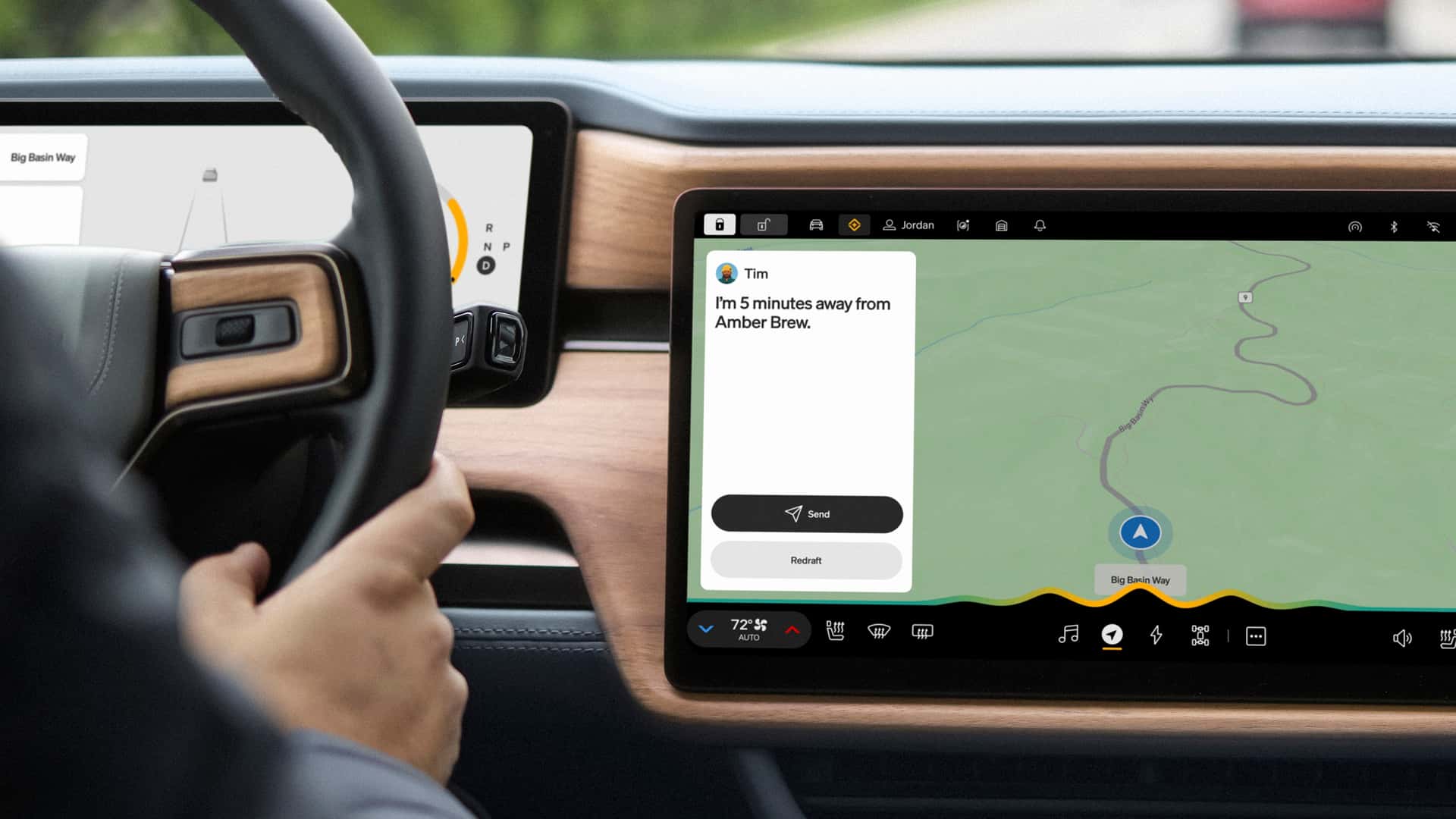
One of the more advanced features is its ability to handle complex, multi-step commands. For instance, a driver could instruct the assistant to “send a friend a batch of restaurant recommendations and your ETA from the navigation system.” The system is designed to process and execute these layered requests, streamlining tasks that would otherwise require multiple manual inputs.
Furthermore, the assistant boasts a conversational memory, allowing it to remember the context of previous interactions. This means follow-up questions or related commands can be understood and acted upon without the need for repeated information, leading to a more natural and less frustrating user experience.
In addition to vehicle-specific tasks, the Rivian Assistant can answer general knowledge questions, akin to popular AI chatbots like ChatGPT and similar generative AI tools. This feature transforms the vehicle into a mobile information hub, capable of providing instant answers on a wide array of topics, from trivia to practical advice.
Rivian also positions the assistant as “an encyclopedia for your vehicle.” This innovative function allows drivers to bypass the traditional owner’s manual, which can often be cumbersome and time-consuming to navigate. Instead, users can simply ask their vehicle questions such as “how to change a tire,” receiving immediate, voice-guided instructions, significantly improving convenience and accessibility to critical information.
Agentic Capability: Integrating External Services
Perhaps one of the most differentiating aspects of the Rivian Assistant is its “agentic capability.” This refers to its ability to connect with and manage various external services, moving beyond mere information retrieval to actively perform tasks on the user’s behalf.
Rivian has indicated a progressive rollout of various service integrations, with Google Calendar being the inaugural external service to be connected. This integration brings a new dimension of productivity to the in-car experience.
For Rivian owners who link their Google accounts, the assistant can manage calendar events directly through voice commands while driving. This includes the ability to reschedule or move meetings, navigate directly to scheduled appointments, and relay calendar information to contacts via text messages. Such functionality significantly reduces the need to physically interact with devices, enhancing both convenience and driver focus.
Availability and Future Prospects
The Rivian Assistant is being progressively rolled out to both Generation 1 and Generation 2 R1S and R1T vehicles. This phased deployment ensures broad access for existing owners of Rivian’s flagship models.
Looking ahead, the advanced AI assistant is confirmed to be a core feature of the upcoming Rivian R2, slated to launch to customers in the coming weeks. This indicates that the Rivian Assistant will be a standard offering in the company’s newer vehicle lineups, reflecting its strategic importance.
It is important to note that accessing the full capabilities of the Rivian Assistant requires an active connectivity subscription. This subscription model aligns with industry practices for advanced in-vehicle services, ensuring ongoing support, updates, and access to connected functionalities.
The introduction of the Rivian Assistant represents a significant step forward for in-vehicle technology, promising a more intuitive, powerful, and integrated driving experience for Rivian owners. As the system continues to evolve and integrate additional services, it is poised to redefine expectations for automotive voice assistants.
Frequently Asked Questions (FAQ)
What is the Rivian Assistant?
The Rivian Assistant is an advanced AI voice assistant developed in-house by Rivian, designed to enable natural-language interaction with the R1S and R1T vehicles, and soon the R2. It allows drivers to control various vehicle functions and access information through intuitive voice commands.
Which Rivian vehicles are receiving the new AI voice assistant?
The Rivian Assistant is currently rolling out to all Generation 1 and Generation 2 R1S and R1T vehicles via an over-the-air software update. It will also be available in the upcoming Rivian R2 model upon its launch to customers.
What are the main features of the Rivian Assistant?
Its main features include natural-language commands for adjusting drive modes, viewing vehicle cameras, providing points of interest, handling complex multi-step requests, retaining conversational context, answering general knowledge questions, and acting as a digital owner’s manual.
How does the Rivian Assistant differ from other in-car voice systems?
Unlike basic phone-mirroring systems, the Rivian Assistant is deeply integrated into the vehicle’s hardware and software. It leverages both in-house and external AI models to offer comprehensive control over vehicle aspects and intelligent task execution, rather than just simple commands.
Does the Rivian Assistant integrate with external services?
Yes, the Rivian Assistant features “agentic capability,” meaning it can connect with and manage external services. Its first integration is with Google Calendar, allowing voice-controlled management of meetings, navigation to appointments, and relaying calendar information via text.
Is a subscription required to use the Rivian Assistant?
Yes, to access the full range of functionalities offered by the Rivian Assistant, owners must have an active connectivity subscription. This ensures continuous access to updates and advanced connected services.
When was the Rivian Assistant initially expected to launch?
The Rivian Assistant was initially announced at the company’s Autonomy & AI Day in December, with an anticipated launch in early 2026. However, Rivian has accelerated its release, making it available significantly sooner than planned.