
Key Takeaways
The Rivian AI Assistant is now rolling out to R1S and R1T electric vehicles via the latest over-the-air software update, bringing sophisticated natural language processing capabilities to in-car interactions. This marks a significant advancement in Rivian’s commitment to cutting-edge in-vehicle technology, integrating both proprietary and external AI models for a deeply connected user experience.
Owners can activate the Rivian AI Assistant using a voice prompt or a steering wheel button to manage diverse vehicle functions, from adjusting drive modes to accessing an ‘encyclopedia’ of vehicle information. A notable feature is its agentic capability, highlighted by the initial integration with Google Calendar, allowing for voice-controlled meeting management and navigation. The service requires an active connectivity subscription and is slated for the upcoming R2 model at launch.
Rivian Accelerates AI Integration with Voice Assistant Rollout
In a significant development for the electric vehicle (EV) landscape, Rivian has officially commenced the rollout of its in-house artificial intelligence (AI) voice assistant, dubbed the Rivian AI Assistant. This advanced feature is being deployed to existing R1S SUVs and R1T pickup trucks through the company’s latest over-the-air (OTA) software update, enhancing the driving experience with intuitive voice commands.
Initially announced at Rivian’s Autonomy & AI Day in December with a projected launch in early 2026, the company has delivered the feature considerably ahead of schedule. This swift implementation underscores Rivian’s agility and its dedication to integrating leading-edge technology into its vehicle ecosystem, setting a new benchmark for in-car natural language processing.
Enhanced Interaction: Beyond Basic Voice Commands
The core objective of the Rivian AI Assistant is to transform how owners interact with their vehicles, moving beyond conventional, rigid voice command systems. By leveraging natural language capabilities, the AI assistant allows for more fluid and conversational exchanges, mirroring interactions users have with modern AI chatbots.
This means drivers and passengers can issue commands and queries in a more natural, human-like manner, eliminating the need for precise phrasing often associated with older voice recognition systems. The system’s ability to understand context and complex requests marks a substantial leap forward in user-vehicle interface design, enhancing both convenience and safety on the road.
Deep Integration: A Core Differentiator
What truly distinguishes the Rivian AI Assistant from many other in-car voice solutions is its deep integration into the vehicle’s fundamental architecture. Unlike systems that primarily mirror smartphone functionalities or rely on external platforms, Rivian’s solution is embedded directly within the vehicle’s hardware and software framework.
As stated by the company, “Unlike basic voice command tools found in phone-mirroring systems, Rivian Assistant is built directly into your vehicle’s hardware and software, providing the unique power to talk to every aspect of the vehicle and get things done for you.” This intrinsic integration provides the AI with unparalleled access and control over various vehicle functions, facilitating a truly holistic user experience.
The Rivian AI Assistant harnesses a combination of proprietary in-house AI models and carefully selected external AI models. This hybrid approach ensures robust performance across a spectrum of tasks, from vehicle-specific controls to broader general knowledge queries, demonstrating a sophisticated technological backbone designed for both immediate utility and future expansion.
Unlocking a Spectrum of Vehicle Functions
Operating the Rivian AI Assistant is designed to be seamless. Owners can initiate interaction by simply saying “Hey Rivian” or by pressing a dedicated button on the steering wheel. Once activated, the system can perform a wide array of tasks and provide information, significantly simplifying routine operations.
For instance, drivers can instruct the assistant to adjust specific drive modes, an action that traditionally requires navigating through on-screen menus. The AI can also access and display feeds from various vehicle cameras, offering real-time situational awareness. Furthermore, it can provide information about nearby points of interest, enriching travel experiences with dynamic, location-aware data.
Complex Commands and Contextual Awareness
A standout feature of the Rivian AI Assistant is its capacity to process complex, multi-step commands. This advanced capability allows users to string together several actions in a single spoken request, streamlining interactions and saving valuable time.
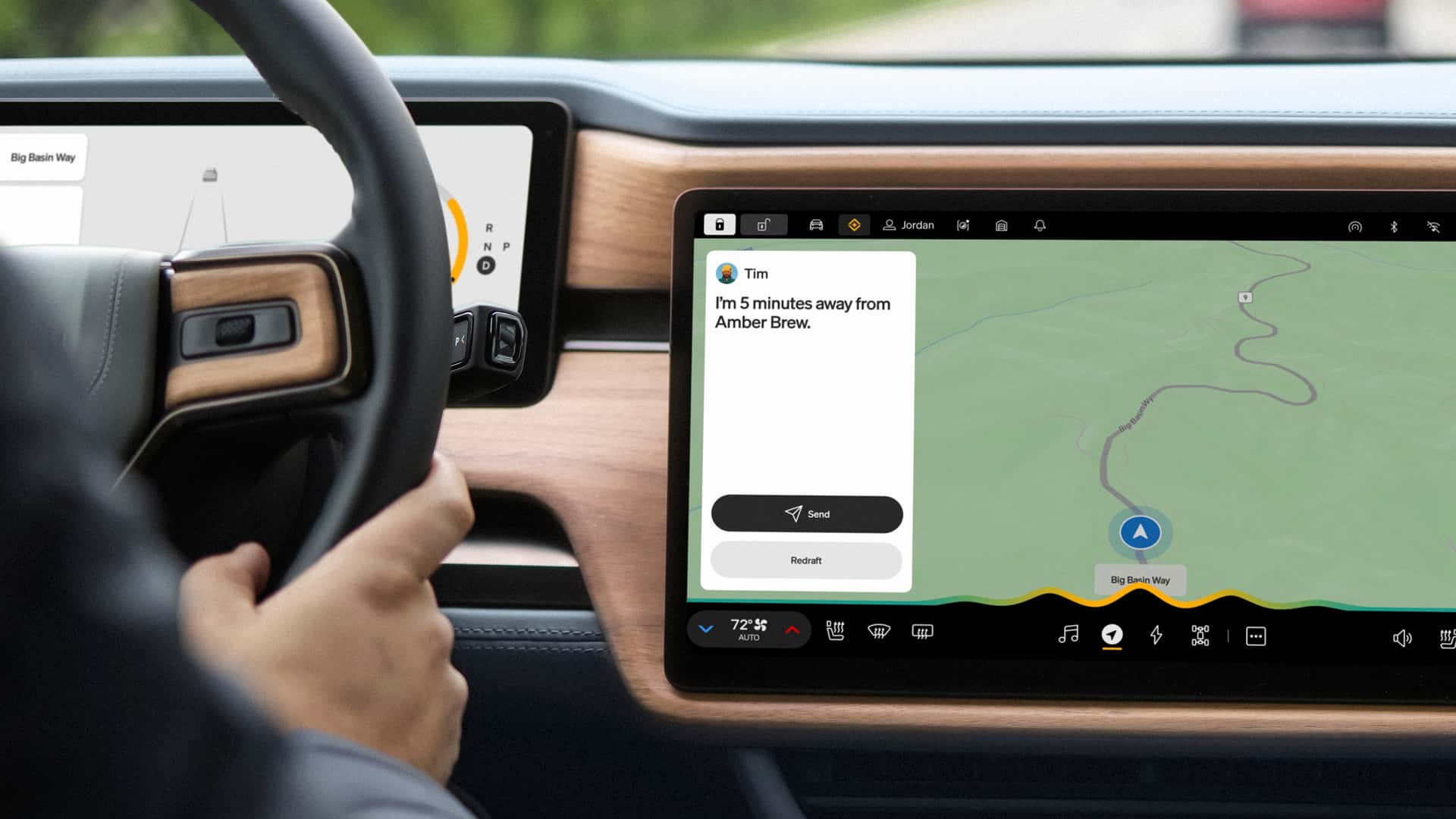
An illustrative example cited by Rivian involves sending a friend a collection of restaurant recommendations along with the driver’s estimated time of arrival (ETA) derived from the navigation system. The assistant’s ability to remember the context of an ongoing conversation further enhances its utility, allowing for follow-up questions and refined requests without needing to re-establish the premise of the discussion. Moreover, much like general-purpose AI tools, the Rivian AI Assistant can answer a broad range of general knowledge questions, transforming the vehicle into an intelligent companion.
Your Vehicle’s Digital Encyclopedia
Beyond active command execution, the Rivian AI Assistant also serves as an invaluable informational resource. Rivian positions the assistant as “an encyclopedia for your vehicle,” providing immediate answers to operational questions that traditionally would require consulting a physical owner’s manual or digital documentation.
This feature significantly boosts user convenience and safety. Instead of fumbling through manuals while potentially distracted, drivers can simply ask their vehicle for instructions on tasks such as how to change a tire or understand a dashboard warning light. This instant access to critical information empowers owners with on-demand guidance, fostering greater confidence and self-sufficiency.
Agentic AI: Bridging Vehicle and Digital Life
The most forward-looking aspect of the Rivian AI Assistant is its agentic capability, which allows it to connect and manage various external services. This functionality transforms the assistant from a reactive command processor into a proactive digital agent that can integrate aspects of an owner’s digital life with their driving experience.
The inaugural integration in this area is with Google Calendar. Rivian owners who link their Google accounts can leverage voice commands to manage their schedules directly from their vehicle. This includes the ability to move meetings, navigate seamlessly to upcoming appointments using the vehicle’s navigation system, and even relay calendar information via text messages—all executed hands-free through voice commands. This integration marks the beginning of Rivian’s vision to create a deeply interconnected and intelligent in-car environment.
A Glimpse into the Competitive Landscape
Rivian’s entry into the advanced in-car AI voice assistant market reflects a broader trend across the automotive industry. Major manufacturers are increasingly incorporating sophisticated AI chatbot technology to enrich the user experience. For instance, General Motors, Volvo, and Polestar have announced plans to integrate Google Gemini into their vehicles, while newer Tesla models feature xAI’s Grok.
Rivian’s strategy, with its emphasis on deep vehicle integration and a blend of in-house and external AI models, positions it uniquely within this competitive arena. The focus on agentic capabilities, particularly with practical integrations like Google Calendar, highlights a commitment to utility and seamless digital lifestyle integration, rather than merely offering a conversational interface.
Availability and Future Expansion
The Rivian AI Assistant is currently being deployed to all Generation 1 and Generation 2 R1S and R1T vehicles. For owners to access and utilize this advanced feature, an active connectivity subscription is required. This subscription ensures the necessary data transfer and cloud processing capabilities essential for the AI assistant’s optimal operation.
Looking ahead, the Rivian AI Assistant is confirmed to be a standard feature in the highly anticipated R2 model, which is expected to launch to customers in the coming weeks. This forward integration ensures that Rivian’s next generation of electric vehicles will offer an equally advanced and intuitive user interface from day one, reinforcing the brand’s reputation for innovative in-car technology.
Conclusion: Charting a New Course for In-Car Technology
The introduction of the Rivian AI Assistant represents a significant milestone for the electric vehicle manufacturer, showcasing its prowess in developing sophisticated in-car technology. By bringing a deeply integrated, natural language-capable, and agentic AI to its R1S and R1T models, Rivian is not just enhancing user convenience but also redefining the interaction paradigm within an automobile.
This move positions Rivian at the forefront of automotive AI innovation, offering a glimpse into a future where vehicles are not just modes of transport but intelligent, responsive partners in our daily lives. As the technology continues to evolve and integrate further services, the Rivian AI Assistant is set to become an indispensable feature for its owners, driving forward the evolution of the connected car.
FAQ Section
What is the Rivian AI Assistant?
The Rivian AI Assistant is an in-house developed artificial intelligence voice assistant now rolling out to Rivian R1S and R1T vehicles via an over-the-air software update. It offers advanced natural language interaction, allowing drivers to control vehicle functions, access information, and integrate with external services using conversational voice commands, moving beyond basic voice recognition tools.
Which Rivian models will receive the AI Assistant?
The Rivian AI Assistant is currently being deployed to all Generation 1 and Generation 2 R1S SUVs and R1T pickup trucks. Additionally, it will be a standard feature in the upcoming Rivian R2 model when it launches to customers. Owners need an active connectivity subscription to access the full capabilities of the assistant.
How does the Rivian AI Assistant differ from other in-car voice systems?
Unlike many systems that mirror phone functions, the Rivian AI Assistant is deeply integrated into the vehicle’s hardware and software. This allows it to directly control and access various vehicle aspects, offer contextual understanding for complex multi-step commands, and provide an “encyclopedia” of vehicle knowledge, utilizing both in-house and external AI models.
What specific functions can the Rivian AI Assistant perform?
The assistant can adjust drive modes, view vehicle cameras, provide information on points of interest, answer general knowledge questions, and act as an “encyclopedia for your vehicle” for operational queries. It also supports complex multi-step commands and remembers conversational context, enhancing user interaction significantly.
Can the Rivian AI Assistant integrate with external services?
Yes, the Rivian AI Assistant features agentic capabilities, enabling it to connect with external services over time. The first such integration is with Google Calendar. Rivian owners can use voice commands to move meetings, navigate to appointments, and relay calendar information via text, bridging their digital life with their in-vehicle experience.
Is a subscription required for the Rivian AI Assistant?
Yes, an active connectivity subscription is required for Rivian owners to access and utilize the full range of features offered by the Rivian AI Assistant. This subscription supports the necessary data processing and cloud-based services that enable the advanced functionalities of the AI assistant within the vehicle.