
Key Takeaways:
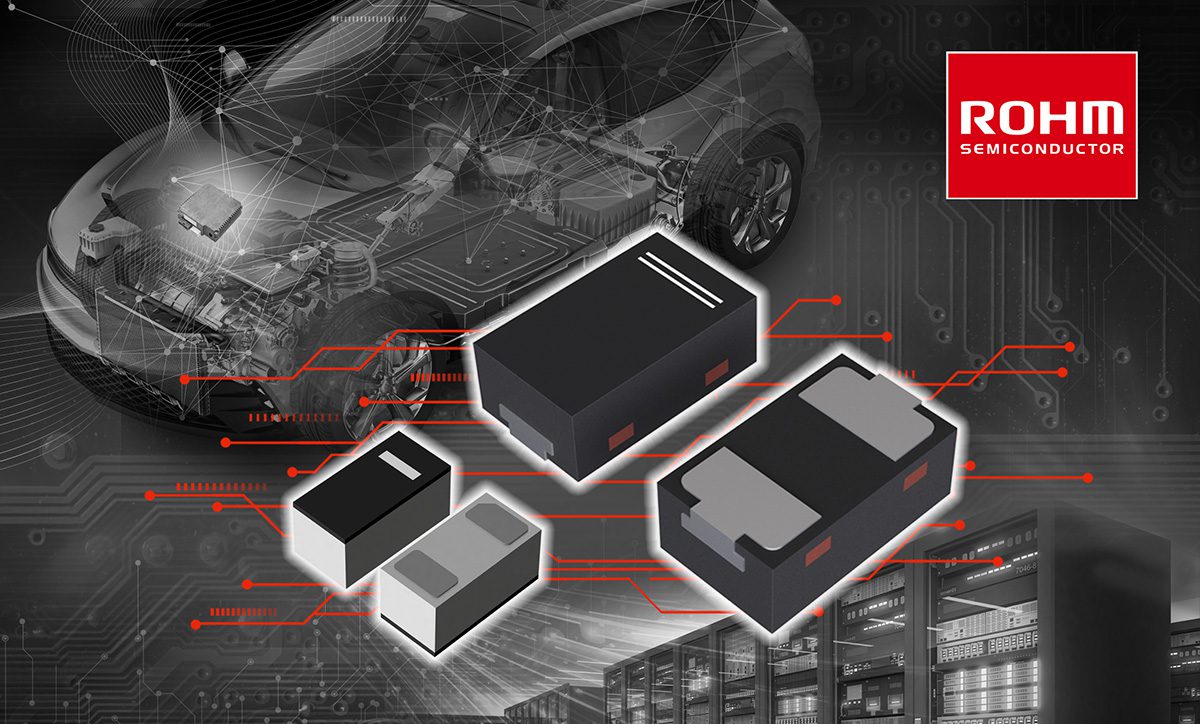
- ROHM Semiconductor has launched the RESDxVx series, a new line of ESD protection diodes designed for high-speed interfaces exceeding 10 Gbps.
- These innovative diodes address a critical design challenge by offering exceptionally low terminal capacitance (0.24 pF bidirectional, 0.48 pF unidirectional) and low dynamic resistance (0.28 Ω) simultaneously.
- This combination results in a clamping voltage approximately 40% lower than conventional products, significantly enhancing protection for sensitive integrated circuits.
- Automotive-qualified variants are AEC-Q101 certified, targeting ADAS, autonomous driving, surround-view systems, and ECUs utilizing SerDes communication.
- Non-automotive applications include AI servers, data center switches, 5G/6G base stations, and consumer electronics with USB4, Thunderbolt 4, PCIe, HDMI, DisplayPort, and MIPI D-PHY/C-PHY interfaces.
In a significant advancement for high-speed data transmission and system reliability, ROHM Semiconductor has officially introduced its RESDxVx series of electrostatic discharge (ESD) protection diodes. Engineered to safeguard critical high-speed interfaces operating at speeds exceeding 10 gigabits per second (Gbps), these new components promise to redefine protection standards across various demanding applications, from cutting-edge automotive systems to high-performance data centers.

Addressing High-Speed Data Challenges with Advanced ESD Protection Diodes
The relentless demand for faster data transfer rates in modern electronics, particularly within the burgeoning fields of automotive intelligence and cloud computing infrastructure, presents unique design challenges. As data speeds climb above the 10 Gbps threshold, the integrity of signal waveforms becomes incredibly sensitive to even minute amounts of parasitic capacitance within protection components. Traditional ESD protection solutions have long grappled with a fundamental trade-off: reducing capacitance to preserve signal quality often meant an increase in dynamic resistance, which in turn compromised the component’s ability to effectively clamp transient overvoltage events and protect downstream integrated circuits (ICs).
ROHM’s RESDxVx series claims to break this long-standing trade-off. The newly launched ESD protection diodes achieve an impressively low terminal capacitance of 0.24 picofarads (pF) for bidirectional configurations and 0.48 pF for unidirectional configurations. Crucially, this low capacitance is paired with an equally remarkable dynamic resistance of just 0.28 Ohms (Ω). This unique combination represents a significant leap forward in designing robust yet transparent protection for high-speed data lines.
Enhanced Clamping for Critical System Reliability
The true measure of an ESD protection diode lies in its clamping response – its ability to quickly and effectively shunt harmful overvoltages away from sensitive components. ROHM Semiconductor reports that its RESDxVx series delivers a clamping voltage approximately 40% lower than that of conventional competing products when compared at equivalent capacitance levels. This enhanced clamping capability is paramount for safeguarding the integrity and longevity of sophisticated ICs that are increasingly vulnerable to transient electrical stresses.
A lower clamping voltage ensures that the protected IC experiences less stress during an ESD event, thereby improving overall system reliability and extending the lifespan of critical electronic modules. This innovation is particularly vital for applications where downtime or component failure can have severe operational or safety implications, such as in autonomous vehicles or mission-critical data infrastructure.
Targeting Next-Generation Automotive Electronics
The automotive sector stands to be a primary beneficiary of the new RESDxVx series. With the rapid evolution of Advanced Driver-Assistance Systems (ADAS) and the drive towards fully autonomous driving, vehicles are becoming sophisticated data hubs. These systems rely heavily on high-speed data interfaces to process information from numerous sensors, cameras, and communication modules in real time.
ROHM has specifically developed automotive-qualified variants within the series, including the RESD3V3BASAFH, RESD5V0BASAFH, RESD3V3UASAFH, and RESD5V0UASAFH. These specific models, housed in compact DFN1006-2W packages, have successfully achieved AEC-Q101 certification. This rigorous standard is a testament to their reliability and suitability for the harsh operating conditions found in automotive environments, ensuring robustness against temperature extremes, mechanical stress, and electrical transients.
Key automotive applications for these specialized ESD protection diodes include:
- ADAS and Autonomous Driving Cameras: Ensuring the uninterrupted and clear transmission of high-resolution video data.
- Surround View Systems: Protecting the data lines that merge multiple camera feeds for a comprehensive vehicle view.
- Electronic Control Units (ECUs): Safeguarding the sophisticated microcontrollers and processors that manage various vehicle functions.
- SerDes Communication: Essential for protecting the Serializer/Deserializer (SerDes) links that efficiently transmit high-speed data over fewer wires within the vehicle’s complex wiring harness, thereby reducing weight and cost.
Expanding Reach to Data Centers, 5G/6G, and Consumer Interfaces
Beyond the automotive realm, the high-performance attributes of the RESDxVx series make it equally indispensable for a broad spectrum of non-automotive high-speed applications. As digital transformation accelerates, the need for robust ESD protection for high-bandwidth data pathways is universal.
Non-automotive variants, available in the even more compact DSN0603-2J package, are poised to support the backbone of modern digital infrastructure and consumer electronics. These include:
- AI Servers and Data Center Switches: Critical for maintaining the integrity of massive data flows within artificial intelligence computing and large-scale data storage and networking.
- 5G/6G Base Stations: Safeguarding the complex communication interfaces essential for next-generation wireless networks, which demand unprecedented data rates and low latency.
- Consumer Interfaces: Providing robust protection for a variety of popular high-speed consumer standards, such as USB4, Thunderbolt 4, PCIe (Peripheral Component Interconnect Express), HDMI (High-Definition Multimedia Interface), DisplayPort, and MIPI D-PHY/C-PHY for mobile device displays and cameras.
The ability of these ESD protection diodes to maintain signal integrity while offering superior transient protection underscores their versatility and importance across diverse technological landscapes. By mitigating the risks posed by electrostatic discharge, ROHM’s new series empowers designers to push the boundaries of data transmission speeds without compromising on system reliability or component longevity.
Source: ROHM Semiconductor
Frequently Asked Questions About ESD Protection Diodes
What are ESD protection diodes?
ESD protection diodes are specialized semiconductor devices designed to protect sensitive electronic components from electrostatic discharge events. They quickly shunt excess current caused by static electricity away from the main circuit, thereby preventing damage to integrated circuits and ensuring the long-term reliability of electronic systems.
Why are low capacitance and low dynamic resistance crucial for high-speed interfaces?
For high-speed interfaces (10+ Gbps), low capacitance is vital because parasitic capacitance can distort signal waveforms, leading to data errors. Low dynamic resistance is equally important as it enables the diode to clamp transient voltages effectively and quickly, minimizing the voltage overshoot seen by the protected IC during an ESD event.
What is AEC-Q101 certification, and why is it important for automotive applications?
AEC-Q101 is a global standard for stress testing discrete semiconductor components used in automotive applications. It ensures that components can withstand the rigorous environmental and operational conditions found in vehicles, making it critical for the reliability, safety, and longevity of automotive electronics like ADAS and ECUs.
How does the RESDxVx series achieve a 40% lower clamping voltage?
ROHM’s RESDxVx series achieves a significantly lower clamping voltage through advanced semiconductor process technology and optimized device architecture. This innovation allows the diodes to offer both ultra-low capacitance and very low dynamic resistance simultaneously, a combination that enhances their ability to quickly and effectively shunt ESD energy.
What is SerDes communication, and why is it used in automotive systems?
SerDes (Serializer/Deserializer) communication is a technique that converts parallel data into a serial stream for transmission over a single or a few differential lines, and then converts it back to parallel data at the receiver. It’s used in automotive systems to reduce the number of wires, simplify harness design, lower weight, and enable high-speed data transfer over longer distances, crucial for complex sensor and camera networks.
What types of high-speed consumer interfaces can benefit from these new diodes?
High-speed consumer interfaces such as USB4, Thunderbolt 4, PCIe, HDMI, DisplayPort, and MIPI D-PHY/C-PHY can significantly benefit. These interfaces handle massive amounts of data for peripherals, displays, and internal device communication, making robust ESD protection essential for maintaining signal integrity, preventing data corruption, and ensuring device reliability.
How do ESD events typically affect electronic devices?
Electrostatic discharge (ESD) events can cause immediate and catastrophic damage, leading to component failure. They can also cause latent damage, where a component is weakened but continues to function for a period before failing unexpectedly. Both types of damage result in system unreliability, increased warranty claims, and higher maintenance costs.
What role do these new ESD diodes play in 5G/6G base stations?
In 5G/6G base stations, these new ESD diodes are crucial for protecting the sensitive high-frequency transceiver circuits and data interfaces that handle massive data throughput. Given the extreme bandwidth and low latency requirements of next-generation wireless communication, ensuring the uninterrupted and error-free operation of these critical components against ESD threats is paramount for network stability and performance.