
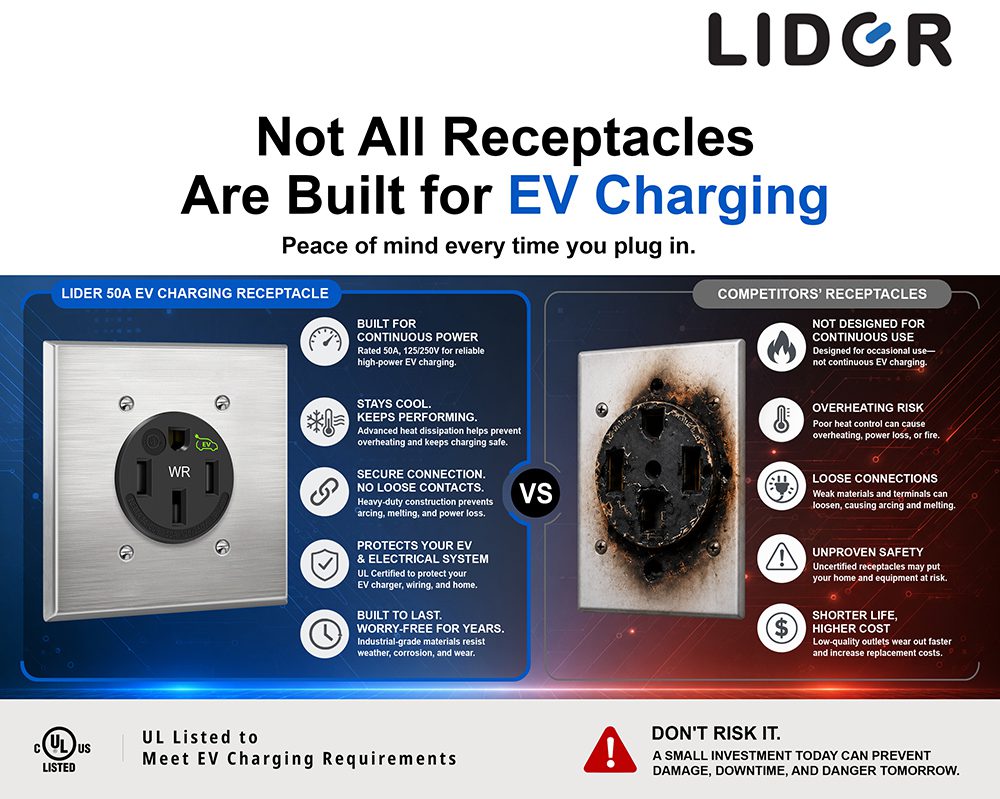
Key Takeaways
- EV charging reliability hinges significantly on the NEMA 14-50 receptacle, the crucial connection point for Level 2 plug-in charging.
- Unlike standard receptacles, EV charging demands sustained electrical loads and repeated use, necessitating purpose-built design and robust construction.
- Lider Electric’s LN-1450RH and LN-1450RHW NEMA 14-50 receptacles feature specific Electric Vehicle Marking and UL certification.
- This specialized marking and certification provide clear identification and assurance of evaluation for EV-related applications.
- Key engineering elements include fortified nylon enclosures, silver-plated brass contacts, and high-purity copper clamps, all designed for long-term performance and heat resistance.
- For homeowners, electricians, and property managers, selecting certified components is vital for a future-ready and dependable EV charging setup.
The Unseen Pillar of EV Charging Reliability
As electric vehicle (EV) adoption accelerates globally, discussions surrounding charging infrastructure often focus on high-level components such such as charger output, software advancements, and grid capacity. While these factors are undeniably critical for overall EV charging reliability, a fundamental, often-overlooked component plays an equally vital role, particularly in residential and light commercial settings: the electrical receptacle.
For Level 2 plug-in EV charging, the NEMA 14-50 receptacle serves as the essential interface where a building’s electrical system connects with the charging equipment. This connection point is subjected to a unique combination of demands, including sustained current flow, contact pressure, mechanical fit, heat generation, and repeated plugging and unplugging cycles. It transforms from a simple wiring device into a cornerstone of the charging infrastructure.

Recognizing this critical nexus, Lider Electric has specifically engineered its LN-1450RH and LN-1450RHW NEMA 14-50 receptacles. These models now feature distinct Electric Vehicle Marking, backed by the latest UL certification documentation. This innovative approach provides installers and end-users with a clear, recognized identification of their certified status for EV-related applications, underscoring Lider Electric’s commitment to safety, connection reliability, and long-term EV charging performance.
Why Standard Receptacles Fall Short for EV Charging Demands
The operational profile of EV charging fundamentally redefines the role of a standard electrical receptacle. It is not a sporadic electrical event, but rather a repeated, prolonged duty cycle for many EV owners. Drivers routinely plug in their vehicles, allow them to charge for several hours, then unplug, only to repeat the process day after day.
This consistent pattern imposes a sustained and rigorous demand on the electrical pathway. Unlike appliances that draw high current for short bursts, or are used intermittently, EV chargers require continuous, high-amperage current over extended periods. This makes the receptacle a critical link in the chain, particularly in demanding environments like home garages, driveways, workshops, and various multi-family or light commercial properties.
Consequently, product selection for EV charging applications must extend beyond mere plug configuration or price. A receptacle intended for EV use demands evaluation based on its ability to withstand daily, prolonged electrical loads, ensure secure wiring connections, effectively manage heat dissipation, and maintain long-term durability under strenuous conditions.
Beyond the Receptacle: A Holistic View of Electrical Safety
It is important to remember that the receptacle operates within a larger electrical ecosystem. Its performance is intrinsically linked to other critical components and installation practices. Proper breaker selection, appropriate wire sizing, effective grounding, suitable enclosure selection, correct terminal torque, adherence to local code compliance, and installation by qualified professionals all contribute to the overall safety and efficiency of an EV charging setup.
Nevertheless, the receptacle remains the physical point where electrical performance translates into direct contact. Its integrity directly impacts the secure transmission of power, making it a pivotal component in the comprehensive EV charging solution.
Engineering for Endurance: Lider Electric’s Approach to EV Receptacles
Lider Electric’s design philosophy for its NEMA 14-50 receptacles is rooted in a deep understanding of actual EV charging usage patterns. The LN-1450RH and LN-1450RHW models are specifically engineered to accommodate repeated charging sessions and the sustained electrical demand inherent in EV ownership, ensuring reliable connection performance over extended periods.
These receptacles are rated for 50A, 125/250V, making them suitable for EV-related installations where consistent, long-duration charging is a paramount requirement. Their design prioritizes several critical aspects: ensuring reliable power delivery at the connection point, employing heavy-duty NEMA 14-50 construction, maintaining secure connection performance even under sustained electrical load, incorporating contacts designed for superior heat resistance during prolonged use, and featuring clear product identification through the Electric Vehicle Marking.
Such meticulous design is particularly significant in a market where many products may appear superficially similar online. While two receptacles might share the same configuration, their internal construction, contact design, material selection, terminal strength, and crucially, certification status, can vary dramatically. For both professional installers and informed buyers, these underlying details are instrumental in confidently selecting a product for an EV-ready electrical upgrade.
Inside the Engineering: Core Components for Sustained Performance
The superior performance of Lider Electric’s EV charging receptacles stems from a focus on internal components engineered to support stable connection performance even under continuous heavy use. Key design specifications include:
- Fortified Nylon Enclosure: Reinforced with glass fibers, this enclosure enhances durability, heat resistance, and wear resistance, crucial for long-term applications.
- Silver-Plated Solid H65 Brass Contacts: These contacts are meticulously designed for optimal electrical conductivity and provide robust resistance to oxidation, ensuring consistent power flow.
- V-shaped High-Purity ETP Copper Clamp: With a copper purity of ≥ 99.9%, this clamp is designed to securely hold both stranded and solid wires, preventing loosening over time.
- Max 75 lb-in Torque Hexagon Terminal Screws: Engineered to facilitate secure installation when professionals adhere to applicable requirements and best practices.
- Self-Grounding Design: Aids in establishing a reliable ground path when installed correctly, contributing to overall electrical safety.
- Electric Vehicle Marking: This specific marking allows for clearer product identification, indicating the receptacle’s suitability for EV-related applications.
These deliberate engineering choices collectively reinforce the core principle guiding the broader product design: that enduring EV charging reliability begins with the unwavering quality of the physical electrical connection.
Claims Versus Certification: The Imperative of Documented Verification
The expanding EV charging market has seen a proliferation of products, many of which claim to meet relevant industry standards. However, a crucial distinction exists between a manufacturer’s self-declared claim and a product that has successfully completed a rigorous, applicable certification process. In practical terms, formal certification is indispensable because it provides installers, inspectors, and customers with a documented, third-party basis for product evaluation.
This validation is particularly valuable when the certification reference directly corresponds with an authorized UL Mark and clearly defined certification scope. For diverse stakeholders, including homeowners, commercial operators, licensed electricians, contractors, builders, and specialized EV installation professionals, this distinction is paramount. UL certification offers a definitive reference point, allowing for more confident and informed product selection for both residential and commercial EV-ready projects. It elevates the purchasing decision beyond mere marketing rhetoric, anchoring it firmly in verifiable, documented certification.
For Lider Electric’s LN-1450RH and LN-1450RHW, the most recent certification documentation confirms a NEMA 14-50 receptacle platform explicitly featuring Electric Vehicle Marking. This marking serves a vital function: it helps identify receptacles that have undergone evaluation under specific UL certification requirements tailored for EV-related use. For all involved parties, this is far more than just a label; it represents a practical and critical product identification tool in a rapidly evolving category where clarity and trust are increasingly important.
According to the UL Certificate of Compliance, representative samples of Lider Electric’s LN-1450RH-** and LN-1450RHW-** have been thoroughly evaluated by UL in accordance with the Standard(s) indicated on the Certificate. For the U.S. Listing, the certificate specifically references “UL 498 – Attachment Plugs and Receptacles.” The Models section explicitly specifies “LN-1450RH-** Electric Vehicle Marking – Suitable for USL only” and “LN-1450RHW-** Electric Vehicle Marking – Suitable for USL only.” Further details regarding this certification and the significance of EV Marking can be found in Lider Electric’s UL certification announcement and its EV Marking Article, which outline how certification documentation supports clearer product identification for EV-related applications.
Implications for the Field: Empowering Informed Decisions
The introduction of clear product identification and certification for EV-specific receptacles carries significant implications across various sectors of the electrical and EV industries.
For electricians and EV installation professionals, unambiguous product identification streamlines the specification and selection process. When a receptacle is clearly marked and documented as suitable for EV-related use, it provides installers with an additional, reliable reference point, aiding in the meticulous planning and execution of a safe and efficient charging setup. This fosters greater confidence in the components chosen for critical infrastructure.
Builders and property managers are increasingly incorporating EV readiness into their long-term property development strategies. By selecting components specifically designed for real-world EV charging behavior and certified for such applications, they can ensure their electrical projects are more future-proof and capable of meeting evolving demands. This foresight contributes to enhanced property value and tenant satisfaction.
For EV owners, the fundamental takeaway is straightforward: dependable charging commences well before the charging cable is connected to the vehicle. It originates with the integrity of the underlying electrical pathway, the precision and quality of the installation, and, crucially, the inherent reliability of the receptacle at the critical connection point. Understanding these foundational elements empowers owners to make more informed choices for their home charging solutions.
Building for a More Demanding Charging Future
As electric vehicle adoption continues its upward trajectory, the expectations placed upon charging infrastructure must evolve in tandem. While factors like charging speed and user convenience will always remain important, the underlying quality and durability of the electrical components behind the wall are equally, if not more, vital for long-term satisfaction and safety. The receptacle, though a relatively small component compared to the charger unit or the vehicle itself, plays an exceptionally meaningful role in supporting consistent, daily charging performance.
Lider Electric’s NEMA 14-50 receptacles, featuring the distinctive Electric Vehicle Marking, exemplify this forward-thinking approach. The LN-1450RH and LN-1450RHW models are meticulously engineered for diverse EV charging environments where connection reliability, clear product identification, secure installation, and unwavering long-term performance are not merely desirable, but essential.
For readers actively evaluating NEMA receptacle options for their EV-ready projects, Lider Electric offers a comprehensive overview through the LIDER NEMA receptacle collection. Those seeking detailed specifications for individual models can consult the LN-1450RH product page or the LN-1450RHW product page. For customers preferring marketplace convenience, the LN-1450RHW is also available on Amazon.
Ultimately, robust and reliable power delivery begins at the precise point of connection. For Lider Electric, this foundational principle is where the journey of thoughtful EV charging design truly commences.
FAQ Section
What makes Lider Electric’s NEMA 14-50 receptacles unique for EV charging?
Lider Electric’s LN-1450RH and LN-1450RHW NEMA 14-50 receptacles are distinguished by their specific Electric Vehicle Marking and UL certification for EV-related use. They are designed for sustained electrical loads and repeated use, featuring fortified construction and advanced materials to ensure long-term reliability and safety, unlike standard receptacles.
Why is UL certification important for EV charging receptacles?
UL certification provides documented, third-party verification that a receptacle has been evaluated against stringent safety and performance standards for EV applications. This gives installers and consumers a clear, objective basis for product evaluation, moving beyond self-declared claims and ensuring components meet established benchmarks for safety and reliability.
How does sustained EV charging impact a standard electrical receptacle?
Sustained EV charging subjects receptacles to continuous, high-amperage current over many hours, repeatedly. This prolonged demand can lead to increased heat, material degradation, and potential failure in standard receptacles not designed for such rigorous duty cycles. EV-specific receptacles are engineered to manage these stresses more effectively.
What is the significance of the Electric Vehicle Marking?
The Electric Vehicle Marking on Lider Electric’s receptacles provides clear product identification, indicating that the device has been specifically evaluated under UL certification requirements for EV-related use. This marking helps electricians, inspectors, and consumers easily identify suitable and certified components for EV charging installations, enhancing safety and compliance.
What internal engineering features contribute to the reliability of these receptacles?
Key internal features include a glass fiber-reinforced nylon enclosure for durability and heat resistance, silver-plated solid H65 brass contacts for conductivity and oxidation resistance, and a high-purity ETP copper clamp for secure wire connections. These elements collectively ensure stable performance under the sustained demands of EV charging.
Who benefits most from using certified EV-specific NEMA 14-50 receptacles?
Homeowners gain peace of mind with a safer, more reliable home charging setup. Electricians and installers benefit from clear product identification and certified performance, simplifying selection and ensuring compliance. Builders and property managers can offer future-ready properties with dependable infrastructure, enhancing value and tenant satisfaction.