
Key Takeaways:
- Vishay Intertechnology has introduced six new 1200 V FRED Pt® Gen 7 hyperfast rectifiers, designed to significantly reduce switching losses.
- These new diodes, housed in the compact eSMP-series SMPC HV package, boast ultra-low reverse recovery charge (Qrr) and a low forward voltage drop (Vf).
- Key specifications include a rapid 50 ns recovery time, 105 nC typical Qrr, and 1.45 V forward voltage, setting a new benchmark for efficiency in their class.
- The components are crucial for high-frequency power conversion, improving performance in industrial, automotive, and energy generation applications, especially for electric vehicles (EVs).
- AEC-Q101 qualified versions are available, ensuring robust performance for demanding automotive power electronics environments.
Vishay Intertechnology, a global leader in discrete semiconductors and passive electronic components, has announced a significant expansion of its Gen 7 family. The company has introduced six new 1200 V FRED Pt® hyperfast rectifiers, engineered to dramatically cut switching losses in a wide array of high-frequency power conversion systems. These cutting-edge components are set to enhance the efficiency and reliability of critical applications, from industrial machinery to the rapidly evolving electric vehicle (EV) sector.

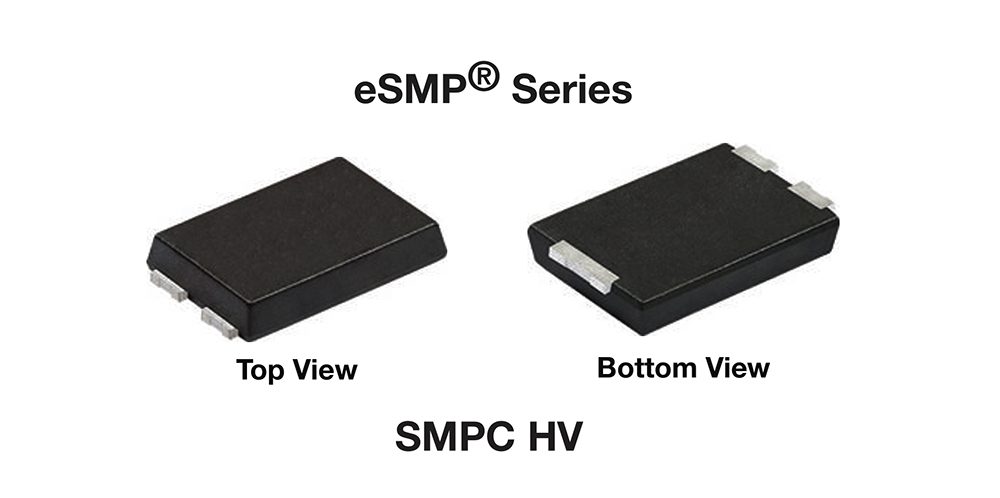
The newly released diodes are built into Vishay’s advanced eSMP-series SMPC HV package. Available in current ratings of 1 A, 2 A, and 3 A, these devices represent a pivotal step forward in power electronics, combining best-in-class low reverse recovery charge (Qrr) with a minimal forward voltage drop (Vf). This combination directly translates into reduced energy wastage, particularly vital in fast-switching power stages where efficiency is paramount.
Next-Generation Performance for Demanding Applications
The introduction of these six rectifiers includes both standard industrial versions and three AEC-Q101 qualified variants, specifically designed to meet the rigorous standards of automotive applications. The industrial models are designated VS-E7SX0112-M3V, VS-E7SX0212-M3V, and VS-E7SX0312-M3V. For the automotive sector, Vishay offers the VS-E7SX0112HM3V, VS-E7SX0212HM3V, and VS-E7SX0312HM3V, ensuring robust performance in challenging environmental conditions typical of electric vehicles.
Across this new range, the technical specifications underscore Vishay’s commitment to superior performance. The devices achieve an impressively fast recovery time of 50 ns, crucial for high-speed switching. The reverse recovery charge (Qrr) is typically as low as 105 nC, indicating minimal energy loss during the diode’s turn-off transition. Furthermore, the forward voltage (Vf) stands at a low 1.45 V, while junction capacitance reaches 7.25 pF. These rectifiers also boast a robust non-repetitive peak surge current capability of up to 70 A, providing enhanced reliability against transient events.

Optimizing Switching Efficiency Through Advanced Design
The core innovation behind these hyperfast rectifiers lies in their ability to minimize switching losses. A lower reverse recovery charge (Qrr) means that the diode releases less stored charge each time it transitions from a conducting to a non-conducting state. This translates directly into less energy wasted per switching cycle, a critical factor for the overall efficiency of high-frequency converters.
Recovery losses inherently increase with higher switching frequencies. Therefore, the reduced stored charge of these Vishay diodes yields substantial benefits in fast-switching power stages, where such losses often dominate. The proprietary planar structure and platinum-doped lifetime control employed in their manufacturing are key enablers, meticulously engineered to keep stored charge and recovery current at exceptionally low levels, thereby mitigating both switching loss and overall power dissipation.
According to Vishay, these six new parts offer the industry’s best Qrr-to-forward-voltage trade-off within their class. This balanced characteristic is further complemented by the lowest junction capacitance and recovery time, reinforcing their position as a leading solution for advanced power management. Such optimized parameters are crucial for system designers seeking to maximize energy efficiency and reduce thermal management complexities in modern electronics.
Enhanced Safety and Compact Integration
Beyond electrical performance, the new hyperfast rectifiers prioritize safety and ease of integration. The components feature a minimum creepage distance of 5.4 mm, a critical factor for high-voltage circuits. This generous spacing helps prevent electrical breakdown and ensures reliable operation under high potential differences. Furthermore, the molding compound utilized in the package is rated with a comparative tracking index (CTI) of 600 or higher, classifying it within Material Group I.
These design choices enable the diodes to fully comply with the stringent IEC 60664-1 spacing rules for high-voltage applications. By meeting these international safety standards, the Vishay rectifiers allow designers to potentially reduce component counts and optimize their Bill of Material (BOM) costs. This compliance simplifies circuit design for high-voltage applications, ensuring both safety and cost-effectiveness.
The eSMP-series SMPC HV package itself is designed for compact and efficient integration. Measuring 4.3 mm x 6.5 mm with a height of just 1.1 mm, these diodes offer a low-profile solution for space-constrained designs. Importantly, the package is footprint-compatible with the widely used TO-277A, facilitating seamless integration into existing designs and streamlining migration paths for engineers.
Versatile Applications Across Key Growth Sectors
The versatility of Vishay’s new 1200 V hyperfast rectifiers makes them suitable for an extensive range of critical power electronics applications across various industries. Their robust performance and high efficiency are particularly beneficial in environments demanding precise power control and minimal energy waste.
Driving Electric Vehicle Innovation
In the burgeoning electric vehicle market, these rectifiers are poised to play a vital role in enhancing system performance. They are ideal for use in EV on-board chargers, where efficient power conversion is essential for fast and effective battery charging. Their high-speed switching capabilities also benefit EV motors, contributing to more efficient motor control systems and overall vehicle performance. The AEC-Q101 qualification of certain versions further solidifies their suitability for the automotive power electronics ecosystem, ensuring reliability and longevity under demanding operational conditions.
Enhancing Industrial Power Systems
Industrial applications also stand to benefit significantly. The rectifiers can function as clamp, snubber, and freewheeling diodes within flyback auxiliary supplies, which are common in industrial drives and tools. Their ability to manage high-frequency switching and handle surge currents makes them robust choices for applications like industrial motor control, power supplies for automation, and various high-power industrial equipment.
Advancing Energy Generation and Storage
The energy sector, particularly in generation and storage systems, requires highly efficient components to minimize losses during power conversion. These rectifiers can improve the performance of solar inverters, wind turbine converters, and battery energy storage systems, contributing to more sustainable and cost-effective energy solutions. Their reliability at high temperatures (up to 175°C) is also advantageous for long-term operation in such demanding environments.
Optimizing Advanced Power Conversion Topologies
Furthermore, these devices serve as high-frequency rectifiers for bootstrap driver stages, which are critical in controlling advanced power switching devices like IGBTs and MOSFETs. They also provide essential desaturation protection for fast-switching insulated-gate bipolar transistors (IGBTs) and high-voltage silicon (Si) and silicon carbide (SiC) MOSFETs, safeguarding these components from overcurrent damage. Specific applications include cuk converters and LED SEPIC (Single-Ended Primary Inductor Converter) circuitry, where their precise control and efficiency are highly valued.
Compliance and Availability
Vishay’s new hyperfast rectifiers are fully compliant with environmental and manufacturing standards, including RoHS-compliance and being halogen-free. They also carry a moisture sensitivity level (MSL) of 1 under J-STD-020, indicating their robustness against moisture during assembly processes. With an impressive operating temperature range extending up to 175°C, these diodes are built to perform reliably in harsh thermal environments.
Samples and production quantities of these advanced 1200 V hyperfast rectifiers are available now. Vishay Intertechnology has indicated an eight-week lead time for new orders, ensuring that manufacturers can integrate these components into their upcoming designs efficiently. This timely availability underscores Vishay’s commitment to supporting the rapid development cycles of the industrial and EV sectors.
Source: Vishay Intertechnology
Frequently Asked Questions (FAQ)
What are Vishay’s new 1200V hyperfast rectifiers?
Vishay has launched six new 1200V FRED Pt® Gen 7 hyperfast rectifiers, which are diodes designed for efficient power conversion. They feature extremely low reverse recovery charge (Qrr) and low forward voltage drop (Vf) to significantly reduce energy losses during high-frequency switching, making them ideal for modern power electronics.
What is the main benefit of these new rectifiers?
The primary benefit is the substantial reduction in switching losses. By minimizing reverse recovery charge and forward voltage drop, these rectifiers waste less energy per cycle, leading to higher overall system efficiency. This is particularly advantageous in high-frequency applications where such losses typically dominate.
Where are these rectifiers primarily used?
These hyperfast rectifiers are designed for critical applications across industrial, automotive, and energy sectors. Specific uses include EV on-board chargers and motors, industrial drives and tools, energy generation and storage systems, as well as advanced power conversion topologies like cuk converters and LED SEPIC circuitry.
Are there versions suitable for automotive applications?
Yes, Vishay offers three AEC-Q101 qualified versions of these rectifiers. These components meet the stringent reliability and performance standards required for automotive power electronics, making them ideal for the demanding environments found in electric vehicles and other vehicle systems.
What makes the eSMP-series SMPC HV package significant?
The eSMP-series SMPC HV package is a compact (4.3 mm x 6.5 mm x 1.1 mm) and efficient housing. Its low-profile design aids in space-constrained applications. Additionally, it ensures high-voltage safety with a 5.4 mm creepage distance and CTI 600+ molding compound, meeting IEC 60664-1 spacing rules.
How do these rectifiers contribute to overall system cost savings?
By meeting IEC 60664-1 spacing rules with their inherent design features, these rectifiers can potentially reduce the need for additional insulating components or complex board layouts. This can lead to a simplification of the Bill of Material (BOM) and overall manufacturing cost reductions, while maintaining high safety standards.
What are the key technical specifications?
Key specifications include a rapid 50 ns recovery time, a low reverse recovery charge (Qrr) of 105 nC typical, and a forward voltage (Vf) of 1.45 V. They also feature a junction capacitance of 7.25 pF and a non-repetitive peak surge current capability of up to 70 A, all contributing to their high performance.