
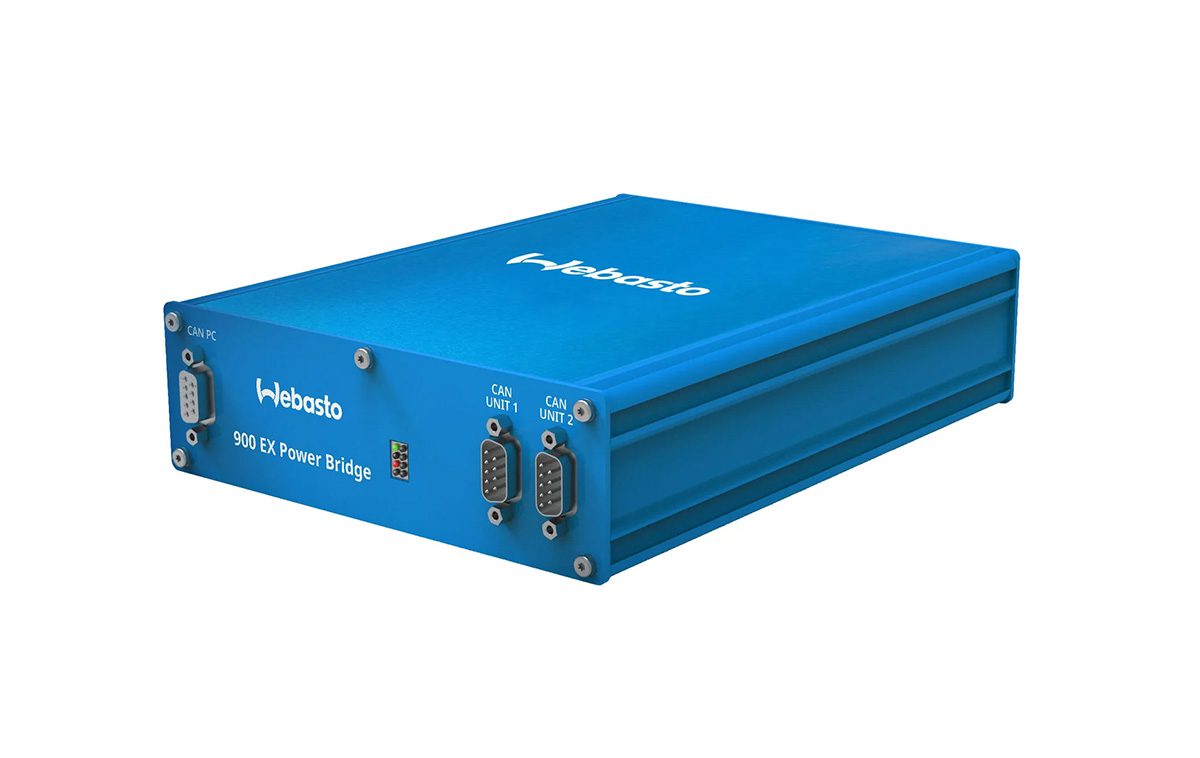
In a significant advancement for electric vehicle (EV) development and energy storage validation, Webasto has introduced a novel solution designed to dramatically enhance existing laboratory infrastructure. The company’s new 900 EX Power Bridge now allows facilities already utilising Webasto’s 900 EX battery test units to achieve unprecedented voltage and power levels without the need for extensive new hardware investments.
This innovative Power Bridge effectively links two 900 EX units, transforming them into a unified system capable of testing at up to 1,500 V and 500 kW. This development directly addresses the escalating demands within the e-mobility sector for higher voltage battery testing capabilities, critical for the next generation of electric vehicles and large-scale energy storage architectures.

Key Takeaways
- The Webasto 900 EX Power Bridge enables existing battery test units to reach 1,500 V and 500 kW.
- It integrates two 900 EX units, allowing laboratories to significantly scale their EV battery testing capabilities without purchasing entirely new equipment.
- This solution directly responds to the growing industry need for higher voltage testing, vital for advanced electric vehicles and energy storage systems.
- Excel Engineering has successfully implemented the Power Bridge, expanding its high-voltage testing services and commending its ease of use and high-frequency control.
- The innovation provides a cost-effective and efficient upgrade path, preserving existing infrastructure and operational familiarity for test environments.
Addressing Evolving Demands in EV Battery Testing
The rapid evolution of the electric vehicle market, coupled with advancements in stationary energy storage systems, has placed immense pressure on research and development laboratories. A central challenge has been the increasing voltage and power requirements of modern battery packs. These advanced designs necessitate robust testing environments that can accurately simulate real-world conditions at elevated operational parameters.
Traditional battery test systems, while capable, often have inherent voltage and power limitations, forcing laboratories to either restrict their testing scope or undertake costly, time-consuming upgrades involving entirely new equipment. Webasto’s 900 EX Power Bridge offers a strategic bypass to this dilemma, providing a scalable and efficient pathway to advanced testing protocols.
Seamless Integration and Enhanced Performance
At its core, the 900 EX Power Bridge is engineered to work in conjunction with existing Webasto 900 EX battery test units. By physically and electronically connecting two of these units, the Power Bridge effectively doubles the cumulative voltage and power output, enabling comprehensive validation of high-voltage battery packs and complex energy storage architectures.

A key design philosophy behind this innovation is the preservation of operational simplicity. Webasto asserts that this approach elevates voltage and power capabilities without introducing additional complexity into the critical aspects of control, calibration, or service. This means that laboratories can upgrade their EV battery testing capabilities while maintaining the familiar look, feel, and function of their existing test environments.
“The 900 EX Power Bridge represents a major step forward for users looking to scale their battery testing capabilities without disrupting existing test setups,” stated Dimitri Liambotis, Sales Manager of Power Test Systems at Webasto. This underscores the company’s commitment to providing practical, forward-looking solutions that support the accelerating pace of electrification.
Meeting the Challenge of 1,500 V Platforms
The demand for testing at 1,500 V platforms is not merely an incremental increase; it reflects a fundamental shift in battery technology and system architecture. Higher voltages are crucial for achieving faster charging times, improving overall system efficiency, and enabling more powerful applications in various sectors, from automotive to large-scale grid storage.
Battery test systems must meticulously match the voltage and power characteristics of the packs they are designed to cycle and validate. The ability to pair two 900 EX units through the Power Bridge offers laboratories a direct and efficient pathway to conduct 1,500 V testing, leveraging their existing investment in high-quality test equipment.
Excel Engineering’s Success Story
The practical application and immediate impact of the 900 EX Power Bridge are exemplified by Excel Engineering, an independent laboratory renowned for its validation services across a broad spectrum of electrical and energy storage systems. This includes critical sectors such as automotive, off-road vehicles, rail transport, marine applications, and stationary markets.
Excel Engineering had been experiencing a significant surge in demand for 1,500 V platform testing. The laboratory sought a solution that could not only meet this rising demand but also integrate seamlessly into their operations and deliver reliable, high-performance results. The Webasto 900 EX Power Bridge proved to be the ideal answer to their requirements.
Matt Sobotka, General Manager of Electrification Testing at Excel Engineering, highlighted the tangible benefits: “This solution allowed us to meet the needs of our customers in a timely manner, which is paramount.” He further lauded the system’s operational excellence, stating, “The controlability, ease of use, and install of the 900 EX are unmatched in the industry. Projects often require high-frequency controls, which we have been able to achieve with this setup.”
This testimony underscores the Power Bridge’s ability to not only expand voltage and power but also to maintain, and even enhance, critical testing parameters such as control precision and frequency response, which are vital for complex battery validation protocols.
Driving Innovation in E-Mobility Testing
The introduction of the 900 EX Power Bridge represents more than just a product launch; it signifies Webasto’s responsiveness to the dynamic needs of the e-mobility industry. By enabling existing infrastructure to handle future testing requirements, the company empowers laboratories to stay at the forefront of battery technology validation.
Solutions like the Power Bridge are instrumental in accelerating the development cycle of new electric vehicles and advanced energy storage systems. They ensure that battery packs, the heart of these modern technologies, can be rigorously tested for safety, performance, and durability under increasingly demanding electrical conditions.
As the global push towards electrification intensifies, the role of sophisticated EV battery testing capabilities will only grow in importance. Webasto’s strategic innovation provides a robust, adaptable, and cost-effective method for laboratories worldwide to meet these evolving challenges, fostering greater confidence and faster time-to-market for next-generation energy solutions.
Future Outlook for Battery Validation
The trend towards higher voltage and power densities in battery technology is expected to continue. This necessitates a continuous evolution of testing methodologies and equipment. The modular and scalable nature of solutions like the 900 EX Power Bridge offers a flexible blueprint for laboratories to adapt without continuous, ground-up rebuilds of their test facilities.
Such advancements ensure that the intricate processes of battery pack design, manufacturing, and validation can keep pace with the rapid innovation in the EV sector. This ultimately contributes to the reliability, safety, and widespread adoption of electric mobility across diverse applications and global markets.
FAQ Section
What is the Webasto 900 EX Power Bridge?
The Webasto 900 EX Power Bridge is an innovative hardware solution designed to link two existing Webasto 900 EX battery test units. This integration creates a single, more powerful system capable of significantly higher voltage and power output for advanced battery testing.
How does the Power Bridge enhance existing test units?
By connecting two 900 EX units, the Power Bridge elevates their combined EV battery testing capabilities to a maximum of 1,500 V and 500 kW. This allows laboratories to test high-voltage battery packs and energy storage architectures without requiring entirely new, costly equipment.
What are the voltage and power ratings achieved with the Power Bridge?
When two Webasto 900 EX battery test units are connected via the Power Bridge, the combined system can achieve a maximum voltage of 1,500 V and a total power output of 500 kW. This expanded capacity meets modern industry demands for high-voltage testing.
Which industries benefit from 1,500 V battery testing?
Industries extensively benefiting from 1,500 V battery testing include the automotive sector for electric vehicles, off-road machinery, rail transport, marine applications, and various stationary energy storage markets. These sectors increasingly utilize high-voltage battery systems requiring rigorous validation.
Does the Power Bridge require extensive changes to existing lab setups?
No, one of the key advantages of the 900 EX Power Bridge is its design to reuse existing infrastructure. It integrates seamlessly with current 900 EX setups, ensuring that control, calibration, and service procedures remain familiar, minimizing disruption and preserving operational efficiency.
What specific benefits did Excel Engineering find using the Power Bridge?
Excel Engineering successfully utilized the Power Bridge to meet rising customer demand for 1,500 V platform testing. They specifically praised its “controlability, ease of use, and install,” noting its effectiveness in achieving the high-frequency controls often required for complex testing projects.