
Key Takeaways (TL;DR)
- NOVOSENSE Microelectronics has launched the SP301H/L series, a new family of three-channel digital isolators.
- These isolators leverage the company’s third-generation capacitive isolation technology.
- The SP301H/L directly replaces three traditional optocouplers and their supporting passive components in RS485 isolation designs, significantly reducing board space and bill of materials.
- Key features include high-speed data transfer (up to 8 Mbps), robust electrical isolation (5 kVrms withstand voltage, >10 kV surge), and enhanced immunity against electrical overstress and power-supply noise.
- Designed for demanding applications like industrial automation, power meters, and energy storage, the new series promises improved reliability, extended service life, and greater design flexibility.
New Delhi, India – In a significant advancement for industrial communication infrastructure, NOVOSENSE Microelectronics has introduced its SP301H/L series, a groundbreaking family of three-channel digital isolators. These innovative components are specifically engineered to streamline and enhance RS485 communication links, a ubiquitous standard in industrial automation, power management, and various other demanding environments.

Built upon the company’s sophisticated third-generation capacitive isolation technology, the SP301H/L series marks a pivotal shift from conventional isolation methods. Its core innovation lies in its ability to integrate three independent isolation channels onto a single chip. This consolidation directly addresses a long-standing challenge in isolated RS485 designs, traditionally reliant on three separate optocouplers along with their requisite supporting passive components.
Consolidating Isolation for Enhanced Efficiency
The strategic integration of multiple isolation channels into a single chip offers profound benefits for system designers. By combining these functions, NOVOSENSE’s new digital isolators dramatically reduce the component count, simplify circuit board layouts, and ultimately lower the overall bill of materials (BOM) for isolated RS485 nodes. This approach not only shrinks the physical footprint required on the Printed Circuit Board (PCB) but also contributes to improved system reliability by minimizing interconnections and potential points of failure.
The SP301H/L family comprises two distinct enable-logic options to cater to diverse system requirements. The SP301H variant features a default-high enable pin, while the SP301L is equipped with a default-low pin. This thoughtful design choice provides engineers with crucial flexibility, allowing them to seamlessly integrate the isolator with various microcontroller (MCU) enable logic configurations without additional circuitry or complex adaptations.

Superior Performance and Compact Design
Performance is a cornerstone of the new SP301H/L digital isolators. The data channel is engineered to operate at an impressive speed of up to 8 Mbps, facilitating rapid and efficient data exchange critical for time-sensitive industrial applications. Complementing this, the enable control channel supports speeds of up to 1 Mbps, ensuring responsive control over communication pathways. These speeds represent a notable improvement over typical optocoupler-based RS485 isolation solutions, which often present limitations in high-speed data transfer scenarios.
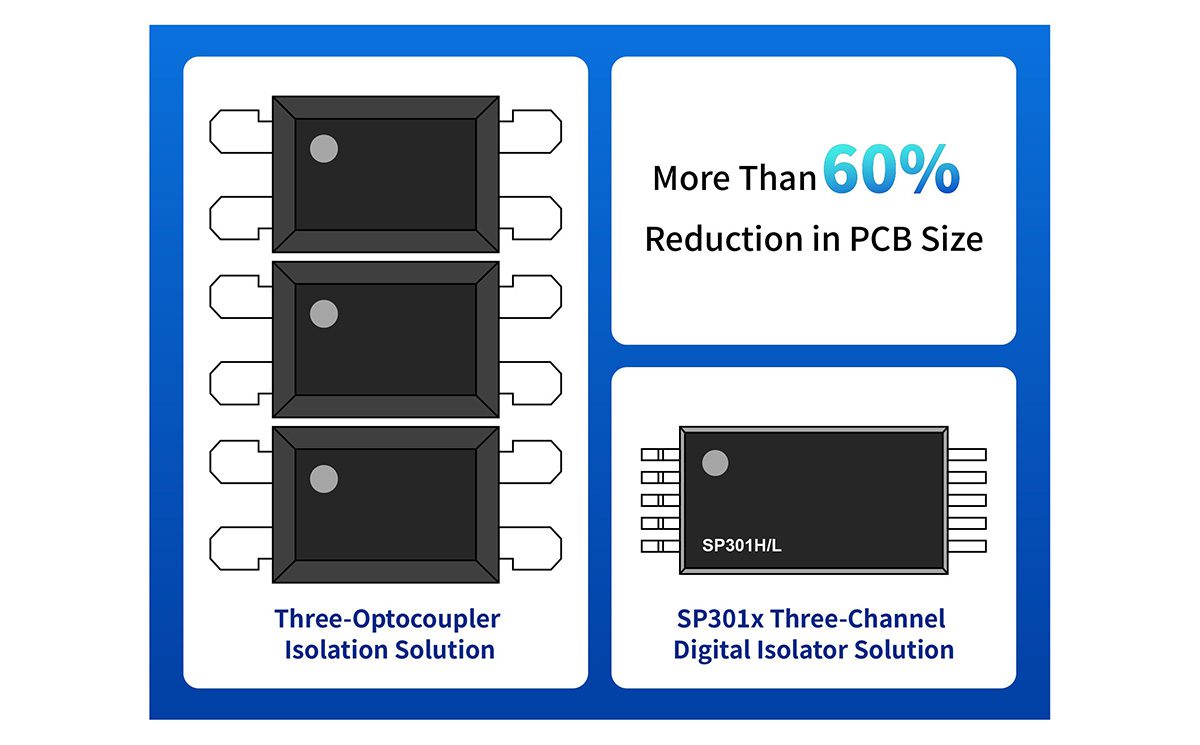
Despite its advanced capabilities, the SP301H/L maintains a remarkably compact footprint. It is housed in a compact SSOW10 wide-body package, characterised by its fine-pitch leads. NOVOSENSE reports that this miniaturised package significantly reduces the required PCB area by more than 60% when compared to traditional designs utilising discrete optocouplers. This space-saving attribute is invaluable in applications where board real estate is at a premium, enabling more compact and feature-rich designs.
The operational resilience of these digital isolators is further highlighted by their broad ambient temperature range, spanning from an extremely cold –40° C to a scorching 125° C. This wide operating range ensures reliable performance across harsh industrial environments, from frigid outdoor installations to high-temperature processing units. Furthermore, a notably low quiescent current consumption makes the SP301H/L particularly well-suited for battery-powered field instruments, where power efficiency is a critical design consideration for extending operational life.
Unparalleled Robustness and Reliability Features
In demanding industrial and automotive applications, robust electrical isolation is paramount for safeguarding sensitive electronics from hazardous voltage differentials and transient events. The SP301H/L series excels in this regard, offering a formidable withstand voltage of up to 5 kVrms for one minute. This capability ensures that the isolator can maintain its integrity and protective function even under significant electrical stress. Additionally, the device boasts a surge capability exceeding 10 kV, effectively protecting downstream components from high-energy surges commonly encountered in industrial power systems.
According to NOVOSENSE, these specifications meet the stringent requirements for reinforced insulation, a critical standard for ensuring safety and reliability in high-voltage environments. The isolators also demonstrate exceptional common-mode transient immunity (CMTI), achieving a typical rating of 200 kV/μs. This high CMTI value signifies the device’s ability to reject large, fast-changing common-mode voltage transients, thereby ensuring communication integrity even in electrically noisy environments prevalent in industrial settings.
Advancements Over Previous Generations
Comparing the new SP301H/L parts to their predecessors, the SP301A and NIRS31 series, NOVOSENSE highlights several key improvements. The latest digital isolators reportedly enhance electrical overstress (EOS) tolerance by approximately 10%. This improvement is crucial for extending the device’s lifespan and reliability when subjected to unexpected voltage spikes or abnormal operating conditions. Furthermore, the latch-up immunity has been maintained above 10 V, a testament to the device’s inherent robustness against parasitic effects that can lead to device failure.
Another significant enhancement is the improved power-supply noise immunity. This feature ensures that communication remains error-free even in the presence of high-frequency, high-amplitude system noise, often observed in the MHz range within complex electronic systems. Such noise rejection capabilities are vital for maintaining signal integrity and preventing data corruption in electrically challenging environments, thereby bolstering the trustworthiness of communication links.
Strategic Position within the Isolation+ Portfolio
NOVOSENSE strategically positions the SP301H/L series within its comprehensive Isolation+ product line. This portfolio encompasses a wide array of advanced isolation solutions, including other digital isolators, isolated sensors, isolated interfaces, isolated power supplies, and isolated gate drivers. This integrated approach allows customers to source a full suite of compatible isolation components from a single provider, simplifying design, procurement, and ensuring system-wide compatibility and performance.
The importance of isolation in RS485 communication cannot be overstated. Nodes within equipment such as power meters, intricate industrial automation systems, and sophisticated energy storage solutions are frequently distributed across considerable distances. This geographical separation often results in differing ground potentials between devices, which can lead to ground loops, signal corruption, and even damage to sensitive electronics. A digital isolator effectively blocks these potential differences and protects against transient surges, ensuring that only the intended signal is passed through, thereby preserving data integrity and system stability.
Digital Isolators vs. Optocouplers: A Clear Advantage
Historically, optocouplers have been a common choice for achieving isolation. These devices function by coupling signals through an LED, converting electrical signals into light, transmitting them across an insulating barrier, and then converting them back into electrical signals. While effective, optocouplers inherently suffer from a wear-out mechanism: the output intensity of their internal LED gradually dims over years of operation. This degradation can lead to shifting timing characteristics, reduced performance, and ultimately a limited service life for the device.
In stark contrast, capacitive isolators, like those employed in the SP301H/L series, operate on an entirely different principle, using electric fields to transmit signals across an insulating barrier. Crucially, capacitive isolators have no such wear-out mechanism, promising a significantly longer operational lifespan and consistent performance over time. Moreover, the ability to integrate three channels into a single chip, as achieved by NOVOSENSE, directly addresses the inherent disadvantages of discrete optocoupler designs, which necessitate a higher bill of materials, increased component count, and more complex board routing, all of which contribute to higher costs and larger PCB footprints.
The introduction of the SP301H/L digital isolators underscores NOVOSENSE’s commitment to advancing industrial and power electronics. By offering a high-performance, compact, and highly reliable alternative to traditional optocoupler solutions, the company is empowering engineers to design more efficient, robust, and future-proof systems for critical applications worldwide.
Frequently Asked Questions (FAQ)
What is the primary benefit of NOVOSENSE’s SP301H/L digital isolators?
The main benefit is the integration of three isolation channels onto a single chip, directly replacing three optocouplers and associated passives. This significantly reduces PCB area by over 60%, lowers the bill of materials, simplifies design complexity, and enhances overall system reliability compared to traditional optocoupler-based solutions.
How do the SP301H/L digital isolators improve RS485 communication links?
They improve RS485 links by providing robust electrical isolation against differing ground potentials and surges, while passing signals at high speeds (up to 8 Mbps). This ensures data integrity and protects sensitive electronics, crucial for reliable communication in industrial automation, power meters, and energy storage systems.
What makes capacitive isolation superior to optocoupler-based isolation?
Capacitive isolators do not have the wear-out mechanism inherent in optocouplers, where LED output dims over time, affecting performance and service life. This ensures long-term stability and reliability. Additionally, the integrated nature of the SP301H/L reduces component count and simplifies board routing, offering a more efficient solution.
What are the key performance specifications for the SP301H/L series?
The SP301H/L features data channel speeds up to 8 Mbps, enable control channel speeds up to 1 Mbps, a broad operating temperature range of –40° C to 125° C, and low quiescent current. It boasts a withstand voltage of 5 kVrms, surge capability exceeding 10 kV, and a common-mode transient immunity of 200 kV/μs.
Which applications will benefit most from these new digital isolators?
Applications that will benefit most include power meters, industrial automation systems, and energy storage systems. These environments often require robust, high-speed, and reliable isolated RS485 communication over long distances, making the SP301H/L’s compact size, high performance, and enhanced durability highly advantageous.
How does the SP301H/L enhance system design flexibility for engineers?
The SP301H/L offers two enable-logic options: SP301H (default-high) and SP301L (default-low). This allows designers to easily integrate the isolator with different microcontroller (MCU) enable logic configurations, reducing the need for additional external components and streamlining the overall system design process for various applications.