
In a significant development for the future of autonomous mobility, electric vehicle giant Tesla has provided more clarity on its ambitious plans for a self-driving robotaxi fleet. During its first-quarter earnings call on April 23, 2024, CEO Elon Musk outlined a groundbreaking hybrid operational model, likening it to a combination of ‘Airbnb and Uber’, that aims to redefine urban transportation. This strategy marks a crucial step in Tesla’s long-term vision, even as the company navigates production priorities and technological hurdles.
Key Takeaways
- Tesla is actively developing a ride-hailing service based on a self-driving robotaxi fleet, aiming for a flexible ‘Airbnb and Uber’ model.
- The company plans to operate a substantial portion of this autonomous fleet directly, while also allowing individual Tesla owners to integrate their vehicles.
- Owners will have control over their cars’ availability and user base, enabling participation on their own terms.
- Tesla is investing heavily in a ‘vision-only architecture with end-to-end neural networks’ to power its full autonomy capabilities.
- While previously rumoured to be prioritising robotaxis over more affordable models, Tesla now states it is accelerating the launch of both new, more accessible vehicles and the robotaxi, with the latter expected later.
- The success of this venture hinges on Tesla’s ability to achieve true Full Self-Driving (FSD), a technology still under active development and requiring driver supervision.
Tesla’s Vision for Autonomous Mobility
Tesla’s strategic pivot towards a comprehensive ride-hailing ecosystem has been a focal point for investors and industry observers. The company’s latest revelations confirm its intent to not merely sell autonomous-capable vehicles but to establish a full-fledged transportation network, fundamentally altering how people interact with personal and public transit.
This initiative represents a significant expansion beyond traditional vehicle manufacturing, positioning Tesla as a potential leader in the burgeoning autonomous mobility services sector. The company believes that a scalable and profitable autonomy business can only be fully realised through a deeply integrated platform.
The Dual-Model Approach: Blending Ownership and Ride-Hailing
Elon Musk elucidated a unique operational framework for the proposed robotaxi fleet, which blends centralised control with individual participation. This hybrid approach allows Tesla to maintain a core fleet while simultaneously leveraging its existing customer base.
According to Musk, Tesla plans to operate its own fleet of self-driving taxis directly. This central operation would ensure service availability, quality control, and brand consistency across various markets. This model mirrors traditional ride-hailing services like Uber, where a significant portion of the service is managed centrally.
However, a distinctive element of Tesla’s strategy is the integration of its existing vehicle owners. Musk stated that Tesla owners would be able to “add or subtract their cars from the fleet whenever they want.” This flexibility extends further, as owners “can decide if they want to only let the car be used by friends and family, or only by five-star users or by anyone.” This functionality echoes the peer-to-peer sharing economy model popularised by platforms such as Airbnb, allowing private asset utilisation for income generation.
Technological Foundations: Vision-Only Architecture and AI
The foundation of this ambitious robotaxi fleet relies heavily on Tesla’s advanced autonomous driving technology. The automaker detailed its ongoing investments in the hardware and software ecosystems essential for achieving full vehicle autonomy and enabling a robust ride-hailing service.
In its first-quarter earnings report, Tesla reiterated its commitment to a “vision-only architecture with end-to-end neural networks.” This highly sophisticated system is designed to process visual data from cameras exclusively, foregoing the need for other sensors like lidar. The effectiveness of this architecture is bolstered by its training on “billions of miles of real-world data,” continuously refining its decision-making capabilities.
This approach signifies Tesla’s belief in artificial intelligence as the cornerstone of reliable self-driving. The vast amount of real-world driving data collected from its global fleet provides an unparalleled training ground for its neural networks, aiming to achieve a level of autonomy sufficient for widespread public robotaxi deployment.
Operational Details and User Experience
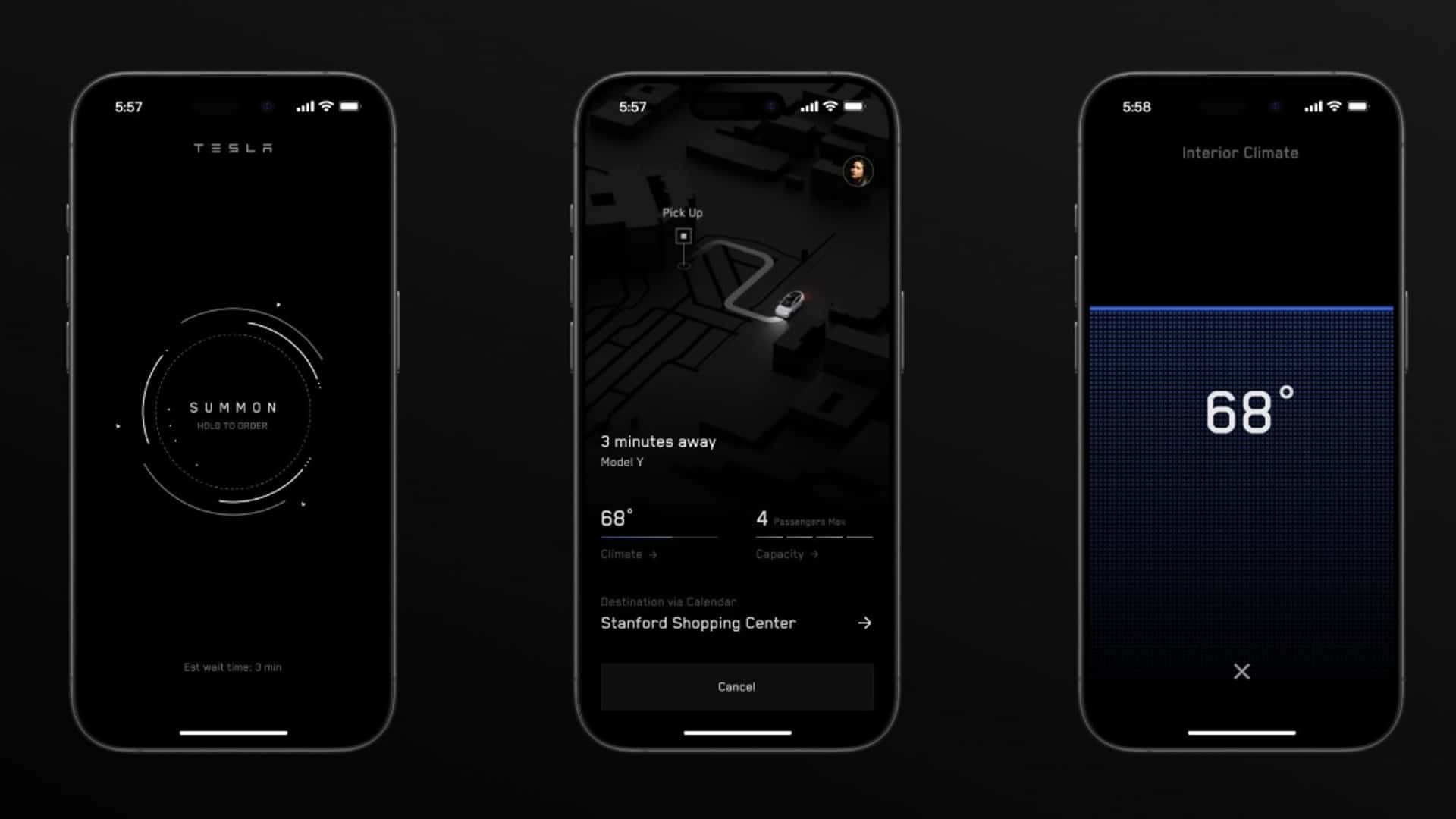
While specific details remain somewhat scant, Tesla provided a glimpse into what the future ride-hailing functionality might entail. A preview of the Tesla app integrating this service showcased a “Summon” button, presumably the primary interface for ordering an autonomous taxi.
Another screen rendering displayed a temperature of 68 degrees, suggesting that users might have the capability to adjust climate settings within their requested autonomous vehicle before it even arrives. Such features could enhance the passenger experience, offering a personalised and comfortable journey from the outset.
These early visualisations underscore Tesla’s focus on seamless user integration and advanced controls, aiming to make the transition to an autonomous ride-hailing experience as intuitive and convenient as possible for customers.
Shifting Priorities: Affordable Models and Robotaxi Timeline
The announcement regarding the robotaxi fleet emerged amid earlier reports from Reuters suggesting that Tesla had deprioritised its plans for a cheaper consumer vehicle in favour of accelerating the robotaxi project. This speculation had led to significant uncertainty among investors and consumers regarding the company’s future product roadmap.
However, Tesla has since moved to clarify its position. During the same earnings call, the company indicated that it is now “accelerating the launch timing of new vehicles, including more affordable models,” with the robotaxi expected to arrive at a later stage. This updated timeline suggests a dual focus, aiming to address both market demand for accessible electric vehicles and its long-term vision for autonomous transportation.
The commitment to more affordable models alongside the robotaxi project reflects a strategy to maintain market share in the competitive EV landscape while continuing to develop groundbreaking autonomous driving technology for the future.
Navigating the Autonomous Challenge
Despite the bold proclamations, the successful deployment of a fully autonomous robotaxi fleet hinges on Tesla’s ability to perfect its self-driving technology. The company’s current Full Self-Driving (FSD) feature, while advanced, still requires active driver supervision and has been known to make errors, highlighting the significant challenges that remain.
Achieving Level 5 autonomy, where a vehicle can operate entirely without human intervention under all conditions, is an extraordinarily complex engineering feat. The regulatory landscape, public perception, and safety standards for such vehicles also present substantial hurdles that Tesla and other autonomous vehicle developers must overcome.
The journey from driver-supervised advanced driver-assistance systems to truly autonomous robotaxis is fraught with technical, ethical, and legal complexities, demanding rigorous testing and validation before widespread public adoption can be realised.
Historical Context and Future Projections
This is not the first time Elon Musk has articulated a vision for a Tesla-operated autonomous taxi service. Notably, he famously proclaimed in 2019 that Tesla would have 1 million robotaxis on the road by 2020. This prediction, among others, did not materialise, serving as a reminder of the often-optimistic timelines associated with groundbreaking technological advancements.
Investors and the public are often advised to consider such ambitious timelines with a degree of pragmatism. While Tesla has consistently pushed the boundaries of electric vehicle technology, the path to full autonomy has proven to be more arduous than initially anticipated across the entire industry. The latest pronouncements, while offering more detail, continue to project a future vision rather than an imminent reality.
The long-term impact of a successful Tesla robotaxi fleet could be transformative, potentially disrupting traditional automotive ownership models and urban transportation infrastructure globally. However, the exact timing and scope of this future remain subject to the company’s ability to deliver on its ambitious technological promises.
FAQ
What is Tesla’s robotaxi fleet concept?
Tesla plans to launch a ride-hailing service featuring autonomous vehicles. It will operate its own fleet while also allowing private Tesla owners to integrate their cars, creating a hybrid model similar to a combination of Airbnb and Uber for transportation.
How will Tesla owners participate in the robotaxi fleet?
Owners can opt to add or remove their autonomous-capable vehicles from the fleet as they wish. They will also have the option to set parameters for who can use their car, such as limiting it to friends, family, or highly-rated users.
What technology underpins Tesla’s autonomous driving?
Tesla relies on a “vision-only architecture with end-to-end neural networks.” This system processes visual data from cameras, trained on billions of miles of real-world driving data, to enable the vehicle’s full self-driving capabilities.
When is the Tesla robotaxi fleet expected to launch?
While an exact date remains unconfirmed, Tesla stated it is accelerating the launch of “new vehicles, including more affordable models,” and indicated that the robotaxi would arrive later than these new consumer vehicles.
Has Elon Musk made previous predictions about robotaxis?
Yes, Elon Musk famously predicted in 2019 that Tesla would have 1 million robotaxis operational by 2020. This earlier projection did not come to fruition, highlighting the complex nature of developing and deploying fully autonomous technology.
What are the main challenges for Tesla’s robotaxi plans?
The primary challenge is perfecting the self-driving technology to achieve true Level 5 autonomy, ensuring safety and reliability without human supervision. Regulatory approvals, public trust, and competition within the autonomous vehicle sector also represent significant hurdles.