
Key Takeaways
- Tesla has revealed more details about its planned robotaxi fleet, outlining a strategy that blends company-owned autonomous vehicles with a peer-to-peer sharing system.
- CEO Elon Musk described the service as a “combination of Airbnb and Uber,” allowing vehicle owners to opt their cars into the ride-hailing network.
- The strategy is predicated on Tesla’s vision-only autonomy architecture, utilizing end-to-end neural networks trained on extensive real-world driving data.
- This announcement provides further context to Tesla’s strategic pivot towards autonomous ride-hailing, following reports of deprioritizing a more affordable consumer vehicle.
- Challenges persist in achieving the full self-driving capabilities necessary for a functional and safe robotaxi service, a long-standing promise from the automaker.
During its first-quarter earnings call on April 23, 2024, Tesla offered new insights into its long-anticipated robotaxi project, aiming to clarify its strategic direction for investors and the broader market. The automaker, under CEO Elon Musk, is actively developing a sophisticated ride-hailing service, signaling a significant shift in its future mobility ambitions.
This development comes amidst considerable speculation regarding Tesla’s priorities, particularly following recent reports suggesting a pivot towards autonomous services over the production of a more budget-friendly consumer electric vehicle. The new details outline a multifaceted approach to the Tesla robotaxi fleet, integrating both company-operated units and a novel owner-participation model.
The Hybrid Robotaxi Vision: ‘Airbnb and Uber’
Elon Musk elaborated on the foundational concept of Tesla’s forthcoming ride-hailing service during the investor conference call. He articulated a unique vision, describing the model as a direct “combination of Airbnb and Uber.” This analogy underscores a dual operational strategy that could redefine urban transportation.
Central to this hybrid model is the ability for existing Tesla owners to participate directly in the network. Musk confirmed that owners would have the flexibility to “add or subtract their cars from the fleet whenever they want.” This optionality aims to empower owners, transforming their personal vehicles into revenue-generating assets when not in use.
Further enhancing this owner-centric approach, Tesla plans to offer granular control over who can utilize a shared vehicle. Owners, according to Musk, “can decide if they want to only let the car be used by friends and family, or only by five-star users or by anyone.” This level of personalization seeks to build trust and encourage broader adoption among the Tesla community.
The establishment of a vast Tesla robotaxi fleet, whether company-owned or owner-contributed, represents a substantial long-term objective for the electric vehicle manufacturer. It is a bold move into the competitive ride-hailing sector, potentially leveraging Tesla’s expansive vehicle base and advanced software capabilities.
Technological Foundation for Autonomous Operation
Tesla’s first-quarter earnings report provided further technical and strategic context for its move into ride-hailing. The company explicitly stated its ongoing commitment, noting that it is “currently working on ride-hailing functionality that will be available in the future.” This confirms the active development phase of the service.
The report highlighted significant investments dedicated to this ambitious undertaking. “We have been investing in the hardware and software ecosystems necessary to achieve vehicle autonomy and a ride-hailing service,” Tesla elaborated. This commitment signifies a comprehensive approach, addressing both the physical components and the intricate programming required for self-driving vehicles.
A cornerstone of Tesla’s autonomous driving strategy is its reliance on a “vision-only architecture with end-to-end neural networks.” This approach eschews lidar and radar in favor of camera-based systems and sophisticated artificial intelligence. The neural networks are reportedly “trained on billions of miles of real-world data,” aiming to create a robust and reliable autonomous driving system.
The company believes that this vision-centric approach is the most effective path to developing a “scalable and profitable autonomy business.” Such a strategy, if successful, could offer cost advantages and simplify hardware integration compared to multi-sensor systems, laying the groundwork for widespread deployment of the Tesla robotaxi fleet.
Glimpse into the Future: The Tesla App Interface
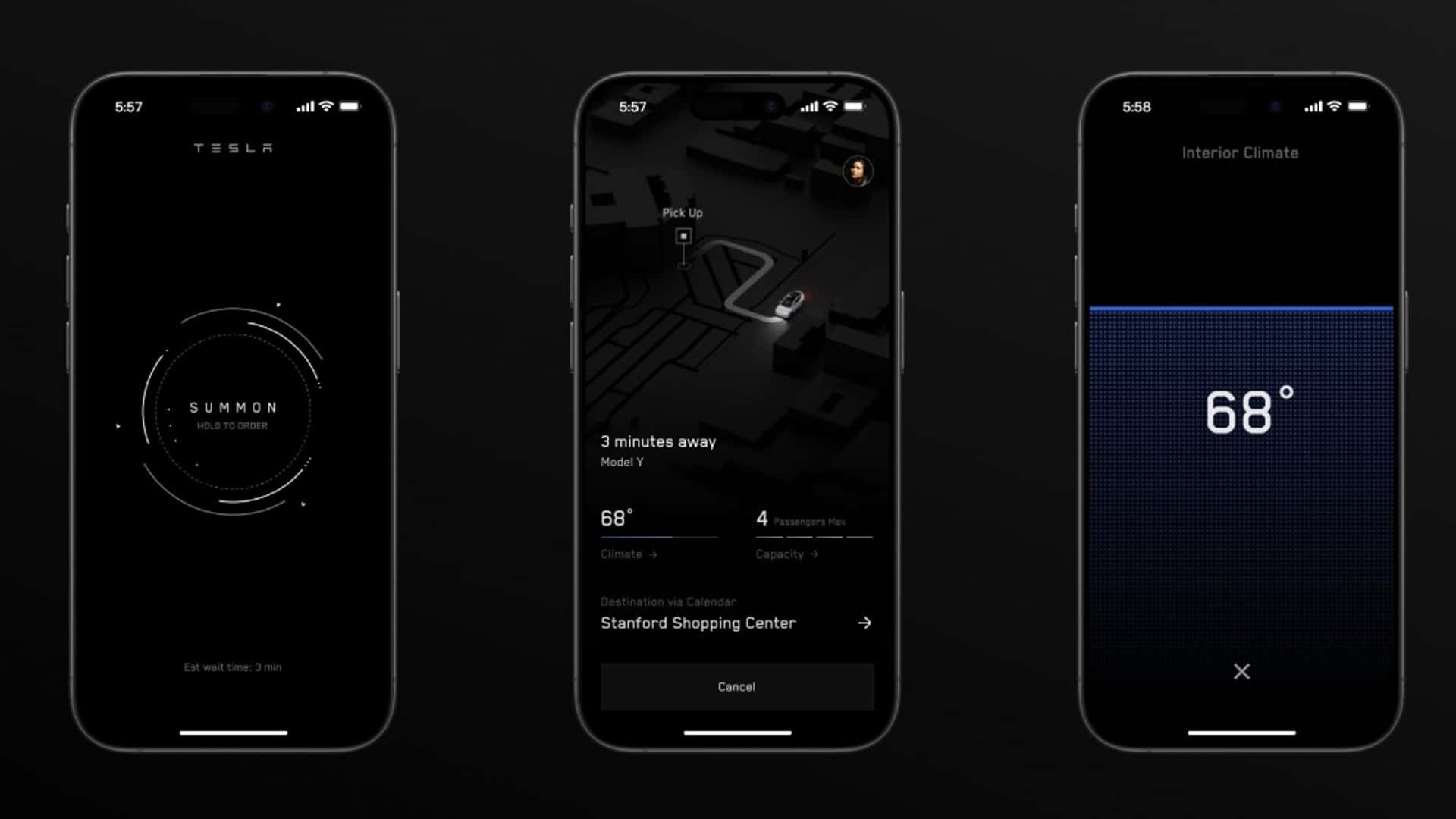
Accompanying the strategic announcements, Tesla also released a preview of what the integrated ride-hailing functionality might look like within its existing mobile application. These renderings offer an initial glimpse into the user experience of ordering and managing a Tesla robotaxi.
The conceptual screens showcased a prominent “Summon” button, strongly suggesting its role in initiating a ride request from an autonomous vehicle. This feature would presumably allow users to call a robotaxi directly to their location, mirroring the convenience of existing ride-hailing platforms.
Intriguingly, one of the preview screens displayed a temperature setting of 68 degrees. While specific details remain scant, this could imply future functionality allowing customers to pre-set cabin climate preferences before their autonomous taxi arrives. Such small details could enhance passenger comfort and personalize the ride-hailing experience.
These early interface designs underscore Tesla’s commitment to user-friendly integration, ensuring that the robotaxi service feels intuitive and accessible to a broad user base. The evolution of this app functionality will be crucial as the Tesla robotaxi fleet moves closer to deployment.
Strategic Reorientation and Market Expectations
The discussions surrounding the Tesla robotaxi fleet have gained intensified scrutiny following a recent Reuters report. That report suggested Tesla had shifted its focus away from developing a more affordable consumer electric vehicle in favor of accelerating the robotaxi project.
During the earnings call, Tesla addressed some of these concerns, indicating a more nuanced strategy. The company stated its intention to accelerate the launch timing of “new vehicles, including more affordable models,” while also signaling that a dedicated robotaxi vehicle would arrive at a later stage. This clarification aims to balance investor expectations for both mass-market vehicles and advanced autonomous services.
This strategic reorientation reflects Tesla’s long-term vision for future revenue streams, moving beyond direct vehicle sales to encompass lucrative service models. The prospect of a scalable ride-hailing business, leveraging advanced AI and a vast installed base of vehicles, is intended to assuage investors and underpin future growth projections.
However, the execution of this ambitious plan depends entirely on Tesla’s ability to overcome significant technological hurdles and achieve reliable full self-driving capabilities, a goal that has proven challenging for the entire industry.
Challenges on the Path to Full Autonomy
The success of the envisioned Tesla robotaxi fleet hinges critically on the company’s ability to deliver truly self-driving vehicles. Despite years of development and substantial investment, achieving full autonomy, often referred to as Level 5, remains an elusive goal for the automotive industry.
Tesla’s current Full Self-Driving (FSD) feature, while continually evolving, still requires active and constant driver supervision. Reports indicate that the system, even in its beta stages, “regularly makes mistakes,” necessitating human intervention to ensure safety. This gap between current capabilities and the requirements for unsupervised robotaxi operation is substantial.
The transition from advanced driver-assistance systems (ADAS) to fully autonomous vehicles involves overcoming immense technical complexities, including navigating unpredictable urban environments, handling diverse weather conditions, and making instantaneous, safe decisions in dynamic traffic scenarios. Regulatory frameworks for widespread autonomous vehicle deployment are also still in development across many jurisdictions.
Therefore, while the vision for a ubiquitous Tesla robotaxi service is compelling, the practical realization requires significant advancements in AI, software validation, and real-world testing. The timeline for achieving this remains a subject of intense debate among experts and analysts.
Historical Context and Future Prospects
Elon Musk has a history of making ambitious predictions regarding Tesla’s autonomous driving timelines. Notably, he famously proclaimed that the company would have “1 million robotaxis on the road by 2020.” This earlier projection did not materialize, underscoring the formidable challenges inherent in developing and deploying such advanced technology.
The renewed emphasis on the Tesla robotaxi fleet, therefore, is viewed by many with a degree of tempered optimism. While the idea of a Tesla-operated and owner-contributed autonomous taxi service is intriguing and holds immense potential, past pronouncements serve as a reminder to “take Musk’s grand proclamations with a grain of salt” until tangible, widespread deployment is achieved.
The path forward for Tesla’s robotaxi ambitions involves not just technological breakthroughs but also navigating complex regulatory landscapes, public acceptance, and intense competition in the autonomous vehicle space. The coming years will reveal whether this grand vision transforms into a profitable reality, reshaping the future of urban mobility.
Frequently Asked Questions (FAQs)
What is Tesla’s plan for its robotaxi fleet?
Tesla plans a hybrid ride-hailing service, combining company-owned autonomous vehicles with a system where private Tesla owners can contribute their cars to the fleet. CEO Elon Musk described it as a blend of ‘Airbnb and Uber,’ offering owners control over vehicle availability and user access.
How will Tesla owners participate in the robotaxi service?
Tesla owners will have the flexibility to add or remove their vehicles from the robotaxi fleet at will. They can also specify usage parameters, such as allowing access only to friends and family, highly-rated users, or the general public, providing a personalized sharing experience.
What technology underpins Tesla’s robotaxi strategy?
The Tesla robotaxi fleet relies on a vision-only architecture, utilizing advanced end-to-end neural networks. These AI systems are trained on billions of miles of real-world driving data, aiming to achieve full autonomy without the need for traditional lidar or radar sensors.
When is Tesla’s robotaxi service expected to launch?
While Tesla confirmed it is actively working on ride-hailing functionality, a specific launch date for the robotaxi service remains unspecified. The company indicated it is accelerating the launch of new vehicles, including more affordable models, with a dedicated robotaxi vehicle arriving later.
What are the main challenges for Tesla’s robotaxi fleet?
The primary challenge is achieving true full self-driving capabilities, as Tesla’s current FSD feature still requires active driver supervision and has shown limitations. Overcoming these technical hurdles, along with regulatory complexities and ensuring public trust, are critical for successful deployment.
How does this plan relate to Elon Musk’s past robotaxi promises?
Elon Musk famously predicted one million Tesla robotaxis by 2020, a target that was not met. The current announcement provides an updated, albeit still conceptual, framework for a future service, prompting a cautious assessment based on previous timelines and technological realities.