
Key Takeaways:
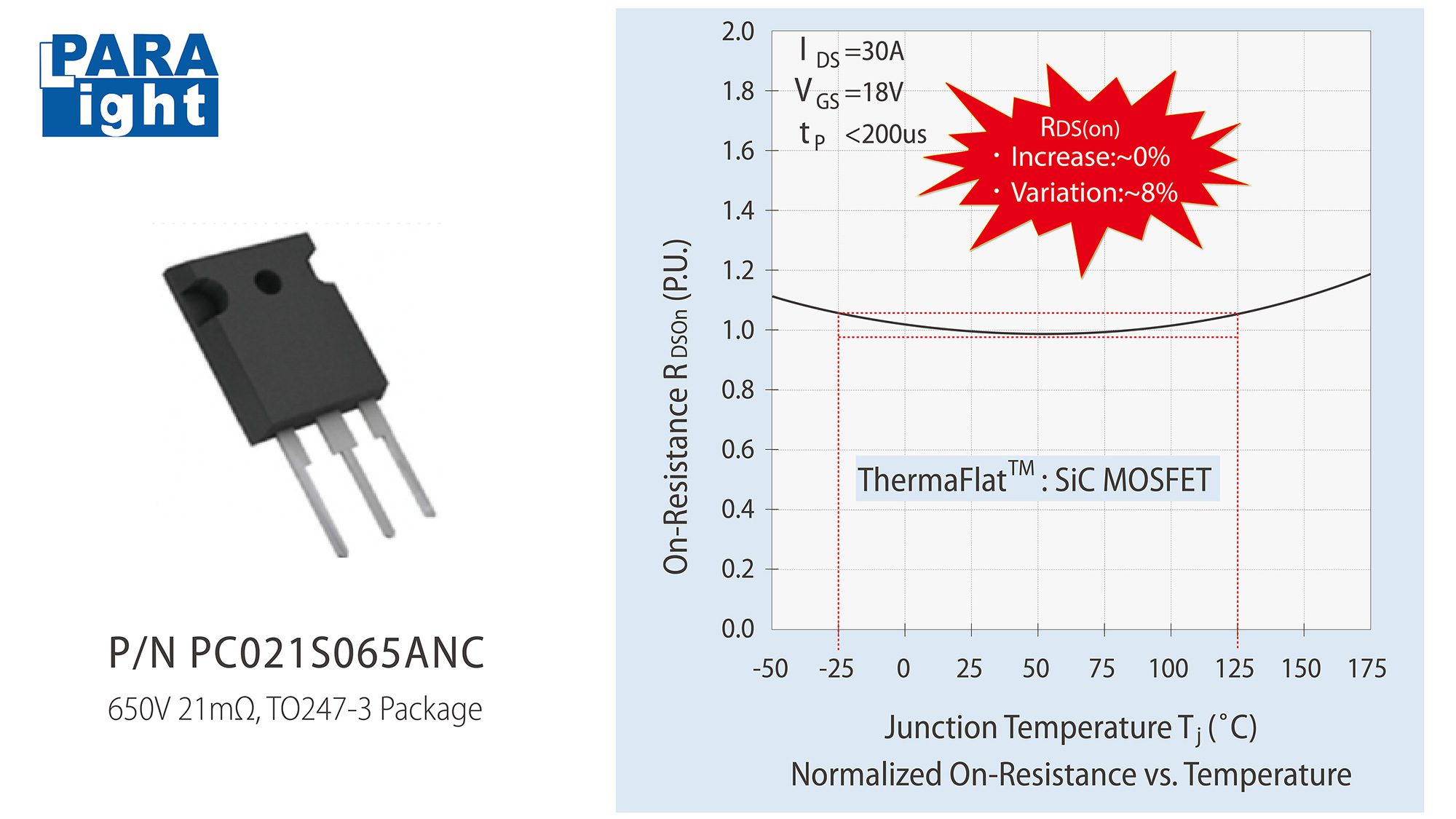
Para Light Electronics has introduced its ThermaFlat family of SiC MOSFETs, featuring 650 V and 1,200 V ratings, designed to address the critical industry challenge of on-resistance drift with temperature. The core innovation is an “ultra-low RDS(on) drift technology” that significantly stabilizes performance across varying junction temperatures. Benchmark testing showcased an approximate 8% change in on-resistance for a 650 V, 21 mΩ device between -25°C and +125°C, improving power density and reducing cooling needs. The new line includes ThermaFlat I for standard applications and ThermaFlat II, which offers enhanced noise immunity and simplifies gate driver circuitry by eliminating the need for a negative gate-off supply. These SiC MOSFETs are poised to impact high-power applications such as AI data centers, EV charging, and grid energy storage.

Revolutionizing Power Electronics: Para Light’s ThermaFlat SiC MOSFETs Tackle Thermal Instability
In a significant development for the power electronics industry, Para Light Electronics has officially launched its ThermaFlat family of Silicon Carbide (SiC) MOSFETs. These new devices, available in 650 V and 1,200 V ratings, are engineered around what the company describes as its groundbreaking “ultra-low RDS(on) drift technology,” directly addressing one of the most persistent challenges in high-efficiency power conversion: on-resistance variation with temperature.
The introduction of ThermaFlat SiC MOSFETs is set to enhance the reliability and performance of power systems across a multitude of high-demand applications, from advanced AI data centers to electric vehicle charging infrastructure. This innovation underscores Para Light’s commitment to pushing the boundaries of SiC technology.
Addressing the Critical Challenge of On-Resistance Drift in SiC MOSFETs
One of the inherent characteristics of SiC MOSFETs, crucial components in modern power electronics, is the tendency for their on-resistance (RDS(on)) to increase as the junction temperature rises. This phenomenon is particularly problematic because higher on-resistance leads to greater conduction losses, which in turn generate more heat, further escalating the junction temperature and exacerbating the on-resistance increase in a self-perpetuating cycle.
Traditional approaches to mitigate this issue often involve derating the device or implementing more extensive and costly cooling solutions. Both methods invariably reduce overall power density and increase system complexity and cost. Para Light’s ThermaFlat technology offers a direct solution by significantly minimizing this temperature-induced drift.
According to benchmark testing conducted by Para Light, a 650 V, 21 mΩ TO-247 ThermaFlat device demonstrated an on-resistance change of approximately 8% as the junction temperature fluctuated from a frigid -25° C to a scorching +125° C. This remarkable stability is a testament to the effectiveness of the new technology, with 1,200 V parts expected to exhibit a similar temperature coefficient, although specific figures were not provided at launch.
Industry Context: Advancing SiC Efficiency and Robustness
The pursuit of higher efficiency and robustness in SiC MOSFETs is a shared objective across the semiconductor industry. While Para Light focuses on minimizing on-resistance drift, other manufacturers are also making strides in enhancing SiC performance.
For instance, ROHM’s fifth-generation EcoSiC devices represent a different strategy, achieving a reduction in on-resistance of about 30% at 175° C compared to their fourth-generation predecessors. Such advancements highlight a collective industry effort to unlock the full potential of silicon carbide in power conversion applications, ensuring more reliable and energy-efficient systems.
Unpacking the ThermaFlat Family: Innovation in Two Distinct Series
The ThermaFlat family is introduced in two distinct series, ThermaFlat I and ThermaFlat II, each tailored to specific design requirements and operational advantages within the broader SiC MOSFET landscape. Both series leverage Para Light’s core ultra-low RDS(on) drift technology, ensuring consistent performance across temperature variations.
ThermaFlat I: Foundations for Mainstream Converter Topologies
The ThermaFlat I series is designed to serve as a robust foundation for a wide array of mainstream converter topologies. These devices are offered in industry-standard packages, facilitating straightforward integration into existing designs and enabling rapid adoption across various power electronics platforms.
Engineers can utilize ThermaFlat I to achieve improved thermal management and enhanced power density in their systems, benefiting from the reduced need for extensive derating and cooling provisions previously necessitated by on-resistance drift.
ThermaFlat II: Enhanced Noise Immunity and Simplified Gate Driver Design
Building upon the foundational drift technology, the ThermaFlat II series incorporates a high gate threshold voltage architecture, delivering additional critical advantages. This architectural enhancement significantly improves noise immunity, a crucial factor in maintaining system stability in high-frequency switching environments.
A notable feature of the ThermaFlat II series is its ability to operate reliably without requiring a negative gate-off supply. Typically, SiC MOSFETs are held off with a negative gate voltage rather than 0 V to counteract the effects of fast dV/dt (rate of voltage change over time) at the switching node. This rapid voltage change can couple through the gate-drain capacitance, potentially causing a brief and undesirable false turn-on of the device.
By raising the gate threshold voltage, ThermaFlat II provides a larger margin against such false turn-on events. This eliminates the need for a negative rail in the gate driver circuitry, allowing engineers to simplify their designs, reduce the overall component count, and consequently lower the bill-of-materials (BOM) cost. This simplification not only streamlines the design process but also contributes to greater system reliability and compactness.
Broadening Horizons: Key Applications for ThermaFlat SiC MOSFETs
The performance characteristics of Para Light’s ThermaFlat SiC MOSFETs make them exceptionally well-suited for a diverse range of high-power and high-efficiency applications where thermal stability and robust operation are paramount. These devices are poised to drive innovation and efficiency in critical sectors of the global economy.
Key application areas include:
- AI Data Centers and Server Power Supplies: These environments demand utmost efficiency and reliability to handle immense computational loads while minimizing energy consumption and cooling infrastructure.
- Battery Backup and UPS Systems: Ensuring uninterrupted power supply requires highly efficient and stable power conversion, which ThermaFlat SiC MOSFETs can reliably deliver.
- EV Charging Stations: The rapid growth of electric vehicles necessitates efficient, high-power charging solutions. ThermaFlat technology contributes to faster charging times and reduced energy losses.
- Grid-Connected Energy Storage: As renewable energy sources become more prevalent, efficient storage and grid integration are vital. SiC MOSFETs enable robust bidirectional power flow management.
- Photovoltaic Inverters: Maximizing energy harvest from solar panels requires highly efficient inverters capable of operating reliably across varying environmental conditions and temperatures.
- Variable Frequency Drives and Industrial Automation: In industrial settings, precise motor control and energy efficiency are crucial. ThermaFlat devices can enhance the performance and longevity of these systems.
The Road Ahead: Para Light’s Commitment to SiC Innovation
Para Light Electronics has affirmed its commitment to the ongoing advancement of SiC technology. The company stated that it is continuously expanding its ThermaFlat portfolio, with plans to introduce additional voltage classes, current ratings, and package configurations in the near future. This strategic expansion aims to meet the evolving demands of the power electronics market and further solidify Para Light’s position as a key innovator in high-performance semiconductor solutions.
The ThermaFlat family represents a significant step forward in optimizing the thermal performance and design flexibility of SiC MOSFETs, promising enhanced efficiency and reliability for the next generation of power conversion systems.
Frequently Asked Questions (FAQ)
What is the primary innovation of Para Light’s ThermaFlat SiC MOSFETs?
The main innovation is the “ultra-low RDS(on) drift technology.” This technology significantly reduces the change in on-resistance across a wide range of junction temperatures, enhancing the thermal stability and overall efficiency of the SiC MOSFETs. This directly translates to more reliable power electronics systems.
How does low on-resistance drift benefit power system designers?
Low on-resistance drift allows designers to create more power-dense systems, as it reduces the need for extensive derating and oversized cooling solutions. This leads to more compact designs, lower material costs, and improved thermal management, ultimately boosting the efficiency and reliability of power converters.
What are the key differences between ThermaFlat I and ThermaFlat II series?
ThermaFlat I offers standard SiC MOSFETs with ultra-low on-resistance drift for mainstream applications. ThermaFlat II incorporates the same drift technology but adds a high gate threshold voltage architecture, which improves noise immunity and allows operation without a negative gate-off supply, simplifying gate driver circuitry.
Why is operating without a negative gate-off supply beneficial?
Eliminating the need for a negative gate-off supply simplifies gate driver circuitry, reducing component count and bill-of-materials cost. This is achieved by the higher gate threshold voltage, which provides a greater margin against false turn-on caused by fast dV/dt coupling through gate-drain capacitance, thereby improving system robustness.
What specific applications will benefit most from these new SiC MOSFETs?
High-power and high-efficiency applications will benefit significantly. These include AI data center and server power supplies, EV charging stations, battery backup and UPS systems, grid-connected energy storage, photovoltaic inverters, variable frequency drives, and various industrial automation systems, where thermal stability and performance are critical.
How do Para Light’s SiC MOSFETs compare to other industry solutions like ROHM’s EcoSiC?
Para Light’s ThermaFlat focuses on minimizing on-resistance drift with temperature. In contrast, ROHM’s fifth-generation EcoSiC devices take a different approach by reducing absolute on-resistance by about 30% at 175°C. Both advancements aim to improve the overall efficiency and performance of SiC MOSFETs in demanding applications.