
Key Takeaways
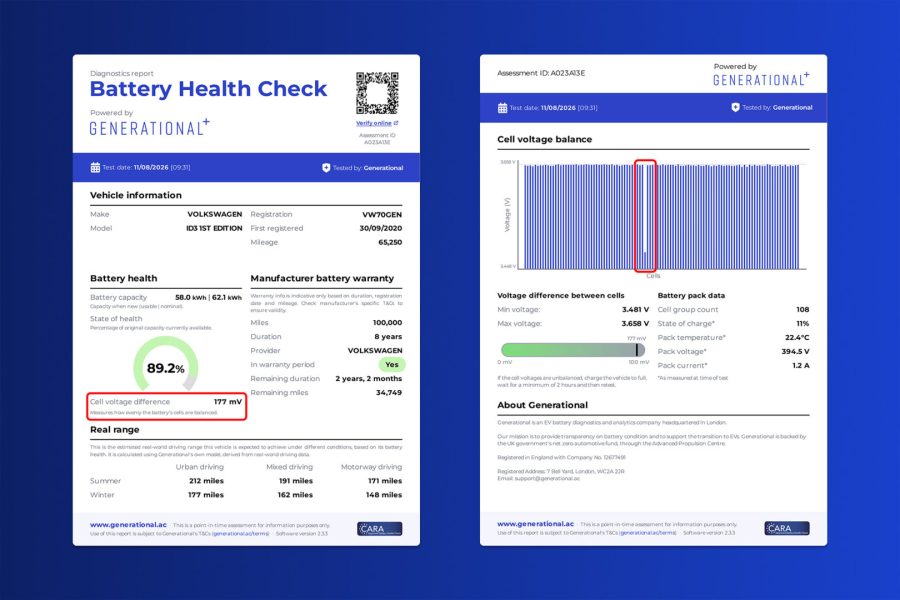
- A recent analysis by UK-based Generational reveals that approximately one in 85 used electric vehicles (EVs) in the UK exhibit a significant cell-voltage imbalance exceeding 50 mV.
- Around one in 200 tested vehicles showed an imbalance above 100 mV, indicating potential underlying battery faults that necessitate immediate investigation.
- The median used EV displayed an 8 mV difference between its highest and lowest cell voltages, based on data from nearly 10,000 battery tests.
- Traditional State of Health (SoH) metrics, which measure capacity, may not detect these crucial cell-level issues, underscoring the demand for sophisticated EV battery diagnostics.
- A single weak cell can severely limit an entire EV battery pack’s performance, affecting range, charging efficiency, and state-of-charge estimates.
- Generational has partnered with Maverick Diagnostics to expand its OBD-port test kits, making advanced EV battery diagnostics accessible to a broader network of repair shops across the UK.
LONDON, UK — A groundbreaking analysis conducted by Generational, a leading UK-based EV battery diagnostics firm, has shed critical light on an often-overlooked issue within the burgeoning used electric vehicle market: cell-voltage imbalance. The company’s comprehensive review of cell-level data, drawn from approximately 10,000 used-EV battery tests performed across hundreds of dealerships throughout the United Kingdom, reveals a significant prevalence of this hidden fault.
The study indicates that while the median used EV exhibited a relatively minor 8 mV difference between its highest and lowest cell voltages, a concerning proportion of vehicles showed much greater discrepancies. Specifically, around one in 85 tests revealed an imbalance exceeding 50 mV, a threshold Generational deems critical enough to warrant immediate investigation. More alarmingly, approximately one in 200 vehicles tested demonstrated an imbalance greater than 100 mV, a level that strongly suggests a potential underlying fault within the battery pack.

Understanding Cell-Voltage Imbalance in EV Batteries
Electric vehicle battery packs are complex systems, meticulously assembled from hundreds of individual cells connected in series groups. This intricate architecture means that the overall performance of the battery is inherently linked to the health of its weakest link. Generational explains that when a single cell within this series reaches its charging limit, the entire pack ceases to charge, irrespective of the remaining capacity in other cells. Similarly, discharge stops as soon as one cell empties.
This fundamental operational principle highlights why a weak cell can critically limit the performance of the entire battery pack. A pack-level average or a simple State of Health (SoH) reading, which primarily measures overall capacity, fails to expose these granular cell-level deficiencies. Consequently, a seemingly healthy battery on paper could be harboring significant internal issues that impact its real-world usability.
Impact on EV Performance and Longevity
The implications of cell-voltage imbalance extend far beyond mere technical curiosities; they directly affect an EV owner’s experience and the vehicle’s long-term value. A significant imbalance can compel the Battery Management System (BMS) to restrict both charging and discharging cycles. This protective measure, while safeguarding the weakest cell, can lead to a noticeable reduction in the vehicle’s usable range, inaccurate state-of-charge estimates, and unpredictable charging behavior.
These issues can manifest gradually, often without immediate warning signs such as dashboard messages or changes in vehicle behavior. This stealthy progression means that a fault can develop and advance significantly before an owner becomes aware, potentially leading to costly repairs or a substantial depreciation in the vehicle’s resale value.
The Limitations of State of Health (SoH) Metrics
For years, State of Health (SoH) has been the primary benchmark for assessing the condition of EV batteries, especially in the used car market. While SoH provides a crucial measure of a battery’s total capacity, Generational’s findings underscore its limitations when it comes to comprehensive EV battery diagnostics. A vehicle can indeed display a stable and acceptable SoH reading while simultaneously developing critical cell-level faults.
Oliver Phillpott, CEO of Generational, articulated this vital distinction, stating: “Reporting on State of Health is essential for used EVs, but it does not tell the full story of battery condition. It measures capacity, not necessarily whether the cells inside the pack are functioning correctly.” He further elaborated on the insidious nature of these problems: “Cell imbalance problems are often imperceptible, while the battery is developing a fault that could affect range, charging or value later on. The only practical way to see that risk early is to test for it.” This statement reinforces the urgent need for advanced EV battery diagnostics beyond simple capacity measurements.
Generational’s Advanced Diagnostic Process
Recognizing these critical gaps in traditional assessment methods, Generational has pioneered a robust diagnostic process designed to identify and address cell-level issues effectively. The company integrated cell-level voltage testing into its dealer diagnostics framework in April, enhancing its ability to provide precise EV battery diagnostics.
When a test flags a vehicle for potential cell imbalance, Generational initiates a carefully structured protocol. The customer is first guided through an attempted cell rebalance procedure. This step is crucial because, as the company notes, cells naturally drift apart and back together during charging and discharging cycles. A borderline imbalance detected at a low state of charge may not always signify a persistent fault.
Following the rebalance attempt, the vehicle undergoes a subsequent test while at rest to confirm whether the imbalance persists. This two-stage verification process ensures that any decision regarding further investigation, potential warranty support, or necessary repairs is based on conclusive evidence of a sustained and significant fault. This methodical approach enhances the reliability of EV battery diagnostics.
Expanding Access to Crucial Diagnostics
To broaden the reach of its sophisticated EV battery diagnostics, Generational forged a strategic partnership with Maverick Diagnostics in July. Maverick Diagnostics, which serves an extensive network of approximately 6,000 UK repair shops, will now distribute Generational’s innovative OBD-port test kits to these workshops. This collaboration marks a significant step towards democratizing access to advanced cell-level battery assessment tools, enabling more repair facilities to accurately diagnose and address potential issues in used EVs.
The wider availability of these diagnostic kits is expected to empower technicians with the necessary tools to perform in-depth EV battery diagnostics. This will not only improve the reliability and safety of used electric vehicles but also foster greater consumer confidence in the rapidly expanding pre-owned EV market.
Industry Context: The 2025 Battery Performance Index
Generational’s latest findings on cell imbalance complement its broader research into EV battery health. The company’s 2025 Battery Performance Index, compiled from over 8,000 assessments conducted across the UK, previously reported an average State of Health (SoH) of 95.15% for used EV batteries. This index also highlighted a trend where the variance in battery condition between vehicles tends to increase with age, suggesting that older vehicles are more susceptible to differing degrees of degradation.
While an average SoH of 95.15% might sound reassuring, the recent cell-level analysis underscores that this aggregate figure can mask critical underlying issues. It reinforces the argument that comprehensive EV battery diagnostics must look beyond simple capacity measurements to truly understand the operational integrity of the battery pack.
The ongoing commitment to rigorous EV battery diagnostics, as demonstrated by Generational’s work, is paramount for ensuring the long-term viability and trustworthiness of the used electric vehicle market. By identifying hidden faults early, consumers can make more informed purchasing decisions, and manufacturers and service providers can implement more targeted and effective maintenance strategies.
The Future of Used EV Market Confidence
As the adoption of electric vehicles continues to accelerate globally, the demand for reliable used EVs is also soaring. However, consumer confidence in the second-hand market hinges heavily on the ability to accurately assess battery health, which remains the most expensive single component of an EV. The traditional reluctance of buyers to invest in used EVs often stems from uncertainty about the battery’s remaining life and potential hidden defects.
The rigorous EV battery diagnostics offered by companies like Generational play a pivotal role in mitigating these concerns. By providing granular, cell-level data, these diagnostic tools offer unprecedented transparency into the true condition of an EV battery. This level of detail empowers buyers, sellers, and service centers with the knowledge needed to make informed decisions, ultimately fostering greater trust and liquidity in the used EV market.
The partnership between Generational and Maverick Diagnostics further signifies a collective industry move towards standardized and comprehensive EV battery diagnostics. This collaboration is set to equip a vast network of repair shops with the capabilities to conduct thorough battery assessments, ensuring that more used EVs can be certified for quality and performance, thereby enhancing their appeal and value.
FAQ Section
What is cell-voltage imbalance in an EV battery?
Cell-voltage imbalance occurs when individual cells within an EV battery pack have different voltage levels. While slight variations are normal, significant differences indicate that some cells are weaker or degrading faster than others, affecting the overall performance and longevity of the entire battery system.
Why is cell-voltage imbalance a problem for EVs?
A significant cell-voltage imbalance can severely limit an EV’s range and charging efficiency. The entire battery pack’s performance is constrained by its weakest cell; it stops charging when the first cell is full and stops discharging when the first cell is empty, leading to reduced usable capacity and potential issues with the Battery Management System (BMS).
How does Generational test for cell imbalance?
Generational employs advanced EV battery diagnostics, including cell-level voltage testing integrated into its dealer diagnostics. If an imbalance is detected, the vehicle undergoes an attempted cell rebalance, followed by a re-test at rest to confirm if the imbalance persists before any further action, such as investigation or repair, is decided.
Is State of Health (SoH) enough to assess a used EV battery?
No, Generational’s findings indicate that while State of Health (SoH) measures battery capacity, it doesn’t reveal cell-level faults. An EV can display a stable SoH while developing critical cell imbalances that can affect range and charging. Comprehensive EV battery diagnostics require cell-level testing beyond SoH alone.
What happens if a cell imbalance is detected?
If a persistent cell imbalance above 50 mV is detected, Generational recommends investigation. An imbalance exceeding 100 mV indicates a potential underlying fault. Such findings lead to a structured process that may involve further diagnostics, warranty claims, or repairs to address the specific issue within the battery pack.
How widespread is cell imbalance in used EVs, according to Generational?
Generational’s analysis of nearly 10,000 used-EV battery tests in the UK revealed that approximately one in 85 vehicles showed a cell-voltage imbalance above 50 mV, and around one in 200 exceeded 100 mV, highlighting a notable prevalence of this issue in the used EV market.
What is the significance of the Generational and Maverick Diagnostics partnership?
The partnership aims to expand the availability of Generational’s crucial OBD-port test kits to approximately 6,000 UK repair shops through Maverick Diagnostics. This collaboration will significantly increase access to advanced EV battery diagnostics, enabling more technicians to accurately assess and address cell-level issues in used electric vehicles across the country.