
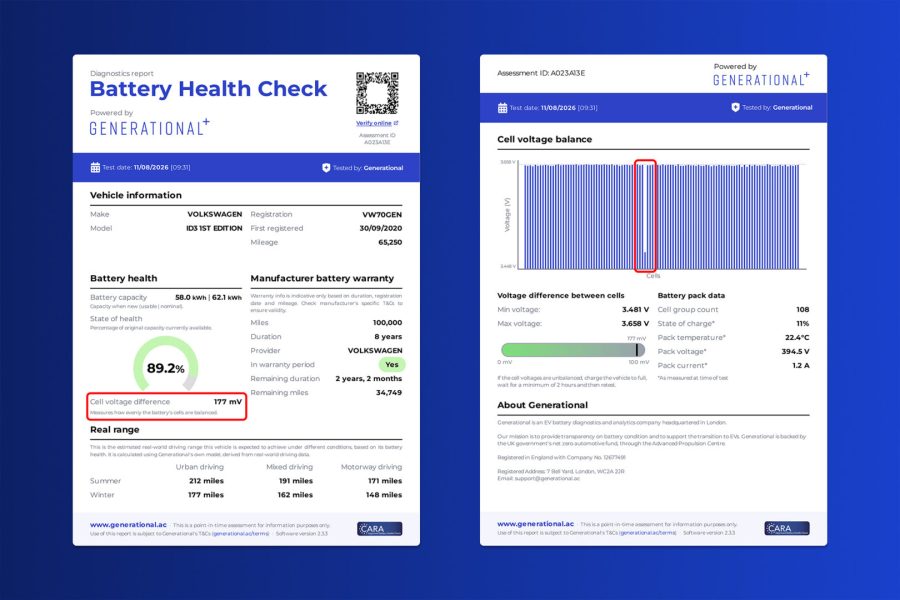
A recent comprehensive analysis by Generational, a leading UK-based EV battery diagnostics firm, has shed critical light on an often-overlooked aspect of electric vehicle health: cell-voltage imbalance. The study, which aggregated cell-level data from approximately 10,000 used-EV battery tests conducted across hundreds of dealerships throughout the United Kingdom, revealed that a significant proportion of pre-owned electric vehicles might be harbouring underlying battery faults, even without overt warning signs.
The findings indicate that while the median used EV exhibited a modest 8 millivolt (mV) difference between its highest and lowest cell voltages, a concerning one in 85 vehicles tested displayed an imbalance exceeding 50 mV. More critically, approximately one in 200 tests showed a severe imbalance beyond 100 mV, signaling a potential latent defect within the battery pack that could impact performance, range, and overall vehicle value.

Key Takeaways: Unveiling EV Battery Health Concerns
- Generational’s analysis of 10,000 used EV battery tests in the UK revealed a significant prevalence of cell-voltage imbalance.
- Around 1 in 85 used EVs showed an imbalance above 50 mV, warranting investigation.
- A critical 1 in 200 EVs exhibited an imbalance exceeding 100 mV, indicating a potential underlying fault.
- Cell imbalance can severely limit battery performance, affecting range, charging, and State of Charge (SoC) estimates, even if the overall battery capacity (State of Health) appears stable.
- Existing diagnostic tools often fail to detect these issues early, as warning lights or noticeable changes may only appear at advanced stages of imbalance.
- Generational has integrated advanced cell-level voltage testing into its diagnostic offerings, partnering with Maverick Diagnostics to expand access to repair shops across the UK.
The Hidden Threat of Cell-Voltage Imbalance in EV Batteries
At the heart of every electric vehicle lies its battery pack, a sophisticated assembly of hundreds of individual cells meticulously connected in series. Optimal performance hinges on the harmonious operation of these cells. However, when a significant cell-voltage imbalance develops, this harmony is disrupted, leading to a cascade of potential issues that can subtly degrade the vehicle’s efficiency and longevity.
Generational’s experts explain that an EV battery pack’s charging cycle is dictated by the first cell to reach its maximum voltage, and similarly, discharge ceases when the first cell empties. This inherent design means that a single underperforming or ‘weak’ cell can effectively bottleneck the entire battery, limiting its overall usable capacity and power delivery, irrespective of the health of the other cells. Crucially, a standard pack-level average State of Health (SoH) measurement often fails to expose these critical individual cell discrepancies.
Understanding the Impact on Performance and Range
The implications of an unaddressed cell-voltage imbalance extend directly to the driving experience. The Battery Management System (BMS), a vital component designed to safeguard the battery, may be forced to restrict charging or discharging currents to protect the weakest cell from overcharging or over-discharging. This protective measure, while essential for battery longevity, can directly translate into reduced driving range, inaccurate State of Charge (SoC) estimations displayed on the dashboard, and erratic charging behaviour.
Initial measurements of cell imbalance can sometimes be transient, with cell voltages naturally drifting apart and then rebalancing during typical charge and discharge cycles. However, Generational advises that a borderline imbalance recorded at a low state of charge does not always signify a persistent issue. The true concern arises when a substantial imbalance endures even after an attempted cell rebalance, indicating a more entrenched and materially significant underlying fault that requires professional attention.
Beyond State of Health: A Deeper Look at Battery Diagnostics
For many years, the primary metric for assessing an EV battery’s condition has been its State of Health (SoH), which quantifies the battery’s current energy storage capacity relative to its original design capacity. While SoH remains a fundamental indicator, Generational’s research underscores its limitations as the sole determinant of battery wellness, particularly in the used EV market.
The company highlights that an electric vehicle can present a seemingly stable SoH reading, indicating robust overall capacity, while simultaneously developing critical faults at the individual cell level. These nascent issues, driven by cell-voltage imbalance, often manifest without any corresponding warning lights, dashboard alerts, or discernible changes in vehicle behaviour until the imbalance reaches a significantly advanced stage, by which point remedial action may be more complex or costly.
“Reporting on State of Health is essential for used EVs, but it does not tell the full story of battery condition. It measures capacity, not necessarily whether the cells inside the pack are functioning correctly,” said Oliver Phillpott, CEO of Generational. “Cell imbalance problems are often imperceptible, while the battery is developing a fault that could affect range, charging or value later on. The only practical way to see that risk early is to test for it.”
Phillpott’s statement encapsulates the urgent need for more granular diagnostic capabilities that delve into the internal workings of the battery pack, moving beyond just overall capacity to scrutinise the health of individual cells.
Generational’s Approach to Early Detection and Remediation
Recognizing this critical diagnostic gap, Generational has been proactive in implementing advanced testing protocols. The company integrated cell-level voltage testing into its dealer diagnostics in April, enabling a more precise and comprehensive evaluation of used EV batteries. This capability allows for the early identification of cell-voltage imbalance, even before it escalates into noticeable performance issues.
When a Generational test flags a vehicle for potential cell imbalance, a structured diagnostic pathway is initiated. Customers are guided through an attempted cell rebalance procedure, which aims to equalise the voltages across the cells. Following this, the vehicle undergoes a subsequent test at rest to ascertain whether the imbalance persists. This diligent, two-step verification process ensures that any decisions regarding further investigation, potential warranty support, or necessary repairs are based on confirmed, persistent faults rather than transient fluctuations.
Expanding Diagnostic Reach: Industry Partnerships
To further democratise access to these crucial diagnostic tools, Generational announced a strategic partnership in July with Maverick Diagnostics. This collaboration aims to extend the availability of Generational’s OBD-port test kits to approximately 6,000 UK repair shops served by Maverick Diagnostics. This expansion is a significant step towards enabling a broader network of technicians to conduct detailed battery health assessments, fostering greater transparency and trust in the used EV market.
Broader Market Implications and Battery Performance Trends
The insights from Generational’s analysis come at a pivotal time as the global used EV market continues its rapid expansion. Consumer confidence in second-hand electric vehicles is heavily influenced by perceptions of battery longevity and reliability. Accurate and transparent battery health assessments, encompassing not just SoH but also critical parameters like cell-voltage imbalance, are paramount for fostering sustained growth in this sector.
Generational’s broader 2025 Battery Performance Index, compiled from over 8,000 assessments across the UK, previously reported an average State of Health (SoH) of 95.15% for used EVs. Interestingly, this index also highlighted that the variance in battery performance between vehicles tends to increase with age. This trend further underscores the necessity of detailed, cell-level diagnostics as EVs mature and enter the second-hand market, where potential buyers are increasingly seeking assurances about their investment.
As the EV ecosystem evolves, comprehensive battery diagnostics will play an indispensable role in maintaining vehicle value, empowering consumers with informed purchasing decisions, and ensuring the long-term sustainability of electric mobility. The proactive identification and addressing of issues like cell-voltage imbalance are fundamental to unlocking the full potential of the used EV market.
Source: Generational
Frequently Asked Questions (FAQs)
What is cell-voltage imbalance in an EV battery?
Cell-voltage imbalance refers to a disparity in voltage levels among individual cells within an electric vehicle’s battery pack. Ideally, all cells should maintain similar voltages. When some cells have significantly higher or lower voltages than others, it indicates an imbalance that can hinder the overall performance and lifespan of the entire battery system, potentially impacting range and charging.
Why is cell-voltage imbalance a concern for used EVs?
In used EVs, cell-voltage imbalance can be an indicator of underlying battery degradation or developing faults. It can severely limit the battery’s usable capacity, as the weakest cell dictates the pack’s overall charge and discharge limits. This issue often goes undetected by standard State of Health (SoH) measurements, leading to reduced range, slower charging, or unexpected battery behaviour for the new owner.
How does cell-voltage imbalance affect an EV’s range and charging?
When cell-voltage imbalance occurs, the Battery Management System (BMS) may restrict the total energy the pack can accept or deliver to protect the weakest cells. This means the battery stops charging when the first cell reaches full capacity and stops discharging when the first cell empties, effectively reducing the usable capacity of the entire pack. Consequently, the vehicle’s driving range is diminished, and charging times or efficiency can be adversely affected.
Can a high State of Health (SoH) mask cell-voltage imbalance?
Yes, a high State of Health (SoH) primarily measures the battery’s overall capacity and does not always reflect the health of individual cells. An EV can display a stable, high SoH while still developing significant cell-voltage imbalance issues internally. This makes comprehensive cell-level diagnostics crucial for a true assessment of battery condition, as an SoH reading alone might offer a misleadingly optimistic view.
What mV imbalance requires investigation, and what indicates a fault?
According to Generational’s analysis, a cell-voltage imbalance exceeding 50 mV between the highest and lowest cells in a battery pack warrants immediate investigation. Furthermore, an imbalance that surpasses 100 mV is considered a strong indicator of a potential underlying fault within the battery, suggesting a more serious issue that could require professional repair or warranty intervention.
How is cell-voltage imbalance typically detected and addressed?
Cell-voltage imbalance is detected using specialised diagnostic tools that can access and analyse individual cell data within the battery pack, going beyond simple overall battery readings. Once detected, the initial step often involves an attempted cell rebalance, a process where the Battery Management System (BMS) tries to equalise cell voltages. If the imbalance persists after rebalancing and re-testing, further investigation, repair, or warranty claims may be necessary.
What role do companies like Generational play in the used EV market?
Companies like Generational are vital in enhancing transparency and trust in the used EV market. By developing and deploying advanced battery diagnostic tools that identify issues like cell-voltage imbalance, they provide buyers and sellers with accurate, detailed insights into battery health. This crucial information helps prevent unexpected problems, supports informed purchasing decisions, and contributes to the sustainable growth of the second-hand electric vehicle ecosystem.