
Key Takeaways:
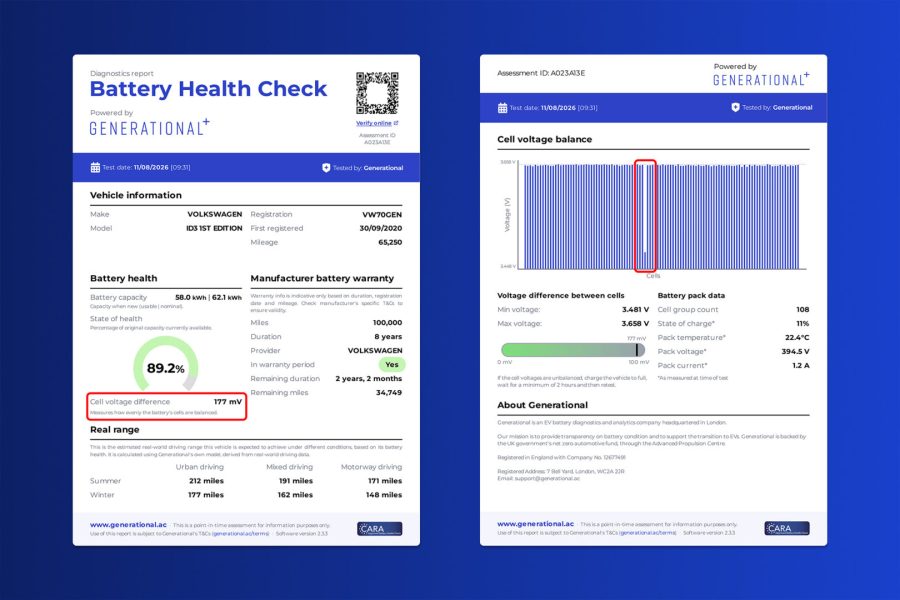
- A comprehensive analysis by UK-based Generational found that approximately one in 85 used electric vehicles (EVs) in the UK exhibits a significant battery cell voltage imbalance, exceeding 50 mV.
- The study, based on data from nearly 10,000 EV battery tests, highlights a crucial aspect of battery health often overlooked by standard State of Health (SoH) metrics.
- Over one in 200 tested vehicles showed an imbalance greater than 100 mV, indicating a potential underlying fault that could severely impact range, charging, and overall vehicle performance.
- Experts emphasize that while a battery’s overall capacity (SoH) might appear stable, individual cell-level faults can develop unnoticed, limiting the entire battery pack’s efficiency.
- Generational’s diagnostic approach includes cell-level voltage testing and rebalancing attempts to identify and address these issues early, preventing future complications for EV owners.
Unveiling Hidden Faults in Used EV Batteries
A recent and critical study conducted by Generational, a leading UK-based electric vehicle (EV) battery diagnostics company, has brought to light a significant concern within the burgeoning used EV market. The analysis, encompassing cell-level data from approximately 10,000 battery tests performed across hundreds of dealerships throughout the United Kingdom, reveals that a substantial number of pre-owned EVs may be operating with critical cell voltage imbalances.

The findings indicate that while the median vehicle tested showed a relatively minor 8 mV difference between its highest and lowest cell voltages, a concerning proportion — specifically, around one in 85 vehicles — exhibited an imbalance exceeding 50 mV. More alarmingly, approximately one in 200 tests recorded an imbalance greater than 100 mV, a threshold that Generational identifies as indicative of a potential underlying fault requiring immediate investigation.
Understanding EV Battery Cell Imbalance
The Architecture of an EV Battery Pack
An electric vehicle battery pack is a complex system, typically constructed from several hundred individual cells meticulously connected in series groups. This intricate design means that the performance of the entire battery pack is intrinsically linked to the health of its weakest component. A fundamental principle of battery operation dictates that the pack will cease charging once its first cell reaches full capacity and similarly stop discharging when the first cell is depleted.
Consequently, even a single underperforming or ‘weak’ cell has the potential to limit the overall capacity and operational efficiency of the entire battery. This crucial detail often goes unnoticed when only a pack-level average or a headline State of Health (SoH) figure is considered, as these metrics may not adequately reflect individual cell discrepancies.
Impact on Performance and Longevity
The presence of significant EV battery cell imbalance can trigger a series of adverse effects on vehicle performance. The Battery Management System (BMS), a critical component designed to protect the battery, may be compelled to restrict charging or discharging cycles to safeguard the weakest cell from overcharge or over-discharge. This protective measure, while essential for battery longevity, can directly impact the vehicle’s usable range, distort state-of-charge estimates, and lead to erratic or suboptimal charging behaviors.
Generational further explains that cell voltages naturally ‘drift apart’ and ‘back together’ as the battery undergoes charging and discharging cycles. Therefore, a borderline imbalance detected at a low state of charge may not always signify a persistent fault. However, a large imbalance that endures even after an attempted rebalance is considered materially more significant, warranting closer scrutiny and potential intervention.
Beyond State of Health: The Need for Deeper Diagnostics
While the State of Health (SoH) metric is widely used to assess battery capacity, Generational’s research underscores its limitations in providing a complete picture of battery condition. A vehicle can consistently display a stable SoH reading, indicating satisfactory overall capacity, even as underlying faults begin to develop at the individual cell level.
In many observed cases, there may be no immediate warning light, dashboard message, or noticeable alteration in vehicle behavior until the EV battery cell imbalance progresses to a more advanced stage. This ‘silent’ progression of faults makes early detection via sophisticated cell-level diagnostics imperative for maintaining battery health and mitigating future performance issues.
Generational’s Diagnostic Protocol and Industry Partnerships
Proactive Fault Identification
To address these critical issues, Generational has implemented a robust diagnostic protocol for used EVs. When a test flags a vehicle due to potential cell imbalance, the customer is guided through a series of steps. This typically begins with an attempted cell rebalance, a process designed to equalize the voltage across individual cells within the battery pack. Following this, the vehicle undergoes a re-test while at rest to confirm whether the imbalance persists. This meticulous approach ensures that any decision regarding further investigation, warranty support, or necessary repairs is based on confirmed and actionable data.
Recognizing the growing need for such granular diagnostics, Generational integrated cell-level voltage testing into its dealer diagnostics offerings in April. This enhancement allows dealerships to conduct more thorough assessments of EV battery health, moving beyond superficial metrics to identify potential problems at their root.
Expanding Reach Across the UK
Further solidifying its commitment to comprehensive EV battery care, Generational announced a significant partnership in July with Maverick Diagnostics. This collaboration is set to extend the reach of Generational’s cutting-edge OBD-port test kits to approximately 6,000 repair shops across the UK. By empowering a broader network of workshops with advanced diagnostic capabilities, the partnership aims to make early detection and remediation of EV battery cell imbalance more accessible to used EV owners nationwide.
Industry Insights: The 2025 Battery Performance Index
Generational’s latest findings build upon insights from its 2025 Battery Performance Index, which aggregated data from over 8,000 assessments throughout the UK. The Index reported an average State of Health (SoH) of 95.15% across the assessed vehicles. A key observation from this comprehensive dataset was that the variance in battery performance between individual vehicles tends to increase proportionally with their age. This trend underscores the importance of thorough, cell-level diagnostics for older used EVs, where the likelihood of developing subtle yet significant internal discrepancies is higher.
The Imperative of Cell-Level Testing
Oliver Phillpott, CEO of Generational, underscored the critical nature of these findings. “Reporting on State of Health is essential for used EVs, but it does not tell the full story of battery condition. It measures capacity, not necessarily whether the cells inside the pack are functioning correctly,” Phillpott stated. He further emphasized the insidious nature of such faults, noting that “Cell imbalance problems are often imperceptible, while the battery is developing a fault that could affect range, charging or value later on. The only practical way to see that risk early is to test for it.”
The study by Generational serves as a vital reminder for both consumers and industry stakeholders that the true health of an EV battery goes beyond headline capacity figures. Proactive cell-level diagnostics are indispensable for ensuring the reliability, performance, and long-term value of electric vehicles in the rapidly expanding used market. As the EV ecosystem continues to mature, sophisticated tools to identify and address issues like EV battery cell imbalance will be crucial for maintaining consumer confidence and accelerating sustainable mobility.
Source: Generational
Frequently Asked Questions (FAQ)
What is EV battery cell imbalance?
EV battery cell imbalance refers to variations in voltage levels among individual cells within an electric vehicle’s battery pack. Ideally, all cells should have similar voltages; however, discrepancies can arise over time due to various factors, impacting the overall performance and lifespan of the battery.
Why is cell imbalance a problem for EVs?
A significant cell imbalance means that a single weak cell can limit the entire battery pack. It forces the battery management system (BMS) to stop charging or discharging prematurely, leading to reduced range, inaccurate state-of-charge readings, and potential issues with charging speed and efficiency.
How is cell imbalance different from State of Health (SoH)?
State of Health (SoH) typically measures the overall capacity of the battery pack. While a high SoH indicates good capacity, it doesn’t reveal individual cell-level issues. An EV could have a good SoH but still suffer from critical cell imbalance that affects performance and could lead to future faults.
What level of cell imbalance is considered critical?
According to Generational’s study, an imbalance above 50 mV between the highest and lowest cell voltages warrants investigation. An imbalance exceeding 100 mV is a more serious concern, potentially indicating an underlying fault within the battery pack that requires immediate attention or repair.
How can EV battery cell imbalance be detected?
Cell imbalance is detected through specialized diagnostic tools that measure the voltage of individual cells within the battery pack. Standard vehicle diagnostics or a simple SoH reading may not identify these issues until they become severe. Companies like Generational offer specific cell-level testing to catch problems early.
Can EV battery cell imbalance be fixed?
In some cases, minor cell imbalances can be addressed through a process called cell rebalancing, which aims to equalize the voltage across all cells. However, if the imbalance is significant and persists after rebalancing, it might indicate a more serious underlying fault that could require further investigation, warranty support, or battery repair.
Does cell imbalance affect used EV value?
Yes, undetected or unrepaired cell imbalance can significantly affect the long-term value of a used EV. It can lead to diminished range, unreliable charging, and potential costly repairs. Transparent diagnostic reporting, including cell-level health, becomes crucial for both buyers and sellers in the used EV market.