
Key Takeaways:
- hofer powertrain has developed an innovative battery module that dynamically adjusts the mechanical pressure on individual cells during operation.
- This programmable cell pressure control replaces fixed designs, allowing active management of cell preload based on operating conditions.
- Years of research indicate that optimal cell pressure significantly influences battery cycle life and performance, potentially doubling longevity and energy density.
- The technology is applicable across various cell chemistries, including NMC, LFP, and next-generation solid-state cells.
- Beyond conventional electric vehicles, this advancement holds promise for commercial vehicles, stationary storage, marine, and future aviation systems, particularly benefiting applications like Vehicle-to-Grid (V2G) and Vehicle-to-Home (V2H).
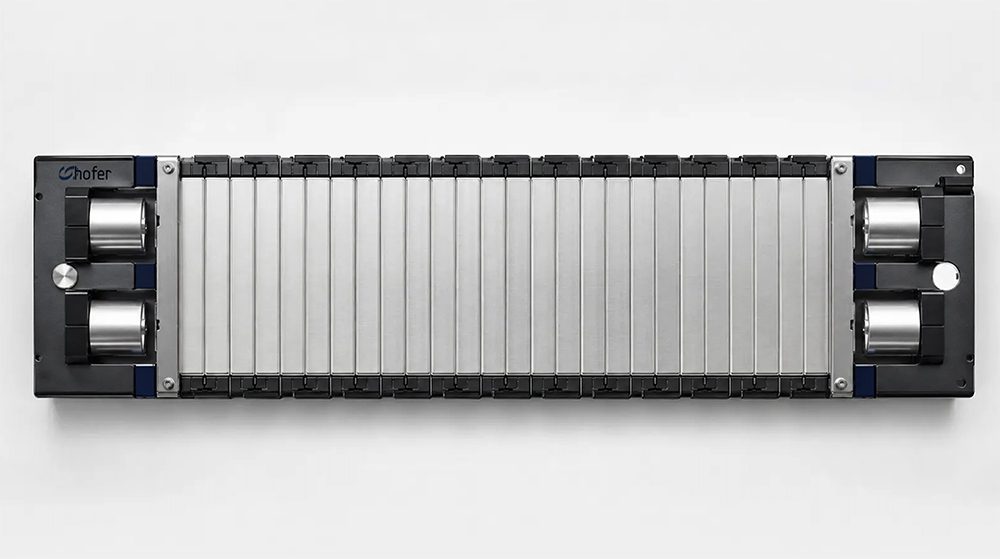
In a significant stride for electric vehicle (EV) engineering and energy storage, hofer powertrain has unveiled a pioneering battery module featuring programmable cell pressure control. This breakthrough departs from conventional battery designs, which typically maintain a fixed mechanical preload on cells, by enabling dynamic adjustment of pressure based on real-time operating conditions.

This innovative approach transforms a traditionally static mechanical design parameter into an actively controlled variable within the battery system. The implications are profound, promising extended battery life and enhanced performance across a wide spectrum of applications, from personal electric vehicles to large-scale stationary storage.
Revolutionising Cell Preload Management
The mechanical preload exerted on battery cells is a critical, yet often overlooked, factor influencing their long-term health and performance. Traditionally, this pressure is a fixed attribute determined during the manufacturing process of the battery module.
hofer powertrain’s new module introduces a freely programmable force map. This allows the pressure on individual battery cells to fluctuate in response to varying operational demands, temperatures, and states of charge. This dynamic adaptation is a cornerstone of next-generation advanced battery management systems.

By transforming a fixed physical design into an intelligent, adaptive system, hofer powertrain aims to unlock new levels of efficiency and durability in battery technology. This marks a crucial evolution in how battery packs are designed and managed.
The Impact of Mechanical Preload on Battery Longevity
For more than five years, hofer powertrain has dedicated extensive research and engaged in numerous customer projects to understand the intricate relationship between cell preload, cell breathing, swelling, deformation, and their collective impact on a cell’s cycle life and overall performance. This deep dive into electrochemical-mechanical coupling is vital for optimizing battery health.
Their research methodology involved developing programmable test equipment capable of recording critical parameters such as cell deformation, temperature, voltage, capacity, and impedance under precise charge and load profiles. These comprehensive readings enable early identification of the optimal mechanical constraints for specific cell technologies, which is crucial for developing robust advanced battery management systems.
This meticulous data collection and analysis have laid the groundwork for the new module, confirming that mechanical factors play a far more significant role in battery degradation than previously accommodated by static designs.
Tailoring Pressure for Diverse Cell Chemistries
A fundamental insight from hofer powertrain’s extensive research is that no universal ideal pressure suits every battery cell. Applying too little or excessive mechanical pressure can equally accelerate cell degradation, diminishing both performance and lifespan.
The optimal pressure is a complex interplay of various factors, including the cell’s specific chemistry (such as Nickel Manganese Cobalt – NMC, Lithium Iron Phosphate – LFP, or emerging solid-state cells), its physical format, current state of charge (SoC), operational temperature, and the overall operating profile.
The company emphasizes the necessity of treating these parameters as an integrated system, rather than isolated variables. This holistic approach ensures that the programmable cell pressure control system can precisely adapt to the unique characteristics and demands of different battery types, thereby extending their operational lifespan and maintaining peak performance.
Enhancing Performance Across Battery Technologies
The company’s methodology has already demonstrated its applicability across a spectrum of cutting-edge cell technologies. This includes widely adopted NMC and LFP chemistries, as well as the highly anticipated next-generation solid-state cells, which are poised to revolutionise energy storage.
Research conducted by the University of Cambridge independently supports these findings, indicating that meticulously controlled mechanical loading can substantially mitigate the aging processes in lithium-ion cells. Under specific test conditions, such controlled loading has been shown to significantly extend the service life of the cells examined.
Building on these insights, hofer powertrain assesses the potential of its programmable cell pressure control approach to achieve up to double the cycle life and double the energy density, particularly for current NMC and solid-state cells. The actual gains, however, will vary depending on the specific cell technology, the operational profile, and the initial system design, underscoring the adaptability of these advanced battery management systems.
Broadening the Horizon: Applications Beyond EVs
While the immediate impact of hofer powertrain’s programmable cell pressure control module is evident in the electric vehicle sector, its potential applications extend far beyond conventional passenger cars. The technology is poised to benefit a diverse range of industries requiring robust and long-lasting battery solutions.
Commercial vehicles, which typically undergo more rigorous and frequent charge-discharge cycles, stand to gain significantly from extended battery life. Stationary energy storage systems, crucial for grid stability and renewable energy integration, also require durable batteries capable of sustained performance.
Furthermore, the marine sector, future aviation, and even aerospace systems, where reliability and weight are paramount, could leverage this advancement. The mechanical precision offered by programmable control is particularly relevant for solid-state cells deployed in stationary storage applications, addressing critical durability challenges.
Supporting Future Energy Infrastructures: V2H and V2G
The module’s capabilities are especially pertinent for vehicle batteries supporting Vehicle-to-Home (V2H) and Vehicle-to-Grid (V2G) operations. These advanced functionalities, which allow electric vehicles to supply power back to homes or the electrical grid, demand an exceptionally high number of charge and discharge cycles.
Such intensive use profiles can rapidly degrade conventional batteries. By actively managing cell pressure, hofer powertrain’s technology ensures that batteries can endure these demanding cycles with significantly reduced degradation, making V2H and V2G more viable and sustainable. This innovation further solidifies the role of advanced battery management systems in future energy ecosystems.
The Future of Battery Management
hofer powertrain’s development of a battery module with programmable cell pressure control marks a pivotal moment in battery technology. By actively managing mechanical stress on individual cells, this innovation promises to unlock greater longevity, performance, and efficiency across a wide array of applications.
This dynamic approach represents a significant leap forward in advanced battery management systems, moving beyond passive protection to active optimization. As industries increasingly rely on electrification, solutions that enhance battery durability and performance will be crucial for accelerating adoption and achieving sustainable energy goals.
The integration of such intelligent control mechanisms will undoubtedly shape the next generation of electric vehicles and energy storage solutions, contributing to a more reliable and efficient electrified future.
Frequently Asked Questions (FAQ)
What is programmable cell pressure control?
Programmable cell pressure control is an innovative battery technology that dynamically adjusts the mechanical force exerted on individual battery cells during operation. Unlike traditional fixed designs, it allows the pressure to change based on real-time operating conditions like temperature and state of charge.
Why is dynamic cell pressure control important for batteries?
Dynamic cell pressure control is crucial because the mechanical pressure on a battery cell significantly impacts its aging rate and performance. Optimizing this pressure prevents premature degradation, extends the battery’s cycle life, and enhances overall efficiency, leading to more durable and reliable batteries.
Which types of battery cells can benefit from this technology?
This technology is adaptable to various battery chemistries, including popular Lithium Iron Phosphate (LFP) and Nickel Manganese Cobalt (NMC) cells. It is also particularly relevant for emerging solid-state cells, which are sensitive to mechanical stress and can achieve greater stability and longevity with precise pressure management.
How does hofer powertrain measure the effects of cell preload?
hofer powertrain utilizes specialized programmable test equipment. This equipment records vital parameters such as cell deformation, temperature, voltage, capacity, and impedance under controlled charge and load profiles. These measurements help identify optimal mechanical constraints for different cell technologies.
What are the potential benefits of this innovation?
The primary benefits include significantly extended battery cycle life and improved energy density. hofer powertrain estimates that their approach could potentially double both the cycle life and energy density for current NMC and solid-state cells, depending on specific applications and design.
Beyond EVs, where else can this battery technology be applied?
The applications extend beyond conventional electric vehicles to commercial vehicles, stationary energy storage, marine vessels, and future aviation and aerospace systems. It is particularly beneficial for applications like Vehicle-to-Grid (V2G) and Vehicle-to-Home (V2H) due to the high number of charge/discharge cycles involved.
How does this technology improve advanced battery management systems?
By enabling dynamic control over a fundamental physical parameter (cell pressure), this technology adds a new layer of sophistication to battery management. It allows for more precise optimization of battery health, moving beyond basic electrical and thermal management to include mechanical factors for holistic longevity.