
Key Takeaways:
- Walmart is rapidly expanding its electric vehicle (EV) fast-charging network, adding 368 public fast-charging ports in Q2, second only to Tesla in the U.S.
- Despite this growth, a recent test of a Walmart-owned-and-operated fast-charging station in Freehold Township, New Jersey, highlighted significant operational challenges for the user.
- The primary issue stemmed from a glitchy mobile application required for payment, leading to a 40-minute failed charging attempt despite adequate cellular connectivity.
- The station utilized Alpitronic HYC400 hardware, capable of delivering up to 400 kilowatts and supporting both NACS and CCS connectors.
- The experience underscores the critical need for reliable and diverse payment options beyond mobile apps, which Walmart indicates are in development.
- A nearby Ionna Rechargery, using the same hardware but offering tap-to-pay functionality, provided a seamless charging experience, contrasting sharply with the Walmart station.
Walmart, a retail giant with an expansive national footprint, is strategically positioning itself as a major player in the evolving electric vehicle (EV) charging landscape. With thousands of stores offering vast parking lots and a massive customer base, the company is uniquely poised to make EV charging more accessible across America, even amidst a perceived slowdown in EV sales.

This aggressive expansion strategy is gaining substantial traction. In the second quarter alone, Walmart augmented its network with 368 new public fast-charging ports, surpassing every other network in the U.S. except for Tesla. The company recently marked a significant milestone, inaugurating its 100th owned-and-operated fast-charging station, thereby extending its presence to 20 states.
Firsthand Encounter with Walmart’s Charging Infrastructure
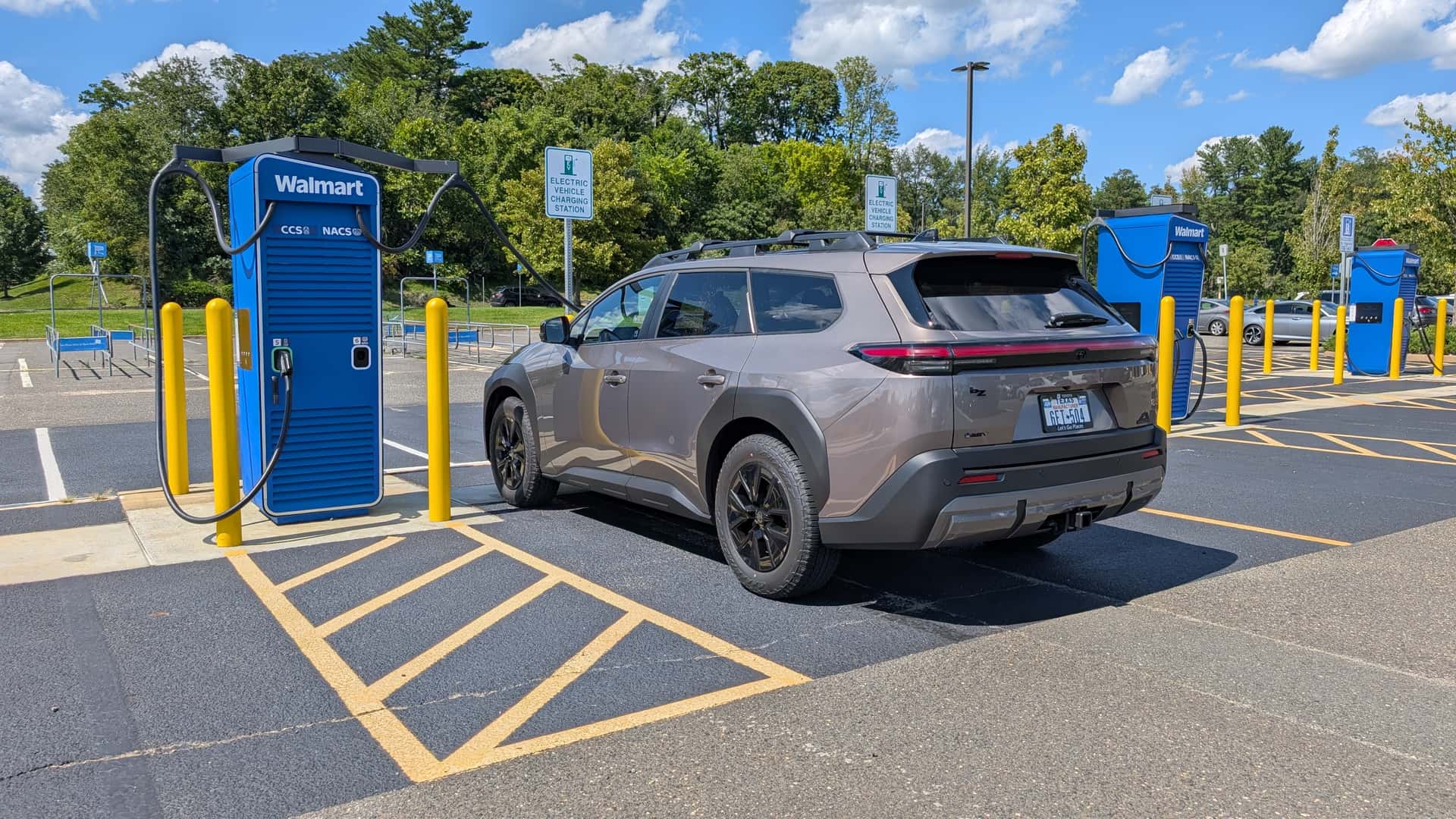
To assess the real-world functionality of this burgeoning network, an evaluation was conducted at a Walmart Supercenter in Freehold Township, New Jersey. The objective was straightforward: to test the charging process for a Toyota bZ Woodland press vehicle, complete a standard 10-80% charging cycle, and assess the overall user experience.
The journey from Brooklyn involved an hour-long, 45-mile drive, with the vehicle’s battery intentionally drained to 12% to facilitate a comprehensive charging test. The chosen station featured four Alpitronic HYC400 units, prominently painted in Walmart’s distinctive blue. These advanced hardware units are designed to deliver up to 400 kilowatts and serve eight charging stalls, evenly split between NACS (North American Charging Standard) and CCS (Combined Charging System) connectors.

The bZ Woodland, equipped with a NACS port, offered the convenience of direct connection without the need for an adapter, a positive step in the industry’s efforts to streamline the charging process. However, the subsequent experience highlighted persistent challenges in the broader public EV charging ecosystem, specifically concerning mobile application reliance.
Navigating the App-Centric Charging Landscape
Anticipating the absence of credit card readers at most Walmart stations, preparations included downloading the Walmart app, creating an account, and pre-loading credit card details. The activation process, as displayed on the charger screen, mandated plugging in the car first, then scanning a QR code via the Walmart app, confirming the port number on the phone, and initiating the session.
Despite these preparations, the initial attempt to commence charging proved problematic. The app’s QR-code scanner repeatedly failed to register the code. Multiple attempts, including closing and reopening the application and cleaning the camera lens, were necessary before the code was eventually recognized, redirecting to the payment screen.
An alternative manual selection of the charger via the app was available, though its functionality was not immediately clear and the app itself displayed intermittent glitches. Upon reaching the payment stage with pre-saved card details, the app abruptly displayed a “something went wrong” message. A full restart of the process, including unplugging and replugging the cable, yielded no success. The metallic buttons on the charging unit, exposed to direct sunlight, were noticeably hot, adding to the discomfort.
Persistent Technical Issues and Customer Support Interaction
Subsequent attempts produced a different error message: “We’re having technical issues, try again in a moment.” Troubleshooting involved trying to charge with the vehicle both off and on, a common diagnostic step for potential handshake errors between the car and charger. These efforts, however, proved futile, leading to growing frustration.
A call to Walmart’s customer service line provided insights into the potential causes, attributing the errors to possible connectivity problems or a software glitch within the Walmart app. Although cellular connectivity at the location registered three to four bars with an LTE or 5G connection, and other applications functioned normally, the customer service representative suggested uninstalling and reinstalling the Walmart app. This recommendation, for an app freshly downloaded for the purpose, seemed counterintuitive but was followed, yet yielded no different outcome; the same errors persisted.
An attempt to use an adjacent dispenser also proved unsuccessful. After approximately 40 minutes and five failed charging attempts, without adding any charge to the bZ Woodland, the decision was made to abandon the Walmart station. The author noted the physical discomfort of waiting under the direct sun during this extended troubleshooting period.
A Stark Contrast in Charging Experiences
With a pre-planned contingency, the vehicle proceeded to an Ionna Rechargery situated at a Wawa gas station, merely four miles away. The experience at the Ionna station presented a dramatic contrast. Charging commenced within a minute of arrival, simply by tapping a phone on the card reader and plugging in the cable.
A notable observation made during the wait was the absence of other EVs at the Walmart station, while the Ionna station was actively serving multiple vehicles. While specific reasons for traffic disparities are complex, the differing ease of initiating a charge session between the two locations, both utilizing identical Alpitronic HYC400 hardware, was a significant differentiator.
The core distinction lay in the payment mechanism: Ionna offered a straightforward tap-to-pay option, whereas Walmart exclusively relied on its repeatedly failing mobile application. The overall Walmart EV charging experience highlighted a critical pain point for drivers seeking reliable and user-friendly infrastructure.
Addressing Industry Challenges and Future Outlook
The challenges encountered at the Walmart station harked back to earlier phases of EV charging infrastructure development, where initiating a charging session often involved downloading multiple applications, navigating complex payment systems, or contacting customer support. This contrasts with the increasingly streamlined experiences offered by established networks like Tesla, where the app generally provides a seamless process, barring widespread outages.
While glitches in public chargers are not uncommon, the inability to complete a single session across multiple attempts and dispensers, necessitating a complete change of charging location, is a concern in the current EV landscape of 2026. Prior experiences with providers like Revel, EvolveNY, and Applegreen Electric have generally been smoother, with issues typically confined to individual stalls rather than the entire station or payment system.
In response to inquiries, Walmart acknowledged the goal of providing a “simple and reliable” charging experience. A spokesperson stated, “We continuously work with vehicle manufacturers and technology partners to improve compatibility. Customers may currently pay for charging through the Walmart app, and we continue to explore additional payment options.”
Crucially, Walmart has announced plans to integrate swipe- and dip-to-pay terminals into its charging stations. This anticipated upgrade is expected to offer much-needed alternative payment methods, mitigating issues stemming from app failures. However, the timeline for these retrofits and their universal implementation across all dispensers remains unclear.
Walmart’s entry into large-scale DC fast charging holds immense potential to transform the EV charging landscape, particularly in regions with sparse infrastructure. Yet, the efficacy of this investment hinges not only on the deployment of hardware but equally on the provision of a consistently reliable and intuitive user experience. An expensive charging station that is not readily usable offers limited value to both the company and the EV drivers it aims to serve.
While individual experiences may vary, as indicated by some successful PlugShare check-ins at the same station, reports of failed sessions and app confusion echo the issues encountered during this evaluation. Until diverse and dependable payment solutions, such as card readers, become standard, many EV drivers may opt for more proven and reliable charging alternatives to ensure a hassle-free journey.
Frequently Asked Questions About Walmart EV Charging
What is Walmart’s strategy for EV charging?
Walmart aims to leverage its extensive network of stores and large parking lots to become a major provider of electric vehicle charging. The company is rapidly installing DC fast chargers at its Supercenters nationwide, aiming to offer convenient charging access to millions of its customers.
How many EV charging stations has Walmart deployed?
As of recent reports, Walmart has significantly expanded its EV charging network, opening its 100th owned-and-operated fast-charging station. In the second quarter alone, it added 368 public fast-charging ports, making it the second-largest deployer of new charging points in the U.S. after Tesla.
What type of charging hardware does Walmart use?
Walmart’s fast-charging stations are equipped with Alpitronic HYC400 units. These advanced chargers are capable of delivering up to 400 kilowatts of power and feature eight charging stalls, supporting both NACS (North American Charging Standard) and CCS (Combined Charging System) connectors.
What payment options are available at Walmart EV charging stations?
Currently, payment for Walmart’s owned-and-operated EV charging stations primarily relies on the Walmart mobile application, which requires scanning a QR code to initiate a session. The company has indicated that it is actively exploring and planning to introduce additional payment options, such as swipe- and dip-to-pay terminals, in the future.
What challenges did a recent test of the Walmart EV charging experience reveal?
A recent test identified significant challenges, primarily related to the reliability of the Walmart mobile app for initiating charging sessions. The app experienced repeated technical glitches, QR code scanning failures, and error messages, resulting in a 40-minute unsuccessful attempt to charge an EV despite adequate cellular connectivity.
How does Walmart’s charging experience compare to other networks?
The test highlighted a disparity, where an Ionna Rechargery using identical hardware offered a seamless tap-to-pay experience, unlike Walmart’s app-dependent system. While other networks like Tesla generally provide reliable app-based charging, the Walmart EV charging experience encountered issues reminiscent of earlier, less streamlined public charging systems.
What is Walmart doing to improve its EV charging services?
Walmart is committed to enhancing the reliability and user-friendliness of its charging network. The company is actively collaborating with vehicle manufacturers and technology partners to improve compatibility and is exploring additional payment options. The planned introduction of physical credit card readers is a key step towards improving the overall customer experience.