
Key Takeaways
- Pilot Company and Tesla are collaborating to establish over a dozen Megacharger stations specifically designed for the Tesla Semi electric truck.
- The inaugural Megacharger station is now operational at a Pilot Travel Center in Ellabell, Georgia, featuring six stalls capable of delivering up to 1.2 megawatts of power each.
- Future charging sites are strategically located along critical U.S. freight corridors, including I-5 and I-10, spanning states like California, Indiana, Nevada, and Texas.
- These stations integrate high-power charging with comprehensive amenities offered at Pilot’s travel centers, enhancing convenience for commercial truck drivers.
- Pilot is also significantly expanding its broader electric vehicle fast-charging infrastructure for passenger cars through partnerships with General Motors and EVgo.
In a significant stride toward electrifying heavy-duty transportation, Pilot Company, North America’s largest travel center network, has partnered with Tesla to deploy an extensive network of high-powered Megacharger stations across the United States. This collaboration aims to support the burgeoning fleet of electric semi-trucks, particularly the Tesla Semi, by providing crucial charging infrastructure along major freight corridors.
The initiative marks a pivotal moment for the commercial trucking industry, addressing one of the primary challenges in widespread electric truck adoption: reliable and rapid charging solutions for long-haul operations. The strategic placement of these Megachargers at existing travel centers leverages established logistics hubs, making the transition to electric heavy-duty vehicles more feasible for fleet operators and independent truckers.

First Megacharger Station Now Operational
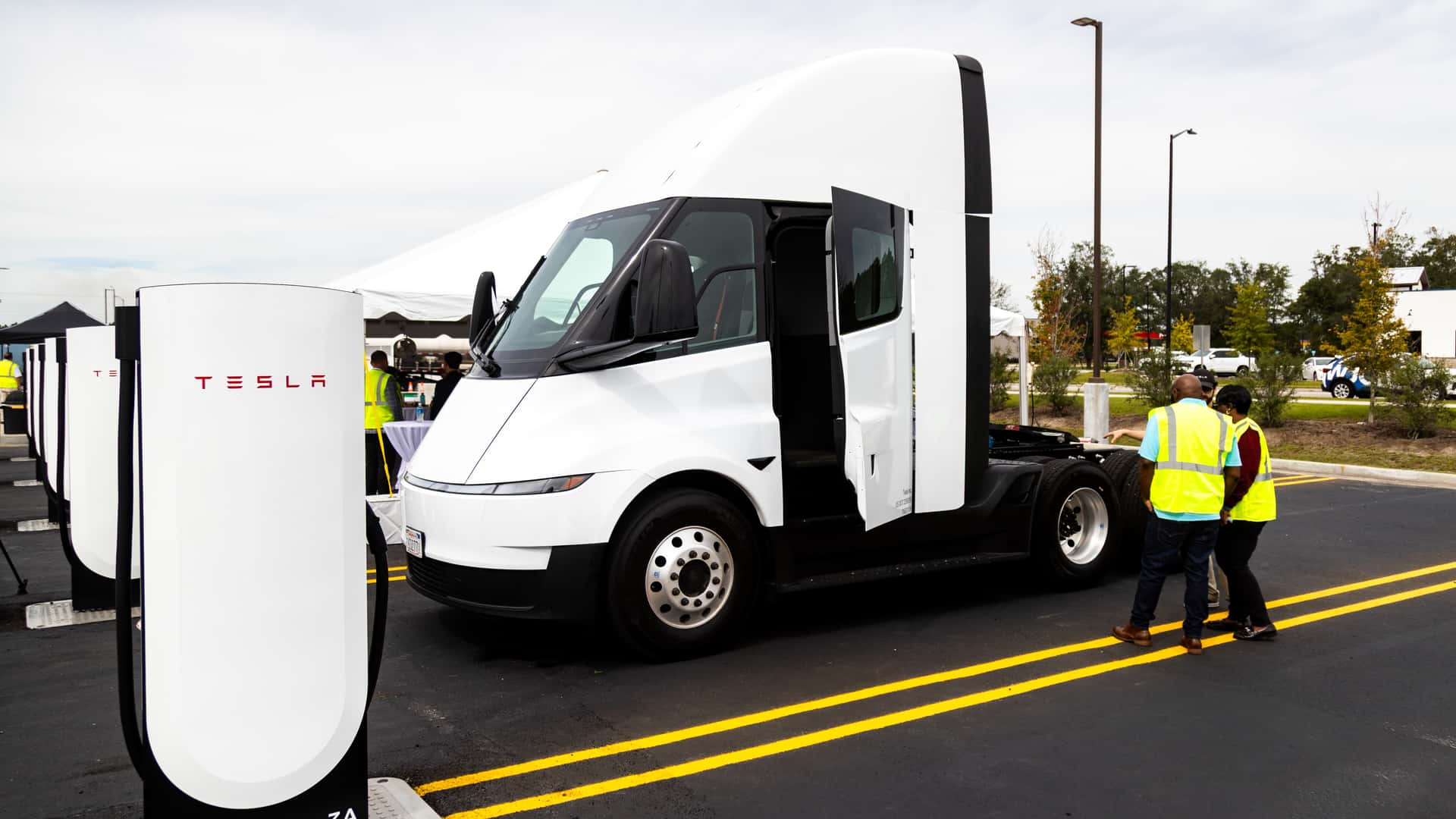
The initial Tesla Megacharger station under this partnership is already online at a Pilot location in Ellabell, Georgia. This pioneering site is equipped with six advanced charging stalls, each engineered to deliver an impressive 1.2 megawatts of power. Such high-capacity charging is essential for minimizing downtime for heavy-duty electric trucks, which require substantially more energy than passenger EVs.
The design of the Ellabell station mandates drivers to back their Tesla Semi into the charging bay. While this configuration differs from traditional pull-through designs, it is optimized for the specific footprint and charging port placement of the Tesla Semi. The rapid charging capability means a 30-minute top-up can boost the Tesla Semi’s state of charge by approximately 60%, a critical factor for maintaining tight delivery schedules.
Beyond this joint venture, Tesla has also independently energized another Semi charging station in Conley, Georgia, earlier this week. Notably, this particular site, not affiliated with Pilot, features pull-through stalls, offering a different operational layout for electric truck drivers.

Strategic Expansion Along Major Freight Corridors
The collaboration between Pilot and Tesla extends far beyond the initial Georgia location. Plans are actively underway to construct over a dozen additional Megacharger stations across the country. These sites are strategically chosen at select Pilot and Flying J travel centers along vital arteries of the U.S. freight network, including Interstate 5 (I-5) and Interstate 10 (I-10).
Key states earmarked for this expansion include California, Indiana, Nevada, and Texas. These regions represent critical logistical hubs and connect major economic centers, making them ideal for establishing a robust Tesla Semi charging network. The development in these areas is crucial for enabling electric heavy-duty transport across vast distances, facilitating the clean movement of goods.
“Pilot is proud to bring heavy-duty charging directly to key trucking routes and pair it with the services and amenities drivers rely on,” said Shannon Sturgil, senior vice president of alternative fuels at Pilot. “With these initial locations, we’re making fleet electrification a more accessible option for long-haul transportation and are excited to continue working with Tesla to move at the pace and preference of our customers.”
Each of the forthcoming Pilot-affiliated Megacharger stations will feature between four and eight charging stalls, ensuring ample capacity to serve the growing number of electric semi-trucks. This scalable approach allows the network to adapt to increasing demand and maintain efficient service for commercial users.
Upcoming Megacharger Locations and Development
Following the successful launch in Ellabell, Georgia, the next Pilot-Tesla Semi charging station is slated to commence operations today at a Flying J location on E. Paige Ave. in Tulare, California. This site represents a significant step in establishing the West Coast segment of the Tesla Semi charging network.
Further expansion plans include a Flying J in Fort Stockton, Texas, which will soon host a Megacharger station, bolstering electric freight capabilities in the Southwest. Additionally, a Pilot Travel Center in North Las Vegas, Nevada, is on the roster for future development, connecting more key logistics points with high-power charging. Currently, nine more sites are actively under construction, though their specific locations have not yet been publicly disclosed, indicating a rapid build-out phase.
Integrating Charging with Trucker Amenities
A significant advantage of integrating the Tesla Semi charging network within Pilot’s extensive travel center infrastructure is the availability of comprehensive amenities. Pilot and Flying J locations are well-known stops for truckers, offering a range of services from quick-service restaurants to restrooms and other facilities.
This integration allows electric truck drivers to conveniently take mandated breaks, grab a meal, or access other essential services while their rigs undergo rapid charging. The ability to combine necessary downtime with efficient charging operations significantly enhances the appeal and practicality of electric semi-trucks for long-haul journeys, contributing to overall logistical efficiency and driver comfort.
Pilot’s Broader Commitment to EV Infrastructure
Beyond its collaboration with Tesla for heavy-duty charging, Pilot Company is also making substantial investments in broader electric vehicle charging infrastructure. The company has forged partnerships with General Motors and EVgo to install fast-charging stalls for conventional electric passenger vehicles across its network.
To date, Pilot has energized an impressive 1,300 fast-charging stalls across 300 locations nationwide, with ongoing plans for further expansion. The company’s ambition is to make no fewer than 2,000 chargers available across 500 Pilot travel centers in the near future. This dual approach underscores Pilot’s commitment to supporting the comprehensive transition to electric mobility, catering to both commercial freight and individual passenger vehicle needs.
The strategic deployment of the Tesla Semi charging network by Pilot and Tesla marks a critical advancement in making electric heavy-duty trucking a viable and scalable reality. By focusing on high-power charging at key logistical points and integrating essential driver amenities, this initiative paves the way for a more sustainable and efficient future for commercial transportation.
FAQ Section
Q1: What is a Tesla Megacharger, and how powerful is it?
A Tesla Megacharger is a specialized charging station designed exclusively for the Tesla Semi electric truck. These stations are exceptionally powerful, with each stall capable of delivering up to 1.2 megawatts (MW) of electricity. This high power output is crucial for rapidly recharging the large battery packs of heavy-duty trucks, significantly reducing charging times compared to standard EV chargers.
Q2: Where are the first Tesla Megacharger stations being built?
The first operational Tesla Megacharger station under the Pilot partnership is located at a Pilot Travel Center in Ellabell, Georgia. Additional stations are under construction across the U.S., including upcoming sites at a Flying J in Tulare, California, another Flying J in Fort Stockton, Texas, and a Pilot Travel Center in North Las Vegas, Nevada, along major freight corridors.
Q3: How quickly can a Tesla Semi charge at these Megacharger stations?
At a Tesla Megacharger station, a Tesla Semi can receive a substantial power boost in a relatively short period. A 30-minute charging session is capable of increasing the truck’s state of charge by approximately 60%. This rapid charging capability is vital for commercial trucking operations, where minimizing downtime is essential for maintaining efficient logistics and delivery schedules.
Q4: Why are these Megacharger stations being built at Pilot Travel Centers?
Pilot Travel Centers are strategic locations because they are established hubs for commercial truckers, offering a wide array of services and amenities. By integrating Megachargers into these centers, electric truck drivers can simultaneously charge their vehicles and access essential facilities like quick-service restaurants, restrooms, and rest areas, making the charging experience more convenient and efficient.
Q5: Is Pilot Company also expanding charging options for regular electric vehicles?
Yes, Pilot Company is actively expanding its electric vehicle charging infrastructure beyond the Tesla Semi charging network. Through partnerships with General Motors and EVgo, Pilot is installing over 1,000 fast-charging stalls for conventional electric passenger vehicles across numerous locations. The company plans to increase this to 2,000 chargers across 500 travel centers in the near future, supporting broader EV adoption.
Q6: What is the significance of placing these chargers along I-5 and I-10?
Interstate 5 (I-5) and Interstate 10 (I-10) are critical freight corridors in the United States, facilitating the movement of goods across vast distances and connecting major economic regions. Placing Tesla Semi charging network along these routes is vital for enabling long-haul electric trucking, reducing range anxiety, and supporting the transition to zero-emission commercial transport across key logistical pathways.
Q7: Will all Pilot Megacharger stations have pull-through charging?
The inaugural Pilot Megacharger station in Ellabell, Georgia, requires drivers to back up into the charging bay. However, Tesla has also developed independent Semi stations, such as the one in Conley, Georgia, that feature pull-through stalls. The specific design configuration, whether back-in or pull-through, may vary across different Megacharger locations based on site planning and optimal use of space.