
Key Takeaways:
- Toyota Motor North America launched an “Electrification 101” program to educate its diverse workforce on hybrid, electric, and hydrogen fuel cell technologies.
- The training addresses a critical knowledge gap, as many employees, including those not specialized in automotive engineering, lacked foundational understanding of electrification.
- Toyota’s program emphasizes a “multi-pathway” strategy, highlighting hybrids as a current focus while preparing for future battery electric vehicles (BEVs) and hydrogen fuel cell electric vehicles (FCEVs).
- The curriculum dispels common myths surrounding electric vehicles, showcases the inherent simplicity and efficiency of electric motors, and includes hands-on demonstrations.
- By informing and exciting employees about the benefits of electrification, Toyota aims to foster internal advocacy, influencing product development decisions and customer engagement towards a more sustainable automotive future.
In a revealing development, a recent attendance at Toyota Motor North America’s “Electrification 101” program brought to light a significant informational disparity within one of the world’s largest automakers. Contrary to common assumptions that all employees at a major car manufacturer are deeply entrenched in automotive nuances, many staff members possess limited understanding of electrification and its broader implications. This observation underscores a crucial strategic imperative for the company: to educate its vast workforce on the evolving landscape of sustainable mobility.

This insight, gained during the comprehensive Toyota electrification training, highlights that a foundational understanding of electric vehicle (EV) technology, hybrid powertrains, and fuel cell electric vehicles (FCEVs) is not universally present, even among those working for an industry leader. However, this revelation is not a cause for discouragement but rather an indicator of proactive engagement by Toyota to bridge this knowledge gap effectively.
Bridging the Knowledge Gap in a Transforming Industry
The assumption that every individual working at a legacy automaker is a fervent car enthusiast, intimately familiar with every technological shift, often proves to be inaccurate. For many employees across diverse departments — from corporate accounting to app development — the appeal of working at a company like Toyota often lies in its stable employment, competitive benefits, respectful corporate culture, and the prestige associated with a global brand. These professionals are not necessarily “car nerds” driven by an inherent passion for automotive minutiae.
Even among employees who do consider themselves automotive enthusiasts, their expertise may not extend to the highly technical and rapidly evolving field of vehicle electrification. For instance, distinguishing between advanced battery chemistries like Nickel Manganese Cobalt (NCM) and Lithium Iron Phosphate (LFP) often requires specialized knowledge that traditional internal combustion engine (ICE) aficionados may not possess. The intricacies of electric motors, battery management systems, and charging infrastructure represent a new frontier even for seasoned automotive veterans.

Recognising this internal knowledge deficit, Toyota initiated its “Electrification 101” program. This initiative marks the second time the company has offered such fundamental educational opportunities, having previously hosted an introductory course on general automotive topics. Such programs affirm Toyota’s understanding that a well-informed workforce is critical for navigating the industry’s paradigm shift towards electrification.
Deconstructing the “Electrification 101” Curriculum
The program’s designation as “Electrification 101,” rather than simply “EV 101,” is strategically deliberate. It reflects Toyota’s steadfast commitment to a “multi-pathway” approach to sustainable mobility. This strategy emphasizes a robust focus on hybrid electric vehicles (HEVs) in the present, while simultaneously nurturing advancements in battery electric vehicles (BEVs) and, notably, hydrogen fuel cell electric vehicles (FCEVs) for the future. The company’s latest quarterly sales figures underscore this strategy: 56.8% of its total sales were electrified vehicles, which encompass HEVs, BEVs, plug-in hybrid electric vehicles (PHEVs), and FCEVs. However, pure BEVs constituted only 1.7% of these electrified sales, highlighting the prevailing emphasis on hybrid solutions.
The comprehensive Toyota electrification training curriculum delves into the core distinctions between various powertrain types. Participants learn the fundamental differences between HEVs, which use a combination of gasoline engine and electric motor, and PHEVs, which offer a larger battery for extended electric-only range before the gasoline engine activates. A significant portion of the course is dedicated to addressing and dispelling prevalent myths surrounding battery electric vehicles.
Addressing Misconceptions and Highlighting Advantages
The training contextualises the current transition by drawing parallels to the early 20th century, when gasoline-powered automobiles began to challenge horse-drawn carriages. At that time, infrastructure for cars was nascent, public education was limited, and rules of the road were unclear, making horse ownership seem simpler. Yet, automobiles ultimately prevailed due an array of advantages. This historical perspective serves to normalise the present-day challenges and uncertainties associated with the widespread adoption of electric vehicles.
The program subsequently highlights the manifold benefits of electrification, primarily focusing on enhanced efficiency and environmental cleanliness. Toyota champions its multi-pathway approach not only for providing diverse customer choices but also, as the company argues, for its optimal utilisation of finite battery resources. This particular stance, however, remains a subject of ongoing debate within the industry. While Toyota advocates for the diversified use of battery cells across various electrified platforms, most independent research suggests that pure battery electric vehicles generally represent the cleanest option on a lifecycle basis, considering emissions from manufacturing to disposal. Additional context on this can be found in discussions like: EV Myth Busted: No, They’re Not ‘Dirtier’ Than Gas Cars, Even If You Use Fossil Fuel Power and Yes, EVs Really Are Cleaner Than Gas Cars. Here’s By How Much.
While the program’s segment on the relative advantages of each powertrain type was largely informative, an industry critic might note its tendency to focus more on the limitations of EVs compared to other powertrain types. It did not, for instance, extensively cover the additional maintenance requirements or the inherent noise, vibration, and harshness (NVH) associated with gasoline engines. Conversely, the course exhibited a characteristic optimism regarding hydrogen fuel cell technology. A program slide asserted that hydrogen “can reduce ‘range anxiety’ as number of stations grow,” citing the Toyota Mirai’s range of up to 402 miles per tank. While such figures were impressive during the nascent stages of EV development, it is worth noting that at least eight current EV models in the U.S. market already surpass this range, with more advanced offerings continuously emerging.
Interactive Learning and Foundational Concepts
Beyond these specific points, the remainder of the classroom instruction maintained a largely neutral and informative tone. It meticulously covered foundational concepts such as various battery chemistries, different types of charging infrastructure, and core electrical units like kilowatts (kW) and kilowatt-hours (kWh). An overview of ongoing battery recycling initiatives was also included, underscoring the company’s commitment to sustainable practices.
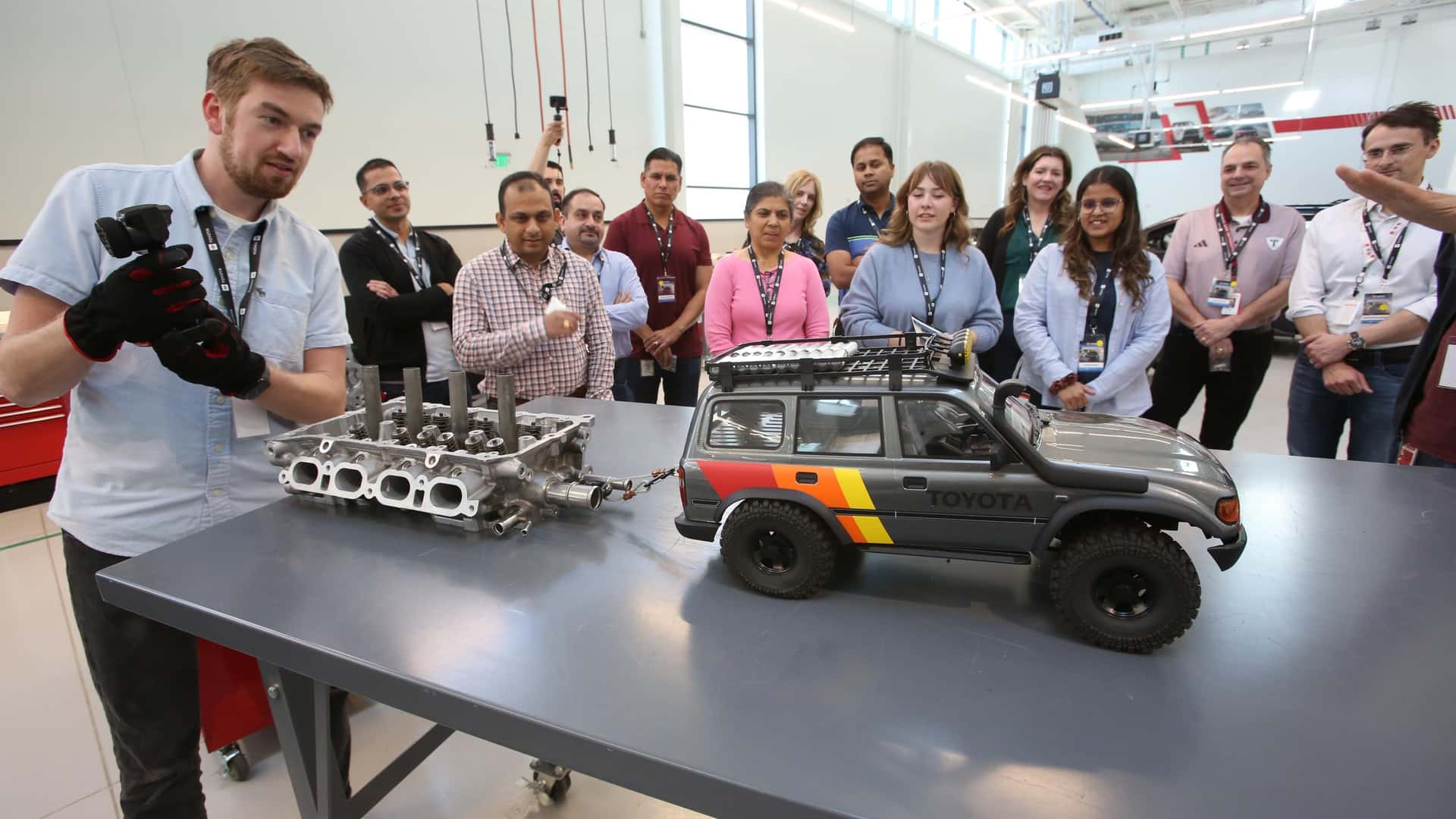
The most engaging aspect of the Toyota electrification training was its interactive segment. Here, employees participated in practical demonstrations designed to demystify electric propulsion. They constructed a rudimentary electric motor using only a screw, a magnet, a AA battery, and a piece of wire. Participants also assembled a simple potato-based battery and observed the different charging outputs in real-time. A memorable highlight was the demonstration of an EV motor’s instant torque, where a small remote-controlled Land Cruiser effortlessly towed a cylinder head weighing over 30 pounds, vividly illustrating the power delivery of electric propulsion systems.
The Underlying Lesson: Simplicity and Efficiency of Electric Propulsion
The overarching message of the training was unequivocally clear: electric motors represent an extraordinary technological advancement. Presenters provided a striking visual comparison, juxtaposing a stripped-out Toyota V-6 engine, with its complex array of accessories and intricate components, against an equivalent electric motor. The electric motor, significantly smaller in footprint, offered greater power output with a remarkably simpler design. Even when integrated into a gasoline powertrain, as seen in the company’s hybrid systems, electric motors can reduce overall complexity by allowing for the elimination of less efficient and more finicky components like traditional transmissions.
This fundamental simplicity is a key advantage, illustrating that adding electric propulsion, in any form, can enhance a vehicle’s efficiency with minimal trade-offs. The deeper one progresses into electrification – from mild hybrids to full battery electric vehicles – the greater the simplification of the powertrain often becomes. A true battery electric vehicle inherently contains fewer moving parts than a conventional internal combustion engine vehicle, potentially leading to fewer points of failure and reduced maintenance requirements over its lifespan.
Despite these clear advantages, Toyota representatives reiterated the company’s cautious, yet forward-looking, perspective. They articulated that while the benefits are evident, the company seeks substantial improvements in battery chemistry and a more robust, widespread charging infrastructure before fully committing to battery electric vehicles as a universal, one-size-fits-all solution. Nevertheless, the underlying intent of the program was unambiguous: to cultivate enthusiasm among its employees for a future increasingly defined by electric propulsion. This strategic move is vital for aligning the company’s internal vision with its long-term product development goals.
Fostering Internal Advocacy for a Sustainable Future
The cultivation of an informed and enthusiastic workforce is paramount for any large corporation, especially when navigating significant technological shifts. Without a deep understanding of the long-term benefits of electrification, employees in critical roles—such as corporate procurement—might perceive only the immediate challenges: the added cost of new component designs or the complexities of onboarding new suppliers. Such a narrow perspective can inadvertently lead to resistance to change, a natural human tendency. However, by generating excitement and understanding, employees become willing to embrace short-term complexities in pursuit of long-term strategic objectives, actively encouraging others toward shared goals.
Brigette Armato, a Toyota employee who participated in the “Electrification 101” program, exemplifies this transformation. She openly admitted to knowing “nothing” about EVs and hybrids prior to the training. Yet, upon completion, she emerged as an advocate. “I work with our lease experience team, so I’m actually working with the customers and the vehicles. This was extremely helpful because now I can have an educated conversation with them and maybe convince them to go for an electric vehicle, whereas before I don’t think I had that skill,” she shared after the session, highlighting the immediate practical impact of the Toyota electrification training.
Her newfound conviction extends beyond customer interactions. Ms. Armato is now actively considering an electric vehicle for herself, despite her current attachment to her Toyota 4Runner. She expresses a desire for more electric alternatives across the product lineup: “I wish we would gravitate more towards electric vehicles across the lineup.” Her sentiment reflects a growing internal consensus that these educational initiatives are designed to foster. With hundreds of employees attending these classes and a substantial waitlist for future sessions, Toyota’s North American headquarters is steadily cultivating a growing cadre of “EV believers.” This internal shift is crucial; it’s not that employees were actively resisting electrification previously, but rather, like many consumers, they simply lacked comprehensive information and context. This proactive educational strategy positions Toyota to better navigate and lead in the evolving global automotive landscape.
FAQ Section
What is Toyota’s “Electrification 101” program?
Toyota’s “Electrification 101” is an internal training initiative designed to educate its employees on various electrified vehicle technologies, including hybrids, plug-in hybrids, battery electric vehicles (BEVs), and hydrogen fuel cell electric vehicles (FCEVs). It aims to provide foundational knowledge and dispel common misconceptions.
Why did Toyota introduce this electrification training program?
Toyota introduced the program to address a perceived knowledge gap within its workforce. Many employees, regardless of their role, did not possess a deep understanding of electrification, its benefits, or the underlying technologies. The training ensures a well-informed staff to support the company’s multi-pathway strategy.
What is Toyota’s “multi-pathway” approach to electrification?
Toyota’s “multi-pathway” approach involves developing and offering a diverse range of electrified vehicles simultaneously. This includes focusing heavily on hybrids today, while also investing in and advancing battery electric vehicles (BEVs) and hydrogen fuel cell electric vehicles (FCEVs) for future market needs and resource efficiency.
What were some key takeaways from the program’s curriculum?
The curriculum covered basics like battery chemistries, charging types, and electrical concepts (kW, kWh). It also highlighted the efficiency and simplicity of electric motors compared to traditional engines. Interactive sessions included building a simple motor and demonstrating EV torque, aiming to excite employees about the technology.
How does employee education impact Toyota’s electrification strategy?
Informed employees become internal advocates, crucial for driving long-term strategic decisions and influencing customer perception. By understanding electrification’s benefits, staff can better contribute to product development, procurement choices, and customer interactions, aligning the company’s internal culture with its sustainable future goals.