
Key Takeaways:
- Toyota Motor North America initiated its “Electrification 101” program to educate employees on diverse electrified vehicle technologies.
- The program aims to inform employees who may not be automotive enthusiasts about hybrids, plug-in hybrids, battery electric vehicles, and hydrogen fuel cell vehicles.
- Toyota champions a “multi-pathway” approach, focusing on hybrids while developing EVs and hydrogen solutions, citing efficient battery resource allocation.
- Training highlights the simplicity and efficiency of electric motors compared to traditional internal combustion engines.
- The initiative fosters internal advocacy for electrification, turning employees into informed proponents of sustainable mobility solutions.
In a significant move to align its vast workforce with the evolving landscape of automotive technology, Toyota Motor North America has rolled out its “Electrification 101” training program. This initiative, designed to educate employees on the intricacies and benefits of electrified vehicles, has brought to light a crucial insight: even within a leading car manufacturer, a considerable segment of the workforce lacks fundamental knowledge about the electrification revolution.

The program serves as a stunning reality check for industry observers often immersed in the daily debates and strategic shifts of electric vehicle (EV) development. It underscores that the philosophical questions surrounding electrification, which often preoccupy executives and critics, are not universally understood by all employees.
Far from being a discouraging revelation, this knowledge gap has spurred Toyota to proactively cultivate a more informed and engaged internal community. The company’s commitment to employee education reflects a broader strategy to ensure its entire organization comprehends and champions its diverse approach to sustainable mobility.
Understanding Toyota’s “Electrification 101” Initiative
Addressing the Knowledge Gap Among Employees
Toyota’s decision to launch the Electrification 101 program stems from a clear recognition that not every employee, despite working for the world’s largest automaker, is an automotive expert or a fervent car enthusiast. For many, a corporate role at Toyota offers stability, respectable benefits, a positive culture, and significant resume prestige, rather than solely fulfilling a passion for cars.

Departments ranging from corporate accounting to app development are staffed by professionals whose primary expertise lies outside the detailed mechanics of vehicle powertrains. Consequently, these individuals may not possess a deep understanding of why electrification is becoming increasingly vital or the technical distinctions between various electrified vehicle types.
Even among car enthusiasts within the company, the rapid advancements in electrification present new challenges. A traditional V8 muscle car aficionado, for instance, might be unfamiliar with the nuances of different battery chemistries, such such as Nickel Manganese Cobalt (NCM) versus Lithium Iron Phosphate (LFP). This technical complexity and relative newness of EV and hybrid technologies necessitate a foundational educational framework for many within the organisation.
The Electrification 101 program is not Toyota’s first foray into foundational employee education. Earlier this year, the company offered a general introduction to automotive concepts, further illustrating its commitment to ensuring a baseline understanding of its products across all departments.
The Multi-Pathway Strategy Unpacked
Crucially, the program is named “Electrification 101,” not “EV 101,” a deliberate choice reflecting Toyota’s overarching “multi-pathway” approach to sustainable mobility. This strategy emphasizes a strong immediate focus on hybrid vehicles, alongside strategic development in battery electric vehicles (BEVs) and, notably, hydrogen fuel cell electric vehicles (FCEVs) for the future.
Toyota’s current sales figures underscore this strategy: in the last quarter, an impressive 56.8% of its total vehicle sales were electrified. However, this figure encompasses hybrids, plug-in hybrid vehicles (PHEVs), and FCEVs, with pure BEVs accounting for a mere 1.7% of these electrified sales.
The company advocates for its multi-pathway approach by arguing that it offers customers greater choice and represents the most efficient use of finite battery resources globally. This perspective, while central to Toyota’s strategy, remains a subject of considerable industry debate, with much research often indicating that BEVs typically offer the cleanest option over their entire lifecycle.
During the program, the Toyota Mirai, one of the few FCEVs available in the United States, was highlighted. Running on compressed hydrogen, which currently has limited availability to specific regions of California and is priced at approximately double the cost of gasoline, the Mirai offers a range of up to 402 miles per tank. While such range figures were once groundbreaking for electrified vehicles, the rapid advancements in BEV technology mean that at least eight EV models currently on the U.S. market already surpass this driving range, with many more high-range options continuously emerging.
Curriculum and Core Concepts
Demystifying Electric Vehicles
A significant portion of the Electrification 101 program was dedicated to dispelling common misconceptions surrounding electric vehicles. The classroom sessions began by drawing historical parallels to the early 20th century, when the nascent gasoline car industry grappled with undeveloped infrastructure, a lack of public education, limited service options, and unclear rules of the road. In that era, owning a horse was often considered a simpler and more straightforward option. The module effectively showcased how, despite initial hurdles, gasoline cars ultimately prevailed, suggesting a similar trajectory for electrified vehicles.
The course then transitioned to outlining the numerous advantages of electrification, with a particular emphasis on improved efficiency and reduced emissions. Participants learned about the benefits of the multi-pathway approach, framed not just as providing customer choice, but also as a responsible method for allocating limited global battery resources.
Technical Foundations and Advantages
While the program thoroughly covered the basics of all powertrain types, including the critical distinctions between hybrids and plug-in hybrids, considerable attention was given to the underlying technologies. Employees were introduced to fundamental concepts such as battery chemistries, various charging standards, and essential electrical terms like kilowatts and kilowatt-hours.
Additionally, the curriculum addressed ongoing battery recycling initiatives, highlighting the industry’s commitment to sustainability. However, in its discussion of the relative advantages of each powertrain, the program tended to focus more on the limitations of BEVs, such as range and charging infrastructure, without extensively detailing the additional maintenance requirements or noise, vibration, and harshness (NVH) characteristics commonly associated with gasoline vehicles. Predictably, the session maintained a notably bullish stance on the potential of hydrogen technology.
Interactive Learning Experience
The most engaging aspect of the Electrification 101 program was its hands-on, interactive component. Participants were given the opportunity to construct a simple electric motor using only a screw, a magnet, a AA battery, and a piece of wire, offering a tangible demonstration of fundamental electromagnetic principles. Employees also engaged in building a rudimentary potato-based battery and observed various charging outputs in action.
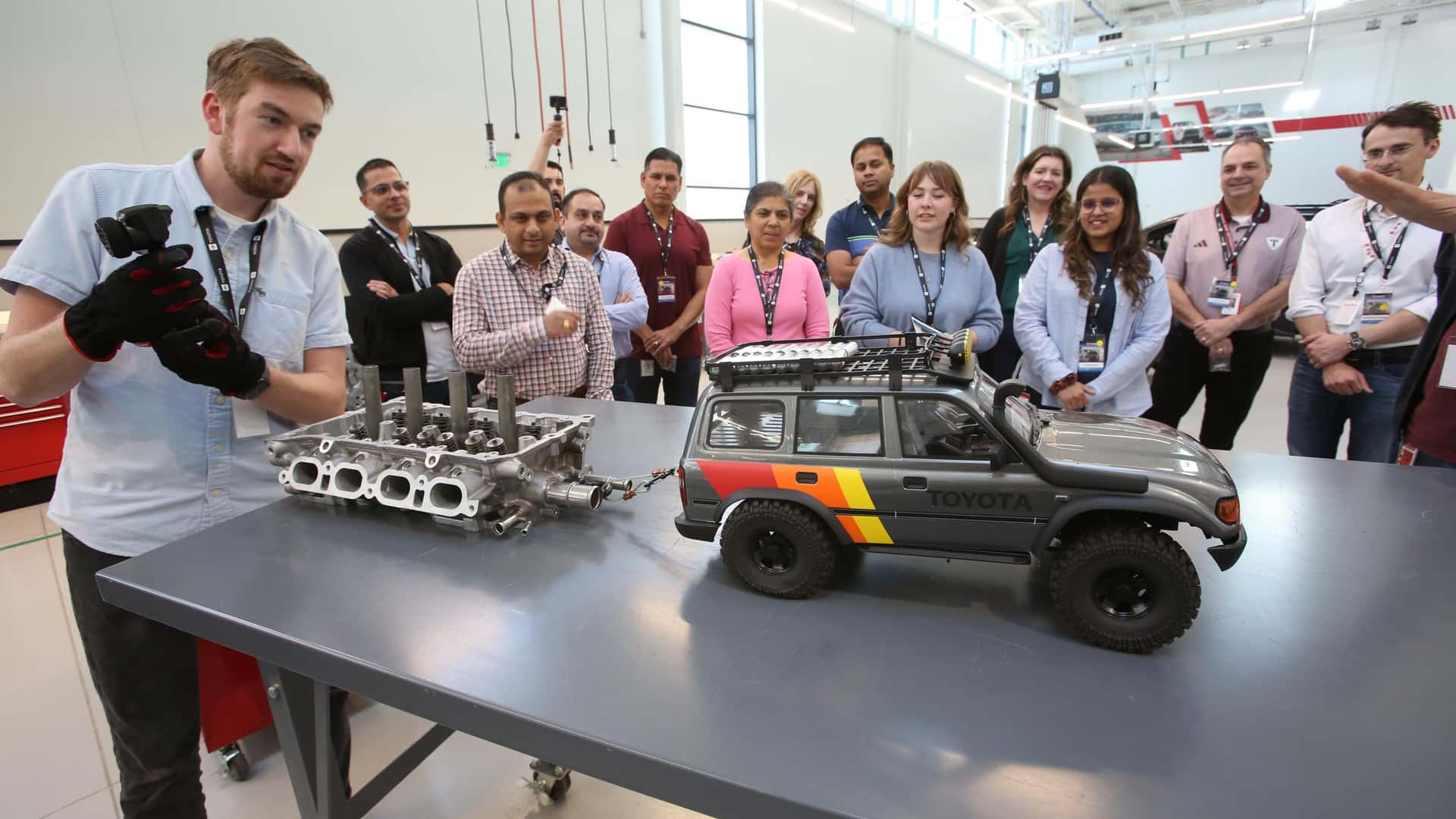
A particularly memorable demonstration showcased the impressive instant torque of an EV motor. A tiny remote-controlled Land Cruiser was used to effortlessly tow a cylinder head weighing over 30 pounds, vividly illustrating the robust power delivery inherent in electric propulsion systems. These practical exercises provided an intuitive understanding of concepts that might otherwise seem abstract, making the technology more accessible and exciting for attendees.
The Simplicity and Potential of Electric Propulsion
From Complex ICE to Streamlined EV
A core lesson derived from the training was the remarkable simplicity and efficiency of electric motor technology. Presenters at the program offered a compelling visual comparison: a stripped-out Toyota V-6 engine, revealing its intricate array of complicated accessories and numerous moving parts, stood in stark contrast to an equivalent electric motor. The electric motor, capable of generating more power, was significantly smaller in footprint and boasted a far simpler design.
The revelation extended to hybrid systems as well. By integrating an electric motor into a traditional gasoline powertrain, Toyota’s hybrid architecture effectively reduces mechanical complexity by often eliminating the need for a finicky transmission. This fundamental shift towards electric propulsion, even in its partial form, clearly demonstrated how it enhances efficiency with minimal sacrifices.
The further one progresses along the path to full electrification, the greater the simplification becomes. In a true battery electric vehicle, the number of moving parts is drastically reduced, inherently leading to fewer potential points of failure and generally lower maintenance requirements over the vehicle’s lifespan.
Long-Term Vision and Current Hurdles
Despite the clear advantages of electric motors, Toyota representatives articulated the company’s cautious yet optimistic long-term vision. They conveyed that while the future is undoubtedly electric, Toyota seeks significant advancements in battery chemistry and a robust expansion of charging infrastructure before fully embracing BEVs as a universal, one-size-fits-all solution for all consumers and regions.
Nevertheless, the underlying sentiment throughout the training program indicated a concerted effort to foster excitement among employees for an increasingly all-electric future. The focus on the inherent benefits and growing simplicity of electric propulsion served to cultivate a positive internal outlook towards the company’s evolving product lineup.
Empowering the Workforce: The Advocate Effect
Shifting Internal Perceptions
The educational impact of programs like Electrification 101 is profound, particularly for employees whose roles might not directly involve product development. For individuals in corporate procurement, for instance, a lack of understanding about electrification’s long-term benefits might lead them to perceive only the immediate challenges: the increased costs associated with designing new components or the complexities of onboarding new suppliers. Without a broader perspective, resistance to change is a natural human inclination.
However, by igniting enthusiasm and providing a clear vision of the long-term goals, Toyota aims to empower its employees. When informed and excited, individuals are more likely to embrace short-term complexities, advocating for the transition and driving others towards the company’s strategic objectives in electrification.
Employee Testimonial and Impact
The program’s success in cultivating internal champions is already evident. Brigette Armato, a Toyota employee who participated in the class, candidly admitted that she knew “nothing” about EVs and hybrids before attending. Yet, the training profoundly transformed her perspective, turning her into an enthusiastic advocate.
“I work with our lease experience team, so I’m actually working with the customers and the vehicles. This was extremely helpful because now I can have an educated conversation with them and maybe convince them to go for an electric vehicle, whereas before I don’t think I had that skill,” Armato shared as the session concluded. Her newfound knowledge not only enables her to better serve customers but also influences her personal choices.
Armato is now actively considering an electric vehicle for herself, despite her current attachment to her Toyota 4Runner. She expresses a clear desire for more electric options within Toyota’s portfolio. “I wish we would gravitate more towards electric vehicles across the lineup,” she stated, echoing a sentiment shared by many external observers and internal proponents of rapid EV adoption.
A Growing Movement Within Toyota
The expanding reach of these training classes, with hundreds of employees already participating and a substantial waitlist for future sessions, signals a growing internal momentum. This educational drive is creating an increasing number of “EV believers” within Toyota’s North American headquarters.
It’s not that these employees were actively resisting electrification previously; rather, much like many car buyers in the general public, they simply lacked comprehensive information. By equipping its workforce with knowledge and enthusiasm, Toyota is laying the groundwork for a more unified and informed push towards an electrified future across its entire operational ecosystem.
Frequently Asked Questions (FAQ)
What is Toyota’s “Electrification 101” program?
Toyota’s “Electrification 101” is an internal training program for its employees. It aims to educate staff on various electrified vehicle technologies, including hybrids, plug-in hybrids, battery electric vehicles (BEVs), and hydrogen fuel cell electric vehicles (FCEVs). The initiative seeks to bridge knowledge gaps and foster a deeper understanding of Toyota’s multi-pathway strategy for sustainable mobility.
Why did Toyota launch this employee training program?
Toyota launched the program because many employees, regardless of their role, may not be automotive experts or fully grasp the nuances of electrification. The company recognized the need to inform its workforce about the benefits, technologies, and strategic importance of electrified vehicles to ensure a unified internal vision and informed decision-making.
What is Toyota’s “multi-pathway” approach to electrification?
Toyota’s “multi-pathway” approach focuses on offering a diverse range of electrified vehicles. This includes a strong emphasis on hybrids today, alongside continued development of battery electric vehicles and hydrogen fuel cell electric vehicles for the future. Toyota believes this strategy provides customer choice and optimizes the use of limited battery resources globally.
Did the program focus solely on Battery Electric Vehicles (BEVs)?
No, the program was named “Electrification 101” and not “EV 101” intentionally. It covered all forms of electrified powertrains, including hybrids, plug-in hybrids (PHEVs), and hydrogen fuel cell electric vehicles (FCEVs), in line with Toyota’s comprehensive multi-pathway strategy. While dispelling EV myths, it presented a broader overview of sustainable mobility options.
What were some key takeaways for employees from the training?
Employees learned about the fundamental differences between various electrified powertrains, the efficiency and simplicity of electric motors compared to traditional engines, and the role of battery chemistries and charging. Crucially, many attendees became advocates for electrification, gaining confidence to discuss these technologies with customers and consider EVs for personal use.
How does this training impact Toyota’s future electrification strategy?
By educating its workforce, Toyota aims to foster a more informed and engaged employee base that understands and supports its electrification goals. This internal advocacy is crucial for long-term decision-making, supply chain management, and customer engagement, ultimately reinforcing Toyota’s commitment to its evolving multi-pathway approach to sustainable automotive technology.