
Key Takeaways
- Toyota Motor North America has launched an “Electrification 101” training program to educate its diverse workforce on various electric powertrain technologies.
- The initiative addresses a notable knowledge gap among employees regarding electric and hybrid vehicles, aiming to demystify complex concepts.
- The program covers hybrids, Electric Vehicles (EVs), Plug-in Hybrid Electric Vehicles (PHEVs), and Hydrogen Fuel Cell Vehicles (FCEVs), aligning with Toyota’s “multi-pathway” strategy.
- Through both classroom sessions and interactive demonstrations, employees gain fundamental understanding of battery chemistries, charging, and the inherent advantages of electric propulsion.
- This strategic internal education is designed to foster greater employee enthusiasm and advocacy for electrified vehicles, crucial for long-term corporate decision-making and market adoption.
In a significant move to align its vast workforce with the evolving automotive landscape, Toyota Motor North America has implemented a comprehensive internal education initiative: the “Electrification 101” program. This training underscores a critical insight into the modern automotive industry: not all employees, even within leading car manufacturers, possess an innate understanding or deep enthusiasm for electrification technologies.
A recent participation in Toyota’s employee electrification training program revealed a surprising reality: many employees, from corporate accountants to app developers, may lack detailed knowledge about electric vehicles (EVs) or the broader spectrum of electrification technologies. This observation challenges the common assumption that all personnel at a major automaker are deeply immersed in every technical facet of automotive product development, particularly concerning nascent technologies like electrification.

While this might initially appear to be a setback, it presents a strategic opportunity for companies like Toyota to proactively educate and empower their teams. The program is designed to bridge this knowledge gap, ensuring that a foundational understanding of electrification permeates throughout the organisation.
Addressing the Internal Knowledge Gap in Automotive Electrification
The traditional image of an automaker’s employee as a dedicated car enthusiast, meticulously following every industry development, often does not reflect the diverse reality of a modern corporate workforce. Many individuals join large corporations like Toyota for various professional benefits, including stability, corporate culture, and career prestige, rather than an inherent passion for automotive minutiae.
Consequently, an employee in a corporate finance role or software development might not possess expert knowledge regarding advanced powertrain technologies. Furthermore, even within the ranks of automotive enthusiasts, specific expertise in electrification, such as the intricacies of Nickel-Cobalt-Manganese (NCM) versus Lithium Iron Phosphate (LFP) battery chemistries, may not be widespread.

Recognising this varied landscape of employee knowledge, Toyota developed its Electrification 101 program. This initiative marks the second such educational offering from the company, following an earlier introductory course on general automotive principles. Such programs highlight Toyota’s commitment to ensuring that all staff, regardless of their departmental specialisation, are equipped with relevant product knowledge.
Toyota’s “Multi-Pathway” Electrification Approach
The program’s denomination as “Electrification 101,” rather than “EV 101,” is deliberate and indicative of Toyota’s broader strategic vision. The company advocates a “multi-pathway” approach to sustainable mobility, emphasising a concurrent focus on various electrified technologies. This strategy currently prioritises hybrids while maintaining a clear outlook toward Battery Electric Vehicles (BEVs) and, notably, hydrogen fuel cell technologies.
Statistical data from the last quarter illustrates this commitment: 56.8% of Toyota’s total vehicle sales were electrified. This figure encompasses hybrids, BEVs, Plug-in Hybrid Electric Vehicles (PHEVs), and Hydrogen Fuel Cell Electric Vehicles (FCEVs). Within this mix, pure BEVs constituted a smaller, though growing, proportion at 1.7% of electrified sales, showcasing the company’s diversified portfolio.
The training curriculum meticulously covers the fundamentals of each powertrain type, providing clear distinctions, for instance, between conventional hybrids and PHEVs. Despite Toyota’s immediate commercial emphasis on hybrid vehicles, a significant portion of the program is dedicated to deconstructing common misconceptions surrounding BEVs.
Debunking EV Myths and Highlighting Advantages
The educational module begins with a historical analogy, drawing parallels between the nascent gasoline car industry of the early 20th century and today’s emerging EV market. Just as early automobiles contended with limited infrastructure, a need for public education, and evolving regulations, today’s electrified vehicles face similar hurdles. The comparison underscores that, like the horse-and-buggy yielding to the car, simpler, more familiar technologies can be surpassed by superior, albeit initially complex, alternatives.
The program subsequently elaborates on the numerous advantages inherent in electrification, primarily focusing on enhanced efficiency and environmental cleanliness. Toyota champions its multi-pathway approach not only for providing diverse customer choices but also for what it posits as the most efficient utilisation of finite battery resources. While this perspective remains a subject of ongoing debate within the industry, with much research suggesting BEVs generally offer the cleanest option over their lifecycle, the program outlines Toyota’s rationale.
Evidence That EVs Are The Cleanest Option
EV Myth Busted: No, They’re Not ‘Dirtier’ Than Gas Cars, Even If You Use Fossil Fuel Power
Yes, EVs Really Are Cleaner Than Gas Cars. Here’s By How Much
The section dedicated to the relative advantages of each powertrain type, particularly from the perspective of external industry analysis, was identified as potentially lacking, primarily due to its emphasis on BEV limitations without a balanced mention of drawbacks associated with other powertrain types, such such as additional maintenance requirements or Noise, Vibration, and Harshness (NVH) characteristics in gasoline-powered vehicles. Furthermore, the presentation maintained a characteristically optimistic outlook on hydrogen technology.
A slide, for instance, suggested that hydrogen “can reduce ‘range anxiety’ as number of stations grow,” highlighting the Toyota Mirai’s capability of offering up to 402 miles per tank. While such figures were impressive during the early stages of EV development, the current market features at least eight BEV models in the U.S. that surpass this range, with numerous others expected to follow, illustrating the rapid advancements in battery electric technology.
Interactive Learning for Deeper Understanding
Beyond the classroom theory, the Toyota employee electrification training program incorporated engaging interactive elements. Participants were given the opportunity to construct a functional electric motor using basic components: a screw, a magnet, a AA battery, and a piece of wire. This hands-on exercise demystified the core principles of electric propulsion.
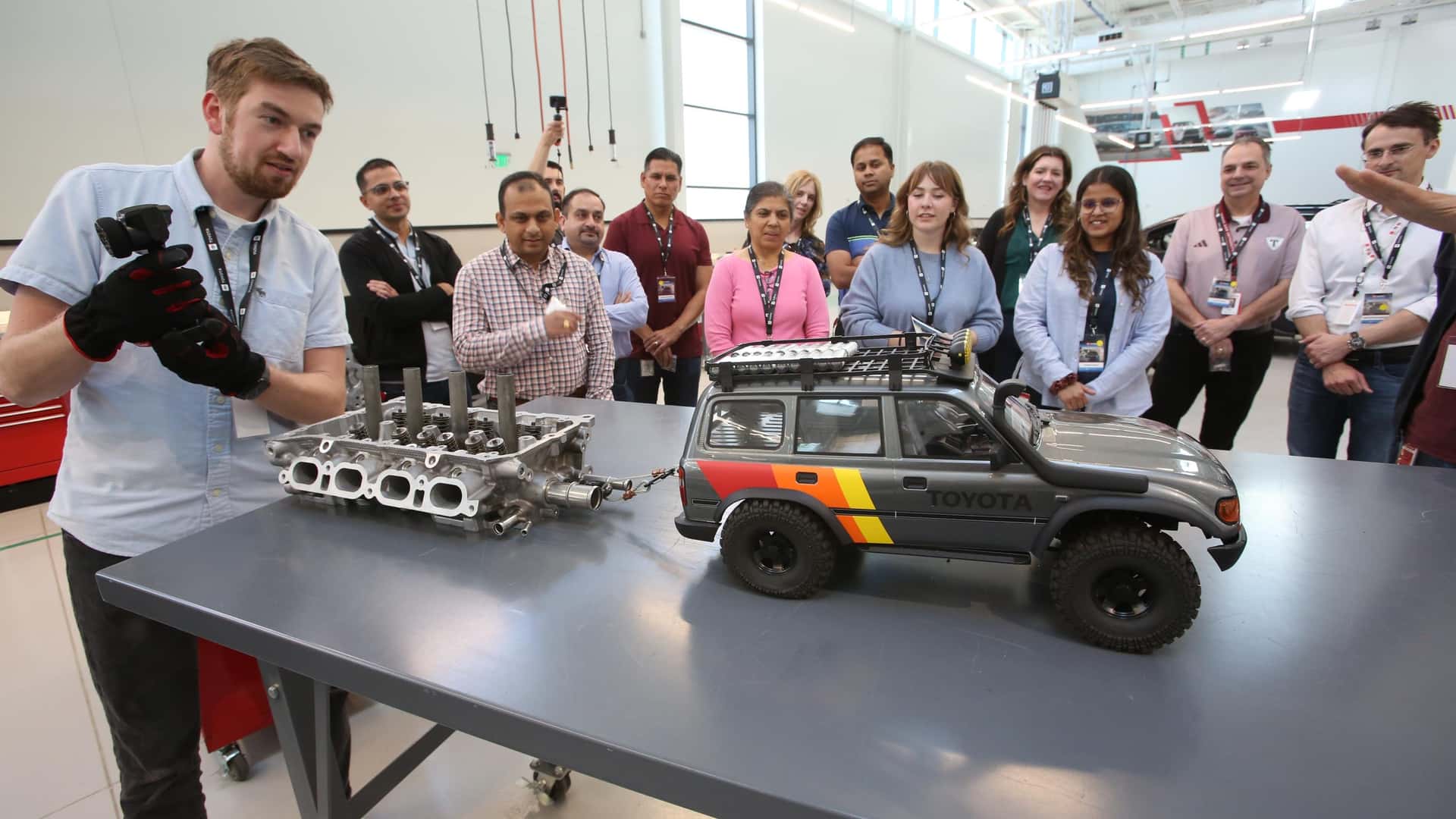
Further practical demonstrations included assembling a rudimentary potato-based battery and observing different charging outputs in real-time. A particularly compelling segment involved showcasing the instant torque of an EV motor, where a miniature remote-controlled Land Cruiser effortlessly towed a cylinder head weighing over 30 pounds, offering a tangible experience of electric power.
The Foundational Lesson: Simplicity and Efficiency of Electric Propulsion
The overarching lesson from these demonstrations was the inherent superiority of electric motor technology. Presenters showcased a stripped-down Toyota V-6 engine, highlighting its intricate components and complex accessories. In stark contrast, an equivalent electric motor was displayed, demonstrating its ability to generate greater power within a significantly smaller footprint and with a much simpler design.
Even when integrated into a gasoline powertrain, as seen in Toyota’s hybrid systems, electric motors can reduce overall complexity by eliminating the need for finicky transmissions. The core message reinforced by the Toyota electrification training program is that incorporating electric propulsion, at any level, enhances efficiency with minimal compromises. Progressing further down the electrification path, towards a pure battery electric vehicle, leads to even greater simplicity, reducing the number of potential points of failure.
However, the company remains realistic, acknowledging that electrification is not yet a fully “solved science.” Toyota representatives underscored that significant improvements in battery chemistry and charging infrastructure are essential before BEVs can be universally adopted as a one-size-fits-all solution. Despite these caveats, the internal sentiment conveyed through the program clearly indicated a concerted effort to generate enthusiasm among employees for an increasingly all-electric future.
Cultivating Internal Advocacy: A Strategic Opportunity
This internal cultivation of excitement and understanding is crucial for Toyota’s long-term strategic objectives. In the absence of a clear comprehension of electrification’s benefits, employees in roles such as corporate procurement might solely perceive the added costs associated with new component designs or the complexities of integrating new suppliers. Such a perspective could naturally lead to resistance to change.
Conversely, by fostering enthusiasm and demonstrating the long-term advantages, employees become more willing to navigate short-term complexities in pursuit of overarching corporate goals. This internal advocacy can then ripple outwards, influencing broader organisational momentum and decision-making. The Toyota electrification training program serves as a catalyst for this transformation.
Brigette Armato, a Toyota employee who participated in the training, exemplifies this shift. She openly admitted to knowing “nothing” about EVs and hybrids prior to the program. Following the training, however, her perspective transformed, and she now identifies as an advocate.
“I work with our lease experience team, so I’m actually working with the customers and the vehicles. This was extremely helpful because now I can have an educated conversation with them and maybe convince them to go for an electric vehicle, whereas before I don’t think I had that skill,” Armato stated after the session. Her newfound confidence underscores the program’s immediate impact on customer-facing roles.
Beyond her professional duties, Armato’s personal outlook on vehicle ownership has also evolved. While currently attached to her Toyota 4Runner, she is now actively considering an electric alternative. “I wish we would gravitate more towards electric vehicles across the lineup,” she expressed, mirroring a sentiment increasingly shared by consumers.
With hundreds of employees attending these sessions and a substantial waitlist for subsequent iterations, the Toyota electrification training program is steadily cultivating a growing cadre of EV proponents within Toyota’s North American headquarters. This internal shift is not about overcoming active resistance but rather about empowering individuals with knowledge, transforming general awareness into informed conviction, much like the broader consumer market’s journey towards electrification.
FAQ Section
Q: What is Toyota’s “Electrification 101” program?
A: It’s an internal training initiative by Toyota Motor North America designed to educate its employees on various electric powertrain technologies, including hybrids, EVs, PHEVs, and FCEVs, fostering a deeper understanding of the company’s multi-pathway strategy.
Q: Why is Toyota providing this training to its employees?
A: The program addresses a knowledge gap among employees who may not be automotive enthusiasts or experts in electrification, aiming to demystify these technologies, highlight their benefits, and convert employees into informed advocates for Toyota’s electrified vehicle lineup.
Q: What specific topics are covered in the Electrification 101 program?
A: The curriculum includes basics of different powertrain types, dispelling common EV myths, advantages of electrification (efficiency, cleanliness), battery chemistries, various charging methods, core concepts like kilowatts and kilowatt-hours, and an overview of battery recycling efforts.
Q: Does the training focus only on Battery Electric Vehicles (BEVs)?
A: No, the program adopts Toyota’s “multi-pathway” approach, covering a broad spectrum of electrified vehicles including hybrids, plug-in hybrids (PHEVs), hydrogen fuel cell vehicles (FCEVs), and battery electric vehicles (BEVs).
Q: Are there hands-on components to the training?
A: Yes, the program includes interactive elements such as building a simple electric motor from basic components, creating a rudimentary potato-based battery, and demonstrations of an EV motor’s instant torque using a remote-controlled vehicle.
Q: How is this program expected to impact Toyota’s business?
A: By educating its workforce, Toyota aims to ensure that employees can make long-horizon decisions supporting electrification, engage confidently with customers, and personally advocate for electrified vehicles, ultimately driving the company’s long-term sustainability and market leadership in evolving automotive technologies.