
In an era defined by rapid advancements in automotive technology, the transition towards electrified vehicles (EVs) is a topic frequently debated by industry experts and enthusiasts alike. However, a recent immersion into Toyota Motor North America’s “Electrification 101” program offered a surprising revelation: even within the walls of a leading global automaker, fundamental knowledge about electrification is not universally understood among all employees.
This insight challenges a common assumption held by many steeped in the automotive world – that every individual contributing to a car company’s operations is inherently a ‘car nerd’ with an intricate understanding of its products and future direction. The experience underscored a critical need for internal education, which Toyota is proactively addressing through its comprehensive training initiatives.

Key Takeaways (TL;DR)
- Many employees at legacy automakers, including Toyota, lack comprehensive knowledge about electrification, challenging the perception that all staff are ‘car enthusiasts.’
- Toyota’s ‘Electrification 101’ program is designed to educate its diverse workforce, from accountants to app developers, on the fundamentals of electrified powertrains.
- The training emphasizes Toyota’s ‘multi-pathway’ strategy, focusing on hybrids in the present while preparing for future battery electric vehicles (BEVs) and hydrogen fuel cell vehicles (FCEVs).
- Despite external debates, the program aims to dispel myths surrounding EVs, highlight their efficiency and environmental benefits, and simplify complex battery and charging concepts.
- Interactive sessions, such as building electric motors, serve to make the technology tangible and exciting, demonstrating the inherent simplicity and power of electric propulsion.
- Internal education is crucial for fostering employee advocacy, influencing long-term decision-making, and accelerating the company’s broader Toyota electrification strategy and adoption of new technologies.
Addressing the Knowledge Gap Within Automakers
For those of us deeply entrenched in the automotive discourse, discussing battery chemistries, charging infrastructure, and the strategic pivots of major manufacturers feels like second nature. It’s easy to assume that senior executives, engineers, and even administrative staff at these companies are equally absorbed in these complex philosophical and technical questions.
Yet, the reality is far more nuanced. A significant portion of employees at a global giant like Toyota are not necessarily driven by an innate passion for automobiles. Their motivations often stem from factors like competitive benefits, career stability, a respected corporate culture, and the prestige associated with working for the world’s largest automaker. A corporate accountant, a software developer, or a human resources specialist, for instance, may not require or possess deep knowledge of automotive minutiae, let alone the intricacies of advanced propulsion systems.
Moreover, even employees who are traditional car enthusiasts might find themselves navigating unfamiliar territory when it comes to electrification. A proponent of classic V8 muscle cars, for example, may not readily distinguish between Nickel Cobalt Manganese (NCM) and Lithium Iron Phosphate (LFP) battery chemistries. The technicalities of electric vehicles and hybrids represent a rapidly evolving, highly specialized field that demands dedicated learning, even from seasoned automotive professionals.

Toyota’s “Electrification 101” Program: A Strategic Overview
Recognizing this critical internal knowledge gap, Toyota proactively developed and implemented its “Electrification 101” program. This initiative marks the second time the company has offered a foundational education course to its employees in Plano, Texas, with an earlier program providing a general introduction to all things automotive. This strategic move underscores Toyota’s commitment to ensuring its entire workforce is equipped with a fundamental understanding of its product landscape and future direction.
Significantly, the program is titled “Electrification 101” rather than “EV 101.” This nomenclature is a deliberate reflection of Toyota’s well-documented “multi-pathway” approach to sustainable mobility. This comprehensive strategy emphasizes a clear and immediate focus on hybrid vehicles (HEVs) as a crucial step, while simultaneously cultivating capabilities in battery electric vehicles (BEVs) and, notably, hydrogen fuel cell electric vehicles (FCEVs) for the future. The company’s recent sales figures reinforce this current strategy, with 56.8% of its last quarter’s sales being electrified vehicles, encompassing HEVs, BEVs, plug-in hybrid electric vehicles (PHEVs), and FCEVs. Pure BEVs, however, represented a modest 1.7% of these electrified sales, indicating the current emphasis on diversified solutions.
The Role of Hydrogen in Toyota’s Vision
A notable aspect of Toyota’s multi-pathway strategy, as highlighted in the training, is its continued advocacy for hydrogen technology. The Toyota Mirai, one of the few FCEVs available in the U.S. market, was showcased, offering up to 402 miles per tank. While this range was once highly impressive for alternative fuel vehicles, it is important to note that over eight BEV models currently on the U.S. market now offer comparable or superior driving ranges, with more expected to arrive. The program optimistically suggested that hydrogen “can reduce ‘range anxiety’ as number of stations grow,” indicating a long-term vision for infrastructure development, particularly in regions like California where hydrogen fueling stations are more prevalent.
Deconstructing Electrification: Curriculum and Content
The bulk of the four-hour “Electrification 101” course was dedicated to classroom instruction, meticulously covering the fundamentals of various powertrain types. Participants learned the key distinctions between conventional hybrids and plug-in hybrids, understanding their respective operational principles and benefits. A significant portion of the module was dedicated to dispelling common myths surrounding electric vehicles, providing fact-based information to counter prevalent misconceptions.
To contextualize the current automotive transformation, the program began with a brief historical overview of the early 20th-century gasoline car industry. It drew parallels to the challenges faced then – a nascent infrastructure, a lack of public education, limited servicing options, and evolving regulations – noting how horse ownership was once perceived as simpler. This historical perspective effectively illustrated that paradigm shifts in transportation are not unprecedented and that modern EVs are merely the latest iteration of such a transition.
The curriculum then delved into the manifold advantages of electrification, primarily focusing on enhanced efficiency and environmental cleanliness. Toyota’s presentation reiterated its argument that the multi-pathway approach represents the most judicious allocation of finite battery resources, offering diverse choices to customers. While this perspective is part of Toyota’s stated position, it is worth noting that a substantial body of independent research generally concludes that battery electric vehicles are often the cleanest option over their entire life cycle, even when accounting for manufacturing and energy grid variations.
Beyond these foundational discussions, the classroom content encompassed essential technical topics. Participants were introduced to the basics of different battery chemistries, gaining an understanding of how they function and their respective applications. The course clarified core concepts such as kilowatts (power output) and kilowatt-hours (energy capacity), which are fundamental to understanding EV performance and charging. Furthermore, an overview of battery recycling efforts was provided, addressing concerns about the end-of-life management of EV components.
Interactive Learning: Bridging Theory and Practice
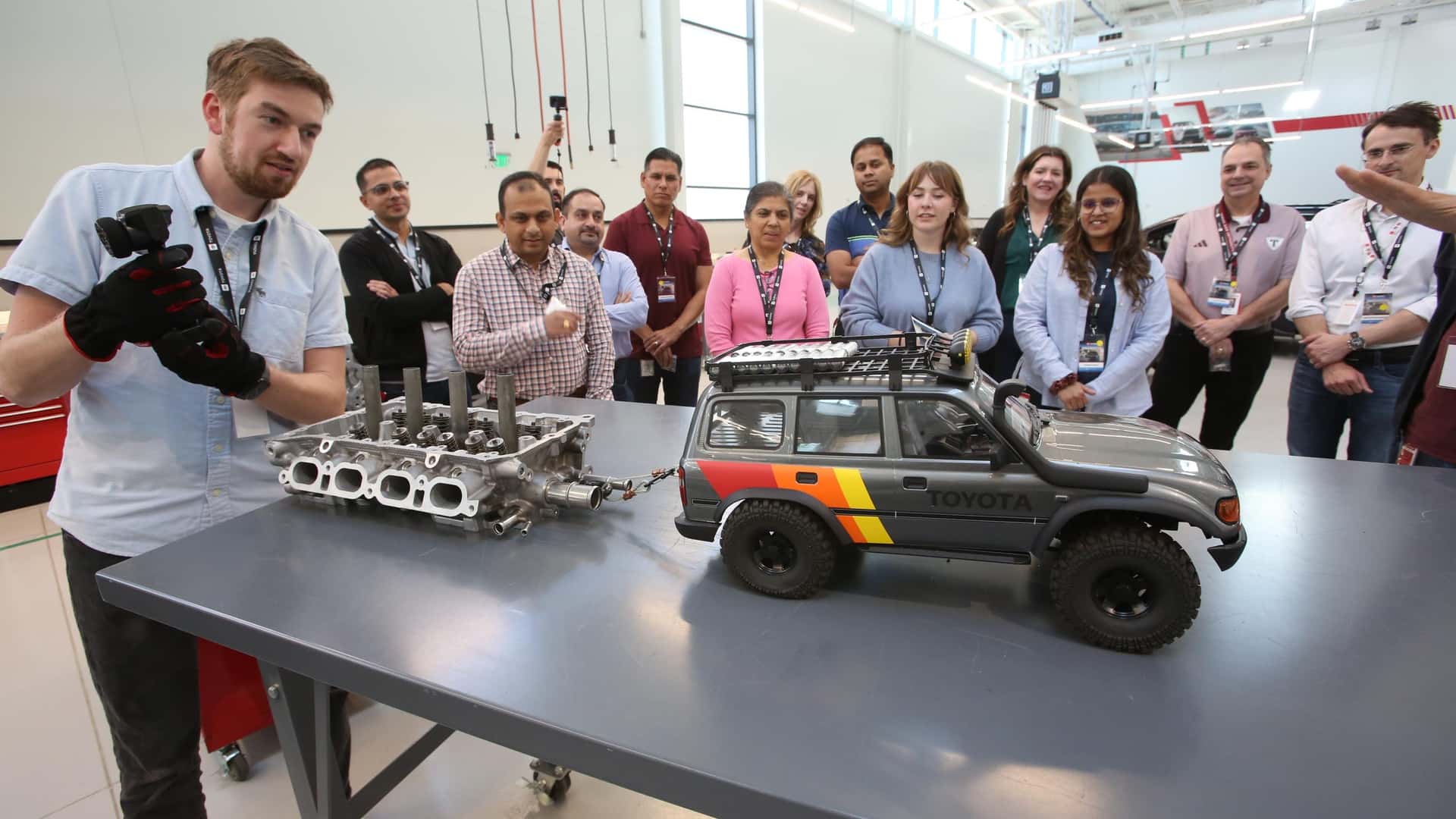
Perhaps the most engaging segment of the training was the interactive, hands-on component. This practical application significantly enhanced learning by transforming abstract concepts into tangible experiences. Employees were guided through the process of constructing a simple electric motor using only a screw, a magnet, a AA battery, and a piece of wire. This exercise vividly demonstrated the fundamental principles of electromagnetism and motor operation.
Further augmenting this experiential learning, participants also built a rudimentary potato-based battery, offering a simple yet effective illustration of electrochemical energy generation. The session concluded with a compelling demonstration of the instant torque characteristic of electric motors. A miniature remote-controlled Land Cruiser, equipped with an EV motor, effortlessly pulled a cylinder head weighing over 30 pounds, showcasing the immense power and responsiveness inherent in electric propulsion systems. These activities were strategically designed to demystify complex engineering principles and create a memorable, impactful learning experience.
The Core Message: Simplicity and Efficiency of Electric Propulsion
The interactive demonstrations and classroom discussions culminated in a clear, overarching lesson: electric motors represent a fundamentally incredible technology. Presenters at the “Electrification 101” program provided a direct comparison between a stripped-out Toyota V-6 engine – with its myriad complicated accessories, intricate components, and fluid systems – and an equivalent electric motor. The electric motor, in stark contrast, offered greater power within a significantly smaller footprint and boasted a far simpler design.
This comparison highlighted a crucial advantage: integrating electric propulsion into any powertrain, particularly through Toyota’s sophisticated hybrid systems, often leads to a reduction in mechanical complexity. For instance, the need for a convoluted, finicky transmission can be minimized or even eliminated. The further one progresses along the path of electrification, towards a pure battery electric vehicle, the inherent simplicity becomes even more pronounced, resulting in fewer moving parts and, consequently, fewer potential points of failure.
While the program clearly championed the benefits of electric motors, Toyota representatives maintained a pragmatic stance, acknowledging that the transition is not yet a “solved science.” They emphasized the company’s desire to see continued advancements in battery chemistry and significant improvements in charging infrastructure before a “one-size-fits all” approach to BEVs becomes fully viable. Nevertheless, the underlying message was unmistakable: Toyota is actively working to cultivate enthusiasm and readiness among its workforce for a progressively electrified, and eventually all-electric, future.
The Broader Implications for Toyota’s Future
This internal education initiative holds profound implications for Toyota’s long-term strategic trajectory. In a vast corporate structure, employees in roles such as corporate procurement, product planning, or supply chain management might initially perceive electrification solely through the lens of added costs associated with new component designs, the complexity of onboarding novel suppliers, or the disruption to established manufacturing processes. Without a comprehensive understanding of the long-term benefits and strategic imperatives of electrification, natural resistance to change can arise.
However, by fostering a deep-seated understanding and genuine excitement for the electric future, Toyota aims to empower its employees to embrace and drive this transformation. This internal advocacy enables individuals to look beyond short-term challenges, recognizing that the current complexities are stepping stones towards significant long-term goals. An informed workforce is better positioned to champion new initiatives, influence internal stakeholders, and contribute to innovative solutions that align with the company’s evolving vision for sustainable mobility.
Cultivating Internal Advocates: Employee Perspectives
The effectiveness of such training programs is best illustrated through the experiences of its participants. Brigette Armato, a Toyota employee from the lease experience team who attended the “Electrification 101” class, candidly admitted she had known “nothing” about EVs and hybrids prior to the course. Her transformation highlights the program’s success in converting a knowledge gap into informed advocacy.
Reflecting on her experience, Armato stated, “I work with our lease experience team, so I’m actually working with the customers and the vehicles. This was extremely helpful because now I can have an educated conversation with them and maybe convince them to go for an electric vehicle, whereas before I don’t think I had that skill.” This testimonial underscores how foundational knowledge empowers employees to become valuable resources for customers, directly influencing consumer adoption.
Beyond her professional role, the training also sparked a personal interest in electrification for Armato. She is now seriously considering an EV for herself, despite her current attachment to her Toyota 4Runner. “I wish we would gravitate more towards electric vehicles across the lineup,” she expressed, echoing sentiments shared by many forward-thinking consumers and industry observers.
Conclusion
Toyota’s “Electrification 101” program represents a strategic investment in its human capital, recognizing that the journey towards a fully electrified future is not solely a technological one, but also a cultural and educational undertaking. With hundreds of employees attending these classes and a growing waitlist for future sessions, the initiative is steadily cultivating a growing cadre of EV believers within Toyota’s North American headquarters.
This internal shift is pivotal. It demonstrates that the initial hesitation or lack of knowledge regarding electrification among employees is not necessarily resistance, but rather an informational vacuum that, once filled, can transform skepticism into enthusiasm and advocacy. By proactively educating its workforce, Toyota is not only preparing for the future of mobility but is also empowering its people to be active participants in shaping that future, ensuring a smoother and more robust transition towards its comprehensive Toyota electrification strategy.
Frequently Asked Questions (FAQ)
What is Toyota’s “Electrification 101” program?
It is an internal training initiative by Toyota Motor North America designed to educate its diverse employee base on the fundamentals of electrified vehicle technologies, including hybrids, plug-in hybrids, battery electric vehicles, and hydrogen fuel cell vehicles. The program aims to bridge knowledge gaps and foster internal advocacy for electrification.
Why is such a training program necessary for Toyota employees?
Many employees, particularly those in non-automotive specific roles like accounting or IT, may not possess in-depth knowledge of vehicle electrification. Even some car enthusiasts might be unfamiliar with newer EV technologies. The program ensures all staff understand the company’s direction and products.
What is Toyota’s “multi-pathway” approach to electrification?
Toyota’s multi-pathway strategy emphasizes offering a diverse range of electrified vehicles, primarily focusing on hybrids in the current market, while also developing battery electric vehicles (BEVs) and hydrogen fuel cell electric vehicles (FCEVs) for future broader adoption. It aims to provide customer choice and efficient use of battery resources.
What topics are covered in the “Electrification 101” course?
The curriculum includes the basics of different powertrain types, advantages of electrification, dispelling EV myths, battery chemistries, charging concepts (kilowatts, kilowatt-hours), and battery recycling efforts. It also features interactive sessions like building electric motors and demonstrating EV torque.
How does the program benefit Toyota’s overall electrification strategy?
By educating its workforce, Toyota cultivates internal advocates who can make informed decisions, influence product development, and better engage with customers. This helps overcome potential internal resistance to new technologies and ensures the entire organization is aligned with the company’s long-term goals in sustainable mobility.